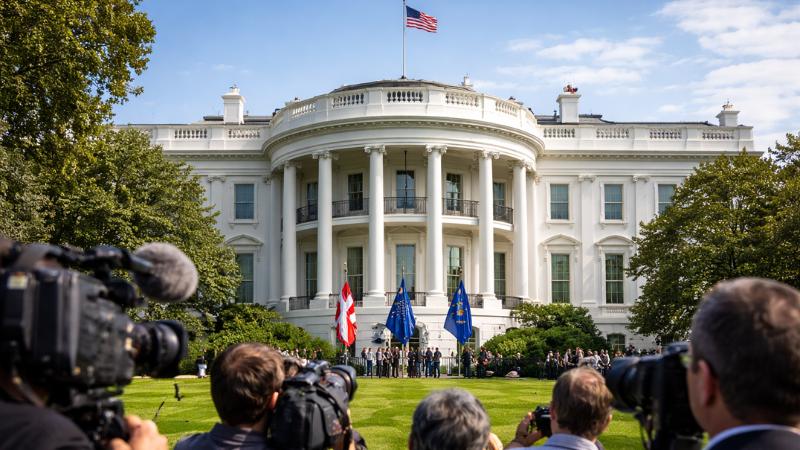
Senior officials from the United States, Greenland, and Denmark are set to hold critical talks at the White House on Wednesday as tensions escalate over Washington’s renewed push to bring the Arctic island under U.S. control. The meeting comes amid increasingly forceful rhetoric from President Donald Trump, raising fresh concerns about transatlantic relations and the future cohesion of NATO.
Greenland Foreign Minister Vivian Motzfeldt and Danish Foreign Minister Lars Lokke Rasmussen are expected to meet U.S. Vice President JD Vance and Secretary of State Marco Rubio in what is being described by diplomats as a high-stakes attempt to contain a growing diplomatic crisis. The discussions follow a series of statements by Trump asserting that Greenland’s incorporation into the United States is essential for American national security.
Hours before the talks, Trump intensified his position in a social media statement, declaring that any outcome short of Greenland becoming part of the United States would be unacceptable. He argued that U.S. control of the island was vital for emerging missile defense initiatives and claimed that NATO would be significantly strengthened if Greenland were under American authority. Trump also said that only the United States could effectively counter perceived strategic threats from Russia and China in the Arctic region.
The comments sharply contrasted with a unified stance presented a day earlier by Greenland Prime Minister Jens-Frederik Nielsen and Danish Prime Minister Mette Frederiksen. Appearing together in Copenhagen, the two leaders emphasized Greenland’s existing status as a self-governing territory within the Kingdom of Denmark and rejected any suggestion of a forced realignment. Nielsen stated that if Greenland were compelled to choose between Washington and Copenhagen, its choice would remain Denmark.
Frederiksen described the pressure from the United States as unprecedented and deeply troubling, noting that the dispute was testing relationships with one of Denmark’s closest allies. She warned that the situation could worsen, underscoring the seriousness with which European leaders view the implications of the dispute for regional and global security.
Trump’s renewed focus on Greenland follows heightened U.S. strategic activity abroad earlier this year, reinforcing concerns in Europe that Washington may be prepared to challenge long-standing norms governing sovereignty and alliance cooperation. Denmark, which retains responsibility for Greenland’s defense, has cautioned that any direct military action against the territory would fundamentally undermine NATO.
Foreign policy analysts say the White House talks carry significant consequences. Some argue the meeting could open the door to negotiated compromises, including increased European investment in Arctic defense and expanded U.S. access to Greenland’s mineral resources. Others warn that failure to de-escalate could lead to a public rift, further weakening trust between the United States and its European partners.
The prospect of a tense encounter has revived memories of past confrontations between U.S. leaders and foreign counterparts, fueling anxiety over how the talks may unfold. Observers note that the involvement of Vice President Vance, who has previously issued blunt criticism of European governments, could signal a harder line from Washington.
Former European leaders have described the situation as a profound crisis for the transatlantic alliance, expressing skepticism that a swift diplomatic solution can be reached. Some believe the best outcome would be an agreement to continue dialogue, even if fundamental disagreements remain unresolved.
Policy experts say a positive result for Denmark and Greenland would include a clear affirmation of Greenland’s sovereignty and its constitutional position. In return, Copenhagen and Nuuk may offer to revisit economic and security cooperation, including expanded U.S. participation in mining projects and enhanced joint efforts to secure Arctic sea routes.
Several European governments have already voiced support for Greenland, emphasizing that security in the Arctic must be addressed collectively and in accordance with international law. Their message underscores a broader concern that unilateral actions could destabilize a strategically sensitive region at a time of rising global competition.
As officials gather in Washington, the outcome of the talks is expected to provide crucial insight into the Trump administration’s intentions and the resilience of long-standing alliances facing renewed geopolitical strain.