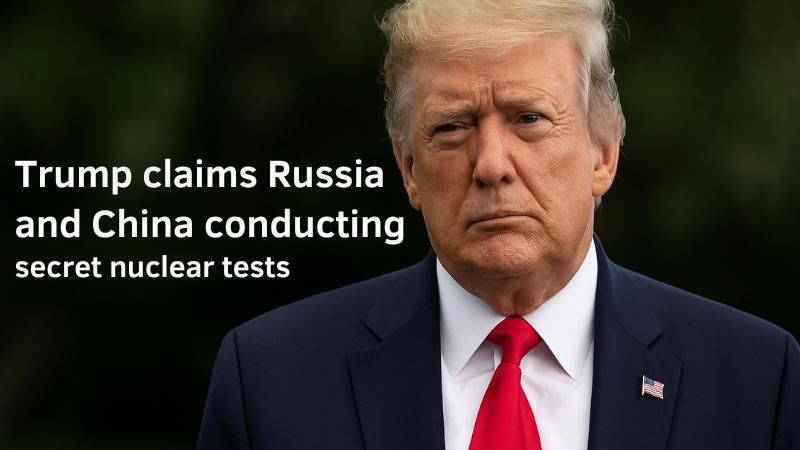
US President Donald Trump has alleged that Russia and China have been secretly conducting underground nuclear tests, accusing the two countries of violating global norms while defending his decision to restart nuclear testing in the United States after more than three decades. The statement has reignited debate over nuclear deterrence, global security, and the risks of renewed arms competition among the world’s leading powers.
Speaking during an interview on Sunday, Trump claimed that Moscow and Beijing were carrying out covert nuclear experiments beyond international scrutiny. “Russia’s testing, and China’s testing, but they don’t talk about it,” he said. “They test way underground where people don’t know exactly what’s happening with the test,” the US president alleged. His remarks followed reports that he had instructed the Pentagon to prepare for potential new nuclear weapons tests — the first since 1992.
Trump defended his controversial move by asserting that it was vital to maintain the reliability and credibility of the American nuclear arsenal. He suggested that while the United States has adhered to a self-imposed moratorium on nuclear testing, other nations have taken advantage of Washington’s restraint. “We’re the only country that doesn’t test,” he said. “I don’t want to be the only country that doesn’t test.”
The president emphasized that nuclear preparedness was an essential part of national defense. “You have to see how they work,” he said, referring to the importance of testing for maintaining readiness. Citing North Korea’s frequent missile and nuclear experiments, he argued that adversaries were advancing their capabilities unchecked. “North Korea’s testing constantly. Other countries are testing. We do have reporters writing about it, but they don’t. No, we’re gonna test because they test and others test,” he stated.
Trump also pointed to Pakistan’s continued nuclear activity and alleged that the opacity of other nations’ programs left the United States at a disadvantage. His comments were seen as a justification for reasserting US leadership in nuclear capability development.
In elaborating on his stance, Trump claimed that America holds the largest nuclear stockpile in the world, followed by Russia and then China. “We have more nuclear weapons than any other country. Russia’s second. China’s a very distant third,” he said. However, he warned that this balance may not last. “They’ll be even in five years. They’re making them rapidly,” he added, suggesting that rivals are expanding their arsenals in secret.
Despite acknowledging that “denuclearisation’s a very big thing,” Trump insisted that maintaining superiority through modernisation and readiness was necessary. “We have enough nuclear weapons to blow up the world 150 times,” he remarked. “Russia has a lot, and China will have a lot. They have quite a bit.” His comments reflected a renewed emphasis on nuclear deterrence — a doctrine that relies on demonstrating credible capability to discourage potential aggression.
The move to consider renewed nuclear testing has drawn international attention because the United States has not conducted such tests since 1992. The last American nuclear detonation occurred under Operation Julin, a series of underground explosions that took place in September that year at the Nevada Test Site. These tests were the final series before the United States signed the Comprehensive Nuclear Test Ban Treaty (CTBT), which bans all nuclear explosions for military or civilian purposes.
Although 187 countries have signed and 178 have ratified the CTBT, the United States remains a signatory that has never formally ratified the treaty. This legal distinction technically leaves room for a future administration to resume testing without violating international law. Trump’s recent comments appear to exploit that grey area, reigniting global concerns about a possible new era of nuclear competition.
Strategic analysts warn that any US decision to restart testing could undermine decades of diplomatic efforts to limit nuclear proliferation. It may also prompt other countries, particularly Russia and China, to accelerate their own programs openly. The development risks destabilizing existing arms control agreements, including the New START Treaty, which limits deployed strategic nuclear weapons and is due for renewal.
Trump’s remarks arrive amid growing geopolitical tension and shifting alliances, where nuclear capability remains a critical symbol of power and deterrence. His assertion that rivals are secretly testing underground could mark the beginning of a broader policy shift aimed at reasserting US military dominance. For now, the world watches as Washington’s decision on whether to resume testing edges closer, a choice that could reshape the global nuclear order for decades to come.