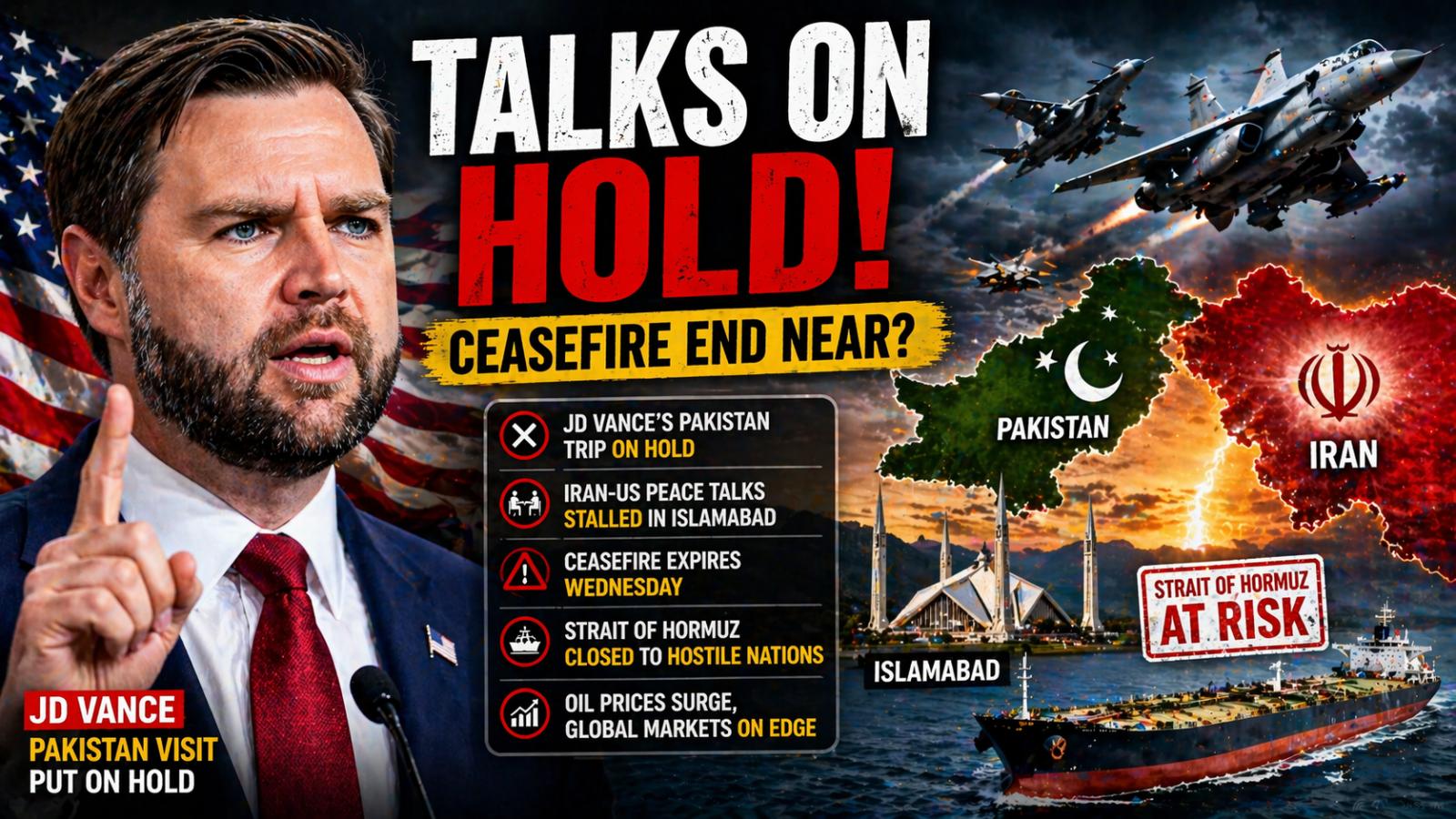
The US Iran war talks delay has added fresh uncertainty to an already volatile situation, as US Vice President JD Vance’s planned visit to Pakistan for peace negotiations has been put on hold. With the ceasefire deadline fast approaching, tensions are rising across the region.
What happened and why it matters
A planned diplomatic trip by JD Vance to Islamabad for talks with Iran has been paused, according to US officials. The development comes just days before the two-week ceasefire between the US and Iran is set to expire. Iran has not yet confirmed whether it will participate in the next round of negotiations. Officials in Pakistan have stated that Tehran’s formal response is still awaited, despite heavy preparations in Islamabad for high-level talks. Iran’s chief negotiator has also signaled a hard stance, saying the country will not negotiate under pressure and is prepared to escalate if necessary.
Why this matters globally
The delay in talks is significant because it increases the risk of renewed conflict in the Middle East. The Strait of Hormuz, a critical global oil route, remains under tension after Iran reimposed restrictions on shipping. Global markets are already reacting, with oil prices remaining high and concerns growing about energy shortages. European leaders have warned of a possible fuel crisis if disruptions continue. Beyond economics, the humanitarian impact is also severe, with thousands of lives already lost across multiple regions affected by the conflict.
Key developments in the crisis
Several key developments highlight the seriousness of the situation. Pakistan has deployed thousands of security personnel in Islamabad, preparing for talks that have yet to materialize. In Gaza, ongoing strikes have resulted in casualties, further escalating tensions in the broader region. China has stepped in diplomatically, urging stability and pushing for the reopening of the Strait of Hormuz to protect global trade routes. Meanwhile, Europe is closely monitoring fuel supplies, with officials warning that reserves could be significantly impacted if the crisis continues.
What happens next
With the ceasefire deadline just hours away, the coming days are expected to be critical. If no agreement is reached, the situation could escalate rapidly, potentially leading to further military action. However, diplomatic efforts are still ongoing behind the scenes, and there remains a possibility of last-minute negotiations. The world is now watching closely to see whether dialogue can prevail or if tensions will spiral further. From a broader perspective, this situation reflects the growing complexity of global geopolitics. Multiple countries, including Pakistan and China, are now playing roles in mediation, highlighting how interconnected modern conflicts have become. At the same time, the crisis underscores the importance of strategic waterways like the Strait of Hormuz in shaping global economic stability. The US Iran war talks delay marks a critical moment in the ongoing conflict. With the ceasefire nearing its end and negotiations uncertain, the stakes are higher than ever. Whether through diplomacy or escalation, the outcome of the next few days will have far-reaching consequences for global security and economic stability.