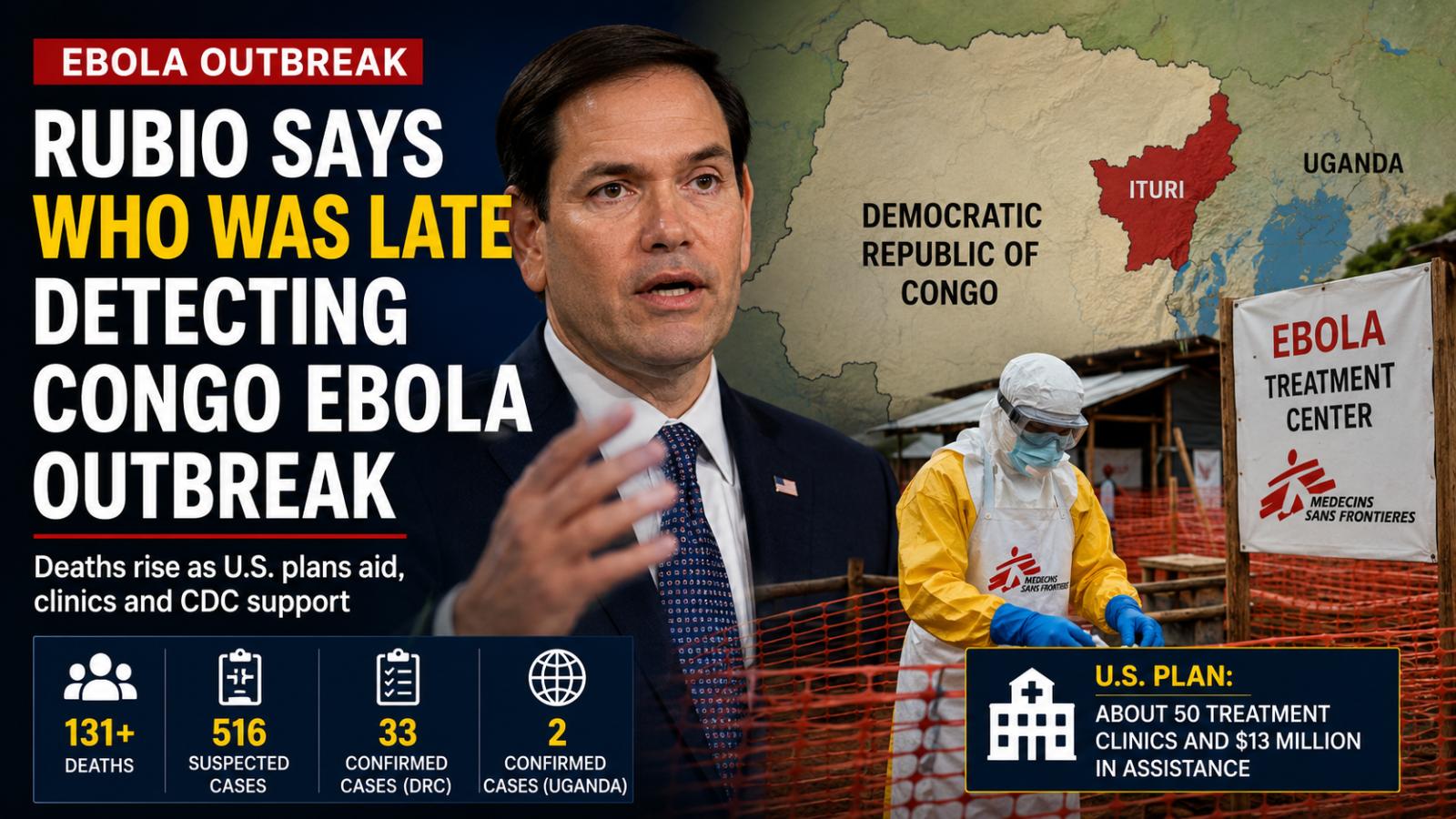
U.S. Secretary of State Marco Rubio said on Tuesday, May 19, 2026, that the World Health Organization was “a little late” in detecting the Ebola outbreak spreading in the Democratic Republic of Congo, as deaths continued to rise and Washington prepared support for the response.
The outbreak has intensified concern among global health officials because of its speed, suspected death toll and spread in difficult field conditions. Reuters reported at least 131 fatalities linked to the outbreak, with 516 suspected cases and 33 confirmed cases in Congo, along with two confirmed cases in neighboring Uganda.
WHO Alarm Over Congo Ebola Outbreak
WHO Director-General Tedros Adhanom Ghebreyesus said he was “deeply concerned” about the scale and speed of the epidemic. WHO has pointed to several risks, including cases in urban areas, infections among health workers and the conflict-affected province of Ituri.
The outbreak involves Bundibugyo virus disease, a rare Ebola type with no licensed vaccine or specific treatment, according to WHO. The agency said Congo officially declared its 17th Ebola outbreak on Friday, May 15, 2026, after earlier suspected illness and deaths were investigated in Ituri Province.
US Plans Aid and Treatment Clinics
Rubio said the Centers for Disease Control and Prevention and WHO would help lead response efforts, while the United States hopes to support the creation of about 50 treatment clinics. He said rural access, insecurity and war conditions in the affected region could make containment more difficult.
The U.S. has committed roughly $13 million in assistance for the response, according to reporting cited by AP. The CDC said on Tuesday, May 19, 2026, that it was monitoring the outbreak in remote areas of Congo and Uganda, with no confirmed U.S. cases linked to the outbreak and low overall risk to the American public and travelers.
Why the Outbreak Is Hard to Contain
Health experts and aid workers say the virus spread for weeks before confirmation, partly because authorities initially tested for the more common Zaire Ebola strain and received negative results. The Bundibugyo strain has complicated the response because vaccine and treatment options are more limited.
The crisis is also unfolding during a politically sensitive period for U.S.-WHO relations, after President Donald Trump moved to withdraw the United States from the global health agency. That makes the Congo Ebola response both a public health emergency and a test of international coordination.