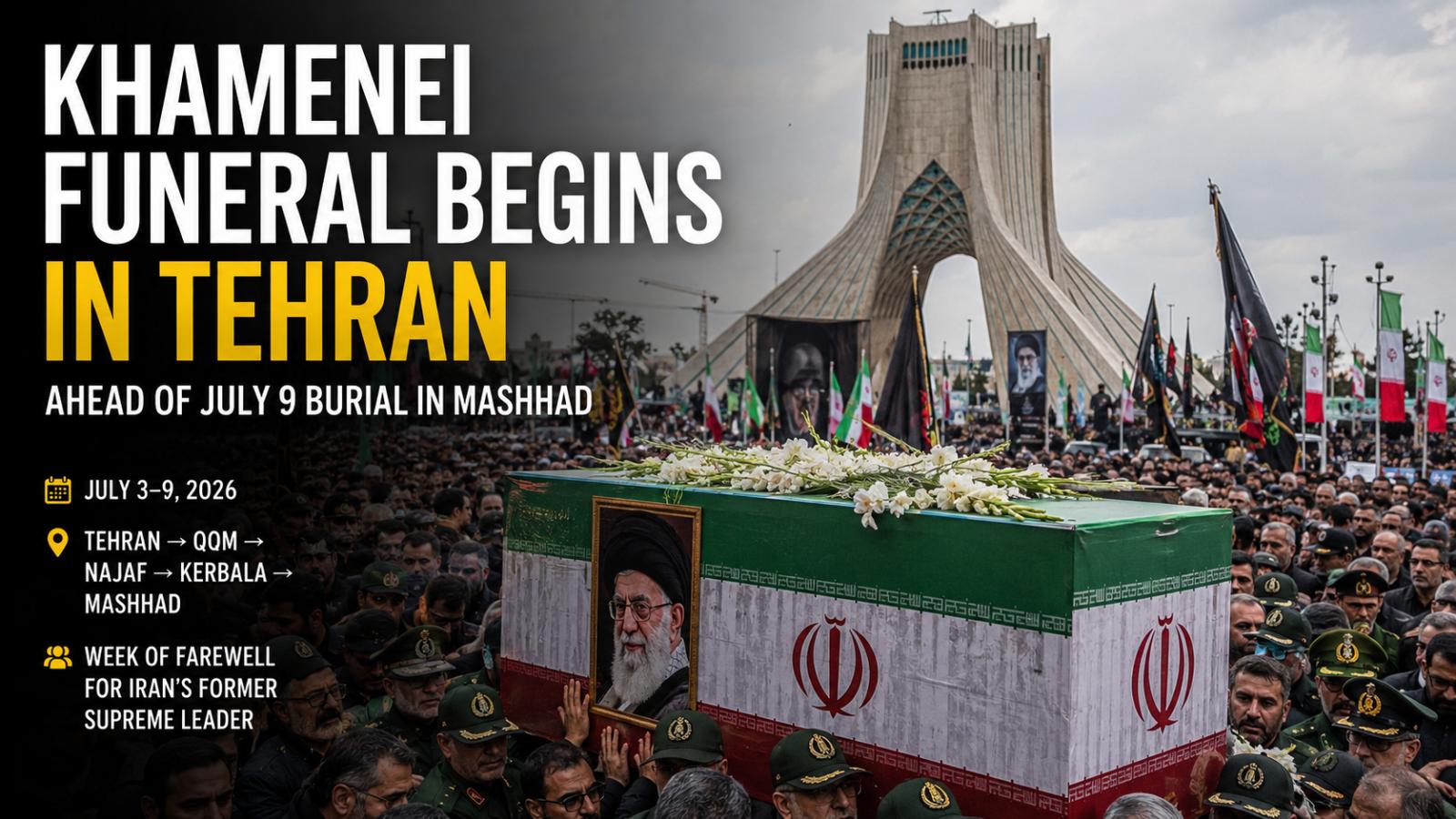
Funeral ceremonies for Ayatollah Ali Khamenei began in Tehran on Friday, July 3, 2026, ahead of a planned burial in Mashhad on Thursday, July 9, 2026, as Iran opened a week of state mourning for its former supreme leader.
Khamenei, who led Iran from 1989 until he was killed in a reported U.S.-Israeli airstrike on February 28, 2026, is lying in state at Tehran’s Grand Mosalla. Coffins of family members killed alongside him were also displayed during the ceremonies.
Khamenei funeral schedule runs from Tehran to Mashhad
The funeral route is expected to carry Khamenei’s remains from Tehran to Qom on Tuesday, July 7, 2026, before ceremonies in Najaf and Kerbala, Iraq, on Wednesday, July 8, 2026. His burial is planned for Mashhad, one of Iran’s most important Shiite pilgrimage centers, on Thursday, July 9, 2026.
Iran has framed the funeral as a display of unity and resistance during a period of renewed regional tension. Senior Iranian political, clerical and military figures attended the Tehran ceremony, while supporters took part in ritual mourning, including chest-beating and public prayers.
Mojtaba Khamenei’s absence draws attention
Mojtaba Khamenei, Ali Khamenei’s son, did not attend the public ceremonies. His absence has drawn scrutiny because he has been viewed as taking on supreme leader responsibilities after his father’s death and was reportedly injured in the same strike.
The funeral also brought foreign delegations to Tehran. Pakistan’s Prime Minister Shehbaz Sharif and Army Chief Asim Munir attended, while India was represented by Bihar Governor Syed Ata Hasnain and Minister of State for External Affairs Pabitra Margherita.
For Iran, the funeral is more than a state ceremony. It is a carefully staged political and religious moment intended to project continuity after Khamenei’s death, while questions remain over security, succession and Iran’s next steps in the region.