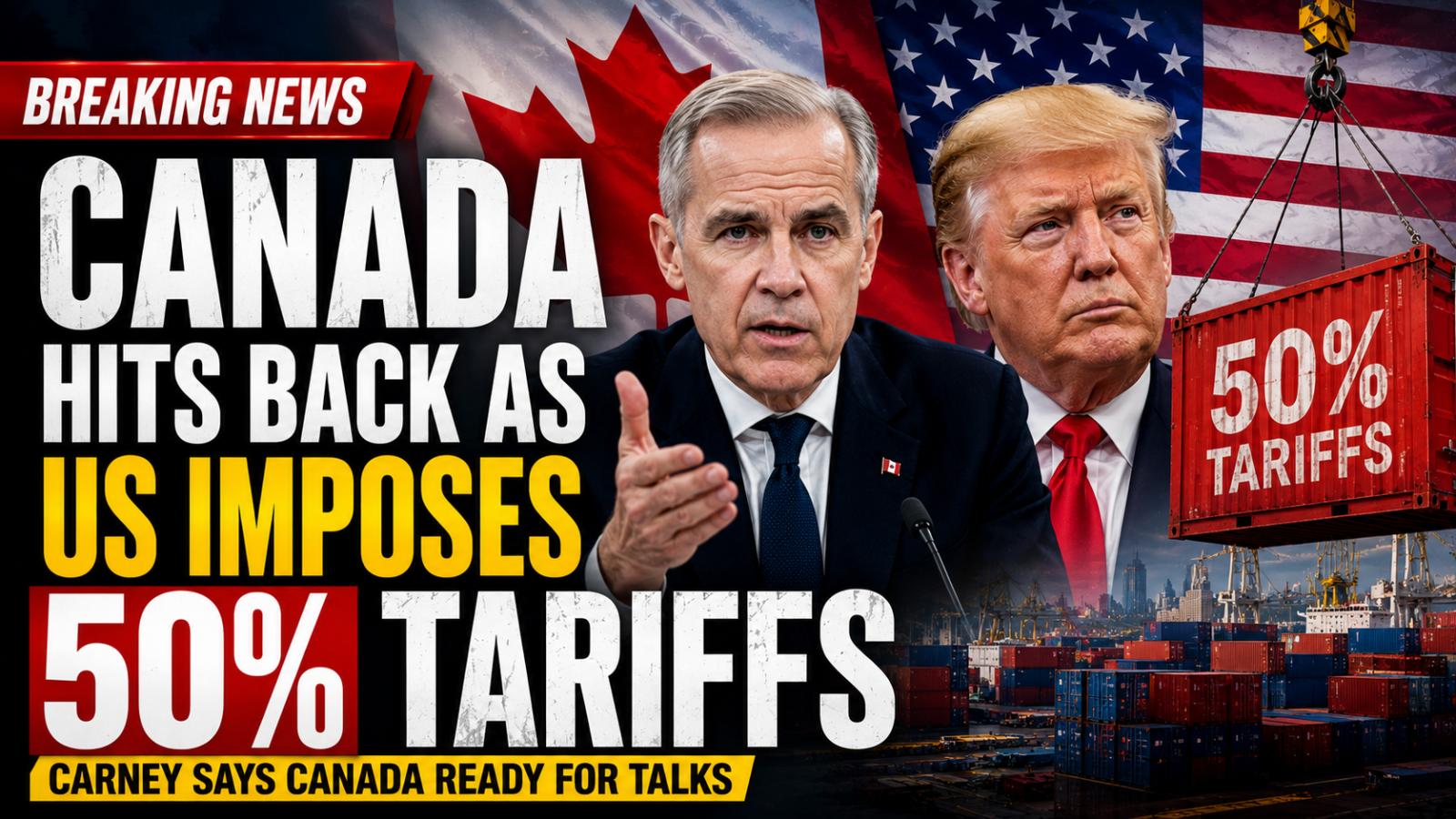
Mark Carney responds to US 50% tariffs by reaffirming Canada's commitment to free and fair trade while expressing readiness for negotiations with Washington. The Canadian prime minister says Ottawa will continue supporting workers, businesses and families as trade tensions escalate over dairy, automobiles and alcoholic beverages.
Mark Carney Responds to US 50% Tariffs on Canadian Goods
Canada US Trade Dispute
Canadian Prime Minister Mark Carney has responded to the latest US tariff announcement by reaffirming his government's commitment to protecting Canadian workers and businesses while keeping diplomatic channels open with Washington. The statement came after US President Donald Trump announced an additional 50% tariff on selected Canadian goods, including products from the dairy, alcoholic beverage and motor vehicle sectors.
In a statement released through official government channels and shared on social media, Carney said Canadians had united in response to what he described as measures affecting Canada's economy and sovereignty. He praised provinces and territories for working together to defend workers, farmers, businesses and families during the continuing trade dispute.
Background: US-Canada Trade Dispute
The United States and Canada share one of the world's largest trading relationships under the Canada-United States-Mexico Agreement (CUSMA). In recent months, trade tensions have increased over tariffs, dairy regulations, automotive policies and market access. The latest US decision to impose additional 50% tariffs on selected Canadian goods has prompted Ottawa to defend its position while keeping negotiations open to avoid further disruption to North American trade.
Read more on: US Imposes 50% Tariff on Canadian Goods Amid Trade Dispute
CUSMA Tariff Violation
Carney argued that the latest US action violates the Canada-United States-Mexico Agreement (CUSMA), the free trade agreement governing commerce between the three North American countries. According to the prime minister, the United States has introduced several rounds of tariffs that conflict with the agreement, while Canada has only implemented measures it believes are permitted under its legal rights.
He said Ottawa has spent the past 18 months presenting detailed proposals aimed at modernising CUSMA and resolving outstanding trade disagreements. Those proposals, he noted, were intended to strengthen long-term economic cooperation rather than deepen the dispute.
The prime minister maintained that Canada remains committed to rules-based international trade and expects existing trade agreements to be respected by all participating countries.
Canada Ready for US Talks
Despite the latest escalation, Carney emphasised that Canada remains prepared to continue negotiations with the United States. He said the government is willing to intensify discussions in the coming weeks in an effort to reach a mutually beneficial solution.
According to Carney, resolving the dispute would benefit citizens and businesses on both sides of the border by reducing uncertainty and restoring confidence in North American trade. He stressed that Canada remains open to constructive dialogue while continuing to defend its national economic interests.
The prime minister also highlighted Canada's broader international trade strategy, noting that the country has signed more than 20 new economic and security partnerships that reflect its commitment to open markets and international cooperation.
Canadian Economy Support
Carney acknowledged that the ongoing tariff dispute has increased costs for businesses and consumers, particularly in the United States, while creating uncertainty across integrated North American supply chains. He said the Canadian government will continue taking all necessary measures to strengthen the domestic economy and provide support for workers, farmers, manufacturers and exporters affected by the new tariffs.
The latest US measures are scheduled to take effect 30 days after President Trump signs the required proclamations. Washington has said the additional tariffs are intended to address what it considers discriminatory treatment of American products in Canada's dairy, motor vehicle and alcoholic beverage sectors.
While trade tensions have intensified, both governments continue to leave the door open for negotiations. Officials on both sides recognise the importance of maintaining one of the world's largest bilateral trading relationships, making upcoming talks particularly significant for businesses, investors and consumers across North America.