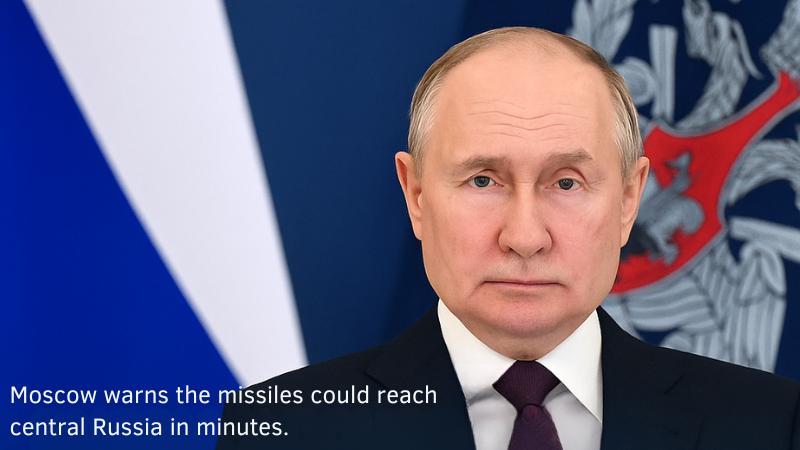
Russian Defense Minister Andrey Belousov has accused the United States of preparing to deploy new missile systems in both Europe and the Asia-Pacific region, claiming that these weapons could reach central Russia within minutes. Speaking at a Security Council meeting chaired by President Vladimir Putin, Belousov said the planned deployments represent a major escalation in military tension and pose a direct threat to Russia’s national security.
According to Belousov, the missile systems in question include the U.S. Army’s Dark Eagle medium-range missile, a weapon designed to carry hypersonic warheads capable of striking targets up to 5,500 kilometers away. If positioned in Germany or other European locations, such missiles could potentially reach Russian targets in just six to seven minutes. Belousov argued that this capability would significantly reduce Russia’s reaction time in the event of a missile launch, destabilizing the global balance of power and eroding existing arms control frameworks.
The Russian Defense Minister also cited a recent U.S. military exercise, known as Global Thunder-2025, which he said simulated a preemptive nuclear strike against Russian territory. He described the exercise as evidence of what Moscow views as Washington’s growing willingness to test nuclear readiness and provoke confrontation under the guise of defense preparedness.
“The United States is actively reviving the architecture of forward-deployed weapons, including systems that were once prohibited under international treaties,” Belousov said. “Such actions undermine strategic stability and increase the risk of miscalculation.”
President Vladimir Putin, who presided over the meeting, echoed Belousov’s concerns but emphasized that Russia would continue to adhere to international agreements. Putin reaffirmed that Moscow remains committed to the Comprehensive Nuclear-Test-Ban Treaty (CTBT), insisting that Russia has no plans to abandon its obligations. He underscored that while the global environment has become increasingly volatile, Russia would respond responsibly and in accordance with international law.
“Russia has strictly complied with its international commitments, including the CTBT,” Putin stated. “We expect our partners to do the same. However, we cannot ignore threats directed toward our country or actions that jeopardize global security.”
Putin’s remarks highlighted Russia’s long-standing stance that U.S. military activities in Europe and Asia-Pacific are part of a broader effort to encircle the country militarily. Moscow has repeatedly accused Washington of attempting to deploy weapons systems near its borders to gain a strategic advantage. The Kremlin argues that such actions contravene previous arms limitation agreements and threaten to reignite a Cold War-style arms race.
The introduction of hypersonic technology into this equation adds an additional layer of complexity. Hypersonic weapons, capable of traveling more than five times the speed of sound, can maneuver mid-flight, making them difficult to detect or intercept. Military analysts have warned that the deployment of such systems could shorten warning times to mere minutes, leaving targeted nations with little opportunity for defense or diplomatic resolution.
Belousov noted that the United States’ stated purpose for these missile systems is deterrence against emerging threats in both Europe and the Indo-Pacific region. However, Moscow interprets the move as an offensive measure aimed at Russia and China. He said that the deployment of Dark Eagle systems, if realized, would violate the spirit of the now-defunct Intermediate-Range Nuclear Forces (INF) Treaty, which once restricted the deployment of ground-launched ballistic and cruise missiles with ranges between 500 and 5,500 kilometers.
“The dismantling of arms control agreements has led to an unpredictable and dangerous situation,” Belousov warned. “Our country must take this into account as we plan our own defense posture.”
Tensions between Moscow and Washington have continued to escalate amid ongoing geopolitical friction, including disputes over NATO’s eastward expansion, U.S. military assistance to Ukraine, and the deployment of advanced defense technologies in regions close to Russian borders. Analysts suggest that the latest warning from Russia is part of an effort to deter further U.S. military buildup in areas it considers part of its strategic sphere of influence.
Despite the sharp rhetoric, both leaders reiterated Russia’s willingness to engage in dialogue on arms control and strategic stability. Putin noted that Moscow remains open to discussions aimed at preventing a further deterioration of global security but stressed that such talks must be based on equality and mutual respect.
“Our position remains unchanged,” Putin said. “We are ready for constructive dialogue, but we will firmly defend our national interests. The security of the Russian Federation is non-negotiable.”
As military developments unfold in Europe and the Asia-Pacific, the international community continues to watch closely. The potential deployment of hypersonic-capable missile systems by the United States — and Russia’s subsequent response — may signal a new and uncertain era in global military competition, where speed, precision, and deterrence replace traditional strategies of distance and diplomacy.