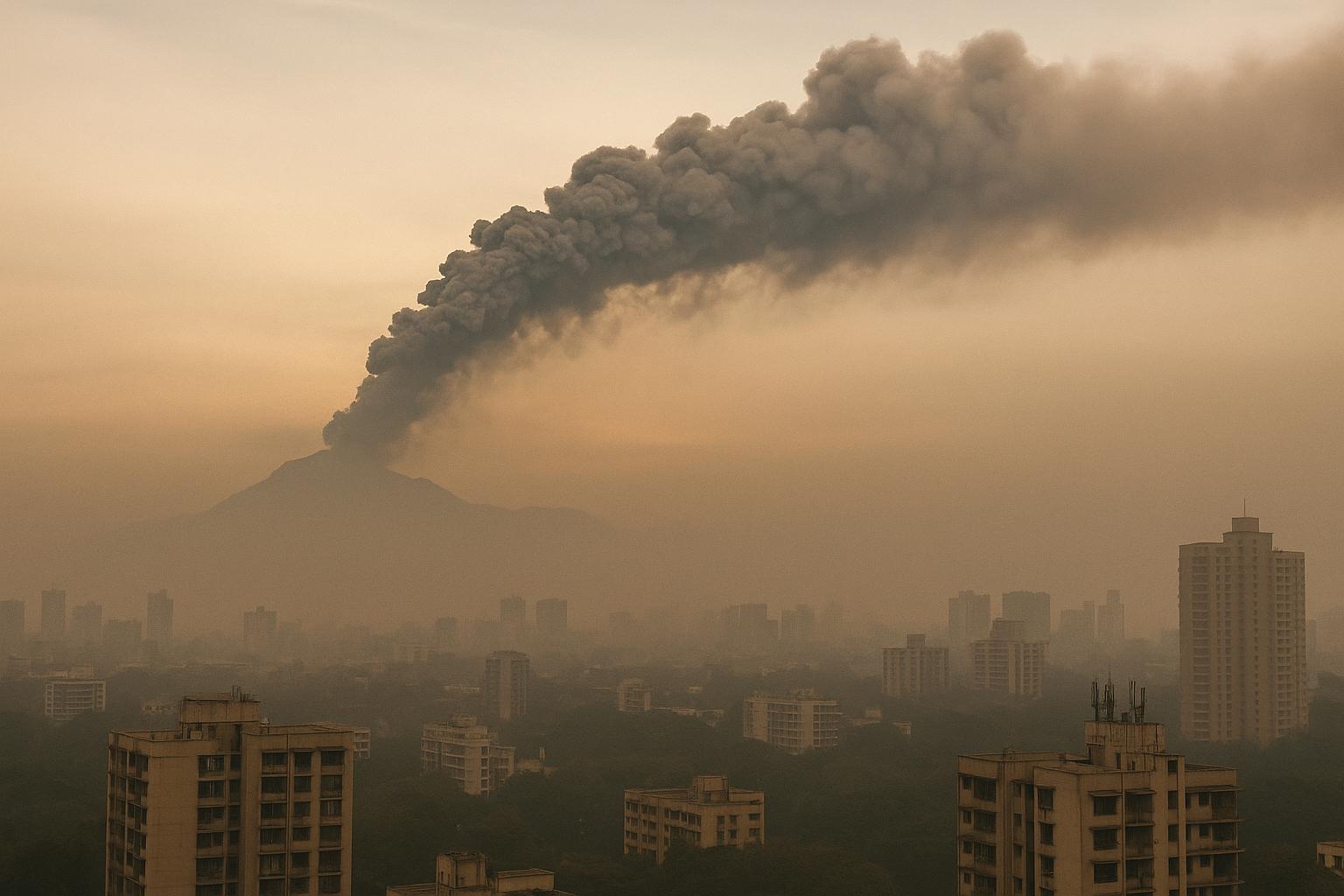
A sulphur dioxide–laden ash plume originating from Ethiopia’s Hayli Gubbi volcano has drifted across parts of north India, raising concerns about potential effects on regional air quality and aviation movement. According to meteorological observers tracking the plume from the Afar Rift region, the cloud has moved over Delhi-NCR, Haryana and portions of Uttar Pradesh, carried eastward by upper-level wind patterns. While the ash concentration remains low at the surface, satellite readings indicate the presence of fine volcanic particles at higher altitudes. Small patches of ash have also been detected over sections of Rajasthan, though experts maintain that the likelihood of significant low-level ashfall remains minimal.
The plume is projected to continue its trajectory toward the Himalayan region in the coming days. Weather analysts note that such long-distance transport of volcanic material is not unusual, particularly when eruptions inject sulphur dioxide and ash into higher layers of the atmosphere. Although the current plume poses no immediate hazard to residents, authorities continue to monitor air quality parameters due to the potential for temporary haze or mild visibility reduction in affected areas.
The movement of the ash cloud has also prompted precautionary steps within the aviation sector. Mumbai’s Chhatrapati Shivaji Maharaj International Airport issued an advisory to passengers after the Ethiopian eruption affected airspace in parts of West Asia, a region that hosts several international flight corridors linking India with Europe, Africa and the Middle East. The airport noted that some airlines may be required to alter their flight paths to avoid the volcanic ash, which can pose serious risks to aircraft engines and onboard systems.
Travellers have been advised to check the status of their flights before heading to the airport, as rerouting and altered air traffic patterns could lead to delays. Aviation authorities and airline operators are working to assess the evolving situation, with real-time monitoring of ash density and plume movement guiding operational decisions. Although widespread disruption is not anticipated at this time, officials emphasise that the advisory has been issued as a precaution to ensure passenger safety and efficient flight management.
The eruption at the Hayli Gubbi volcano highlights the far-reaching impacts of volcanic activity, with atmospheric conditions capable of carrying ash thousands of kilometres from the source. As monitoring continues, weather experts and aviation authorities remain in close coordination to address any developments that may arise from the ongoing movement of the ash plume.