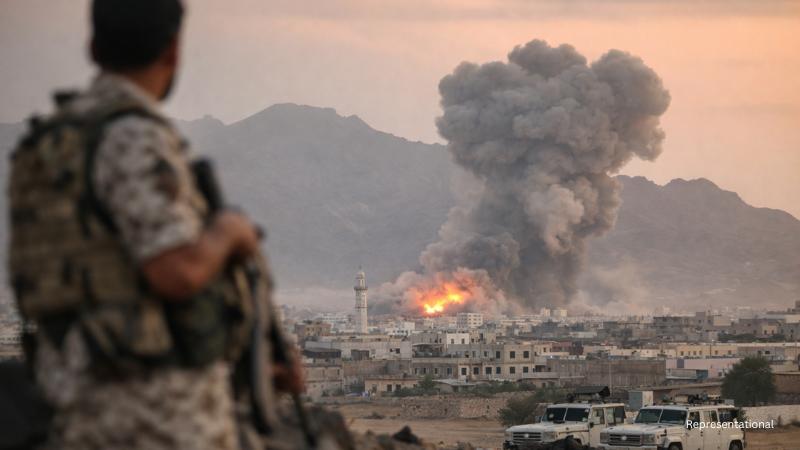
The Saudi-led coalition announced on Wednesday, Jan 7, that it had conducted what it described as limited pre-emptive military strikes in Yemen, citing concerns that escalating actions by UAE-backed secessionist forces could further destabilize the fragile security situation. Coalition officials said the strikes were aimed at preventing a wider confrontation and preserving the possibility of political dialogue amid renewed tensions in the country’s south.
According to the coalition’s statement, the operations were carried out in response to movements by forces aligned with the Southern Transitional Council, or STC, a separatist group that has sought greater autonomy in southern Yemen. The coalition accused the group of taking steps that risked undermining existing ceasefire understandings and derailing ongoing efforts to de-escalate the conflict. Officials emphasized that the strikes were limited in scope and intended as a precautionary measure rather than the start of a broader military campaign.
The coalition also reported that Aidarus Al-Zubaidi, the leader of the STC, had fled to an unknown location. Al-Zubaidi had been expected to travel to Saudi Arabia late Tuesday night to participate in talks aimed at easing tensions and resolving political disputes. However, coalition sources said he did not board the scheduled flight, raising questions about his whereabouts and the future of the planned discussions.
The absence of the separatist leader has added uncertainty to an already complex political landscape in Yemen, where rival factions and foreign backers have long competed for influence. Analysts note that the involvement of regional powers, including Saudi Arabia and the United Arab Emirates, has made the conflict particularly sensitive, with shifts on the ground carrying broader implications for regional security.
Coalition officials reiterated their commitment to supporting a negotiated political solution while maintaining what they described as the right to respond to actions that threaten stability. They urged all parties to refrain from further escalation and to return to dialogue as the preferred path toward resolving disputes. The situation remains fluid, with observers closely monitoring developments to assess whether the latest strikes will calm tensions or prompt further confrontations in the conflict-torn country.