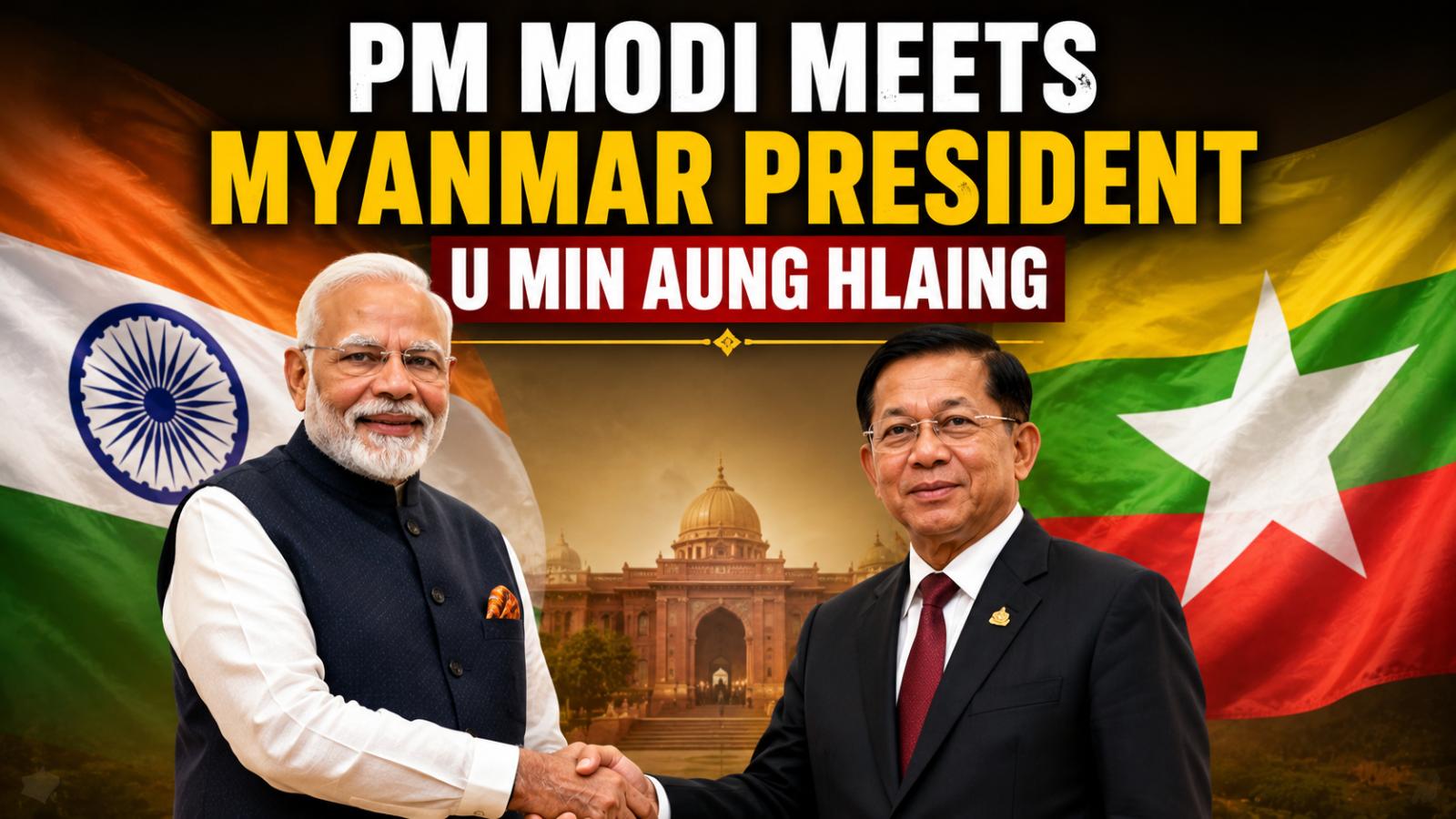
Prime Minister Narendra Modi met Myanmar President U Min Aung Hlaing at Hyderabad House in New Delhi on Monday as India and Myanmar looked to strengthen bilateral cooperation during the visiting leader’s official trip to India. The meeting was part of Min Aung Hlaing’s visit from May 30 to June 3, which marks his first visit to India in his current capacity as President.
The Myanmar President arrived in India with a high-level delegation that included cabinet ministers, senior officials and business leaders. His visit is being watched closely because of Myanmar’s strategic importance for India, especially in areas such as border security, connectivity, trade, regional stability and Buddhist cultural ties.
India-Myanmar talks focus on cooperation
Before the meeting with Prime Minister Modi, National Security Adviser Ajit Doval called on President Min Aung Hlaing on Sunday. External Affairs Minister S Jaishankar also met him and said he appreciated the Myanmar leader’s positive approach towards deepening long-standing bilateral cooperation.
The Ministry of External Affairs had earlier said that President Min Aung Hlaing would hold discussions with Prime Minister Modi on taking India-Myanmar ties forward. MEA spokesperson Randhir Jaiswal described the relationship between the two countries as historical, civilisational and multifaceted.
The talks are expected to cover a wide range of issues. For India, Myanmar is not just a neighbour but a key country for its Act East policy. The two countries share a long border, and developments inside Myanmar have a direct impact on India’s northeastern states. Security cooperation, border management, infrastructure projects, trade routes and people-to-people ties are likely to remain important parts of the bilateral agenda.
The visit also comes at a politically sensitive time. Myanmar has been under global scrutiny since the 2021 military takeover, and India’s engagement with the country is often seen through the lens of security concerns, regional influence and humanitarian issues. India has maintained contact with Myanmar’s leadership while also pushing for stability and inclusive political processes in the country. Reuters reported that Min Aung Hlaing’s visit is also being seen in the context of regional diplomacy and Myanmar’s effort to broaden engagement beyond China.
Bodh Gaya visit highlights spiritual ties
Before arriving in New Delhi, President Min Aung Hlaing visited Bodh Gaya in Bihar, one of the most sacred Buddhist pilgrimage sites in the world. He paid homage at the Mahabodhi Temple, a UNESCO World Heritage Site, underlining the deep Buddhist and civilisational links between India and Myanmar.
This spiritual connection is a major soft-power pillar in India-Myanmar relations. Myanmar has a large Buddhist population, and Bodh Gaya remains one of the most important pilgrimage destinations for devotees from the country. By including Bodh Gaya in the visit, both sides signalled that the relationship goes beyond politics and security.
However, the practical stakes of the visit are equally important. India needs stability in Myanmar for border peace, connectivity projects and regional trade. Myanmar, on the other hand, needs diplomatic engagement, investment and development partnerships. The presence of business leaders in the visiting delegation suggests that economic cooperation may also be discussed.
For India, the challenge is to balance strategic necessity with democratic concerns. Ignoring Myanmar is not a realistic option because instability there directly affects India’s northeast. At the same time, engagement with Myanmar’s military-backed leadership carries reputational risks, especially when rights groups and Western governments continue to criticise the regime. AP reported that critics have accused India’s engagement of giving legitimacy to Myanmar’s military-backed government.
The Modi-Min Aung Hlaing meeting therefore has significance beyond protocol. It reflects India’s attempt to protect its border interests, maintain regional influence, keep connectivity projects alive and prevent Myanmar from moving completely into China’s strategic orbit. The success of the visit will depend on whether both sides can turn diplomatic language into concrete cooperation on security, trade, infrastructure and stability.