The Trump administration is considering a $100,000 green card bond for certain applicants completing consular processing abroad. The unconfirmed proposal would examine financial self-sufficiency but leaves eligibility, refund rules and implementation unclear.
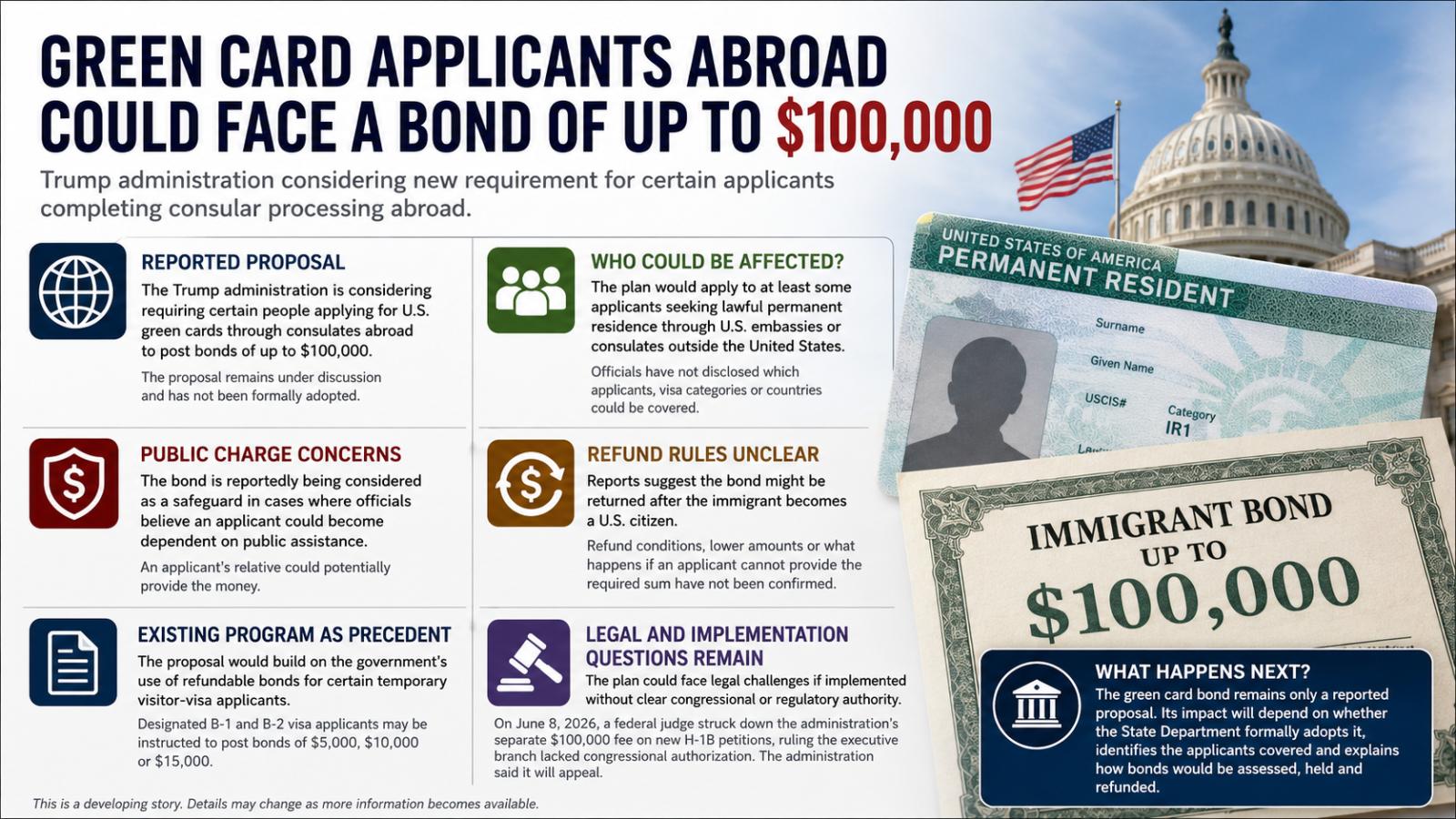
The Trump administration is considering requiring certain people applying for U.S. green cards through consulates abroad to post bonds of up to $100,000, according to published reports. The proposal remains under discussion and has not been formally adopted.
Green Card Applicants Abroad Could Face a Bond
Many H-1B professionals are also asking whether the proposal could affect their employment-based green card process. Read our detailed explainer: Will H-1B Holders Have to Pay the Proposed $100,000 Green Card Bond?
The reported plan would apply to at least some applicants seeking lawful permanent residence through U.S. embassies or consulates outside the United States. Officials have not disclosed which applicants, visa categories or countries could be covered.
State Department spokesperson Tommy Pigott said President Donald Trump expects prospective immigrants to be financially self-sufficient. He said the department was working with the Department of Homeland Security on procedures intended to enforce existing immigration law.
Public Charge Assessments Drive the Proposal
The bond is reportedly being considered as a safeguard in cases where officials believe an applicant could become dependent on public assistance. Under the concept being discussed, an applicant’s relative could potentially provide the money.
The impact may depend on whether an applicant uses a U.S. consulate abroad or files from within the United States. See: Could the Green Card Bond Affect Consular Processing?
Reports have suggested that the bond might be returned after the immigrant becomes a U.S. citizen. However, the government has not formally confirmed the refund conditions, whether lower bond amounts would be available or what would happen if an applicant could not provide the required sum.
Existing Visa Bond Program Offers a Precedent
The proposal would build on the government’s use of refundable bonds for certain temporary visitor-visa applicants. Under that program, designated B-1 and B-2 visa applicants may be instructed to post bonds of $5,000, $10,000 or $15,000.
A green card bond of up to $100,000 would be substantially larger and could place permanent residency beyond the immediate financial reach of many qualifying families.
Legal and Implementation Questions Remain
Because the government has not released final eligibility rules, applicants should understand which groups could potentially fall within the proposal. Read: Who Could Pay the Proposed Green Card Bond?
The plan could face legal challenges if implemented without clear congressional or regulatory authority. On Monday, June 8, 2026, U.S. District Judge Leo Sorokin struck down the administration’s separate $100,000 fee on new H-1B petitions, finding that the executive branch lacked congressional authorization to impose the charge. The administration said it planned to appeal.
The proposed bond would not be the same as the regular fees applicants already pay during the immigration process. Learn more: Green Card Bond vs. Green Card Fees: What’s the Difference?
The green card bond remains only a reported proposal. Its broader impact will depend on whether the State Department formally adopts it, identifies the applicants covered and explains how bonds would be assessed, held and refunded.