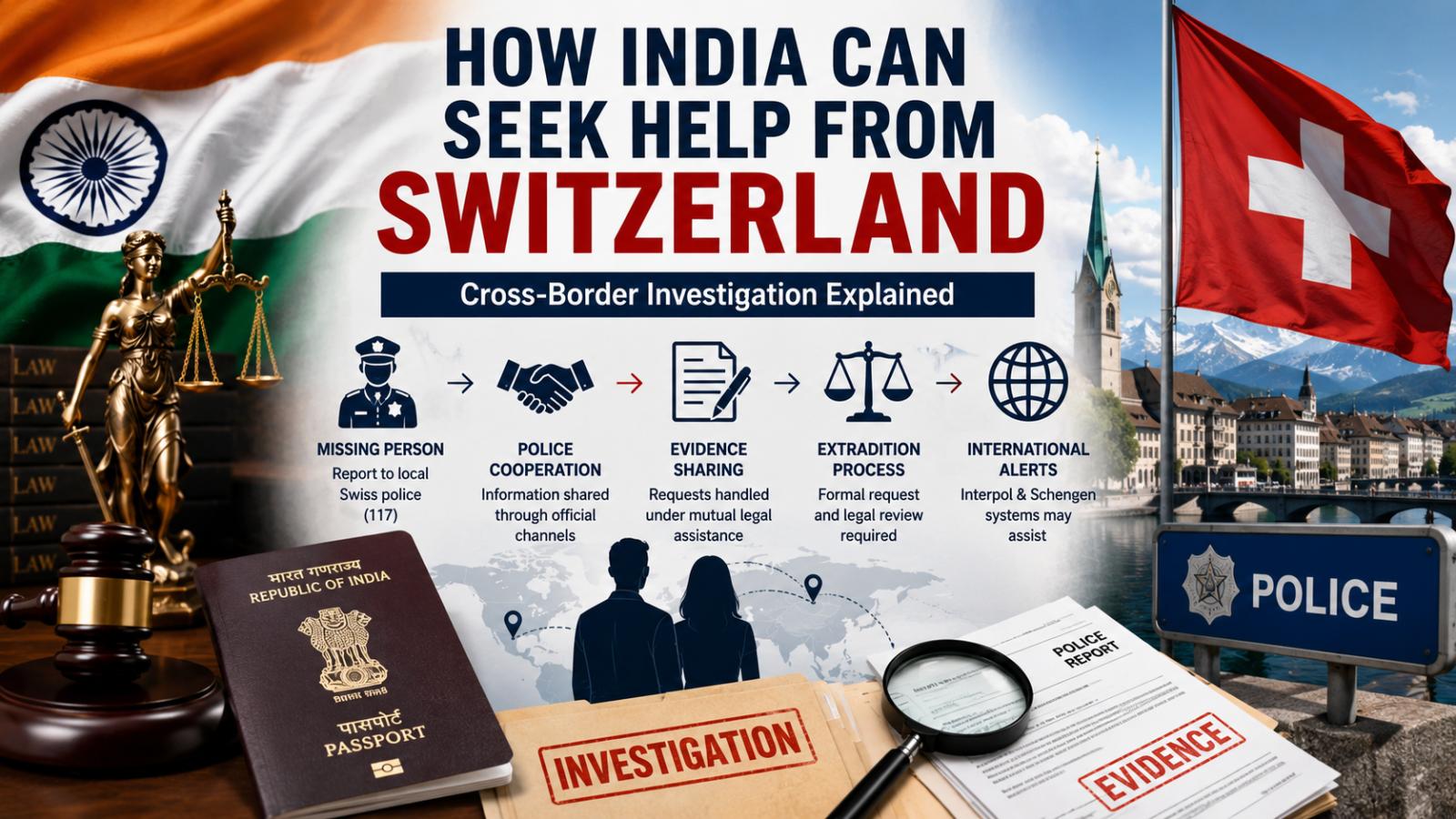
The Hyderabad couple case has drawn attention to how an India Switzerland investigation may proceed. Swiss police can assist with missing-person searches, while evidence sharing, international alerts and extradition require separate official procedures and legal review.
Reports concerning a Hyderabad couple who allegedly became unreachable during an overseas trip have prompted questions about what Indian authorities can do when a missing person or suspect may be in Switzerland.
A cross-border case does not automatically become a Swiss criminal investigation. The response depends on whether authorities are seeking missing people, verifying travel, collecting evidence or pursuing people accused of an offence.
This explainer follows reports about the Hyderabad couple missing after a reported Switzerland trip, a case that has prompted questions about cross-border police cooperation.
How a Swiss Missing-Person Investigation Begins
A person believed to be missing in Switzerland should normally be reported to the nearest Swiss police station or through the emergency number 117. Local cantonal police handle the initial response, while Switzerland’s Federal Office of Police, known as fedpol, coordinates cases involving multiple cantons or international authorities.
Indian authorities would therefore need to share identifying information and the circumstances of the disappearance through official diplomatic or police channels.
How India-Switzerland Police Cooperation Works
Indian police cannot independently search a property, question witnesses or make an arrest on Swiss territory. Those steps must be performed by the appropriate Swiss authorities under Swiss law.
International police cooperation can help exchange information and locate people. Switzerland has access to the Schengen Information System, which contains alerts concerning wanted and missing people. An alert must be entered by an authorized authority and is not created simply because a family files a complaint or a news report names someone.
Can Authorities Verify a Switzerland Trip?
Investigators may examine passports, visas, airline information and immigration records through lawful procedures. Switzerland’s Entry/Exit System records the entry and departure of third-country nationals crossing the external borders of the Schengen area and calculates their authorized period of stay.
However, entering the Schengen area through another member country would not necessarily prove that a traveller reached or remained in Switzerland.
What Happens When Fraud Is Alleged?
A missing-person report and a financial-fraud investigation are legally different matters. If Indian police receive fraud complaints, they must investigate the allegations, collect evidence and obtain any required warrants or court orders.
An accusation made in India does not automatically authorize Swiss police to detain someone. Indian authorities may need to send a formal request for records, banking evidence, witness assistance or other investigative material.
Mutual Legal Assistance and Extradition
Switzerland’s Federal Act on International Mutual Assistance in Criminal Matters governs assistance such as evidence collection and extradition. Swiss authorities examine whether a foreign request satisfies applicable legal conditions before acting on it.
Extradition is separate from locating a missing person or sharing evidence. It normally requires a formal request, adequate documentation and legal review in Switzerland. An Interpol notice may support international cooperation, but it does not by itself establish guilt or guarantee extradition.
Until authorities confirm the couple’s travel movements and the status of any criminal proceedings, the matter should be described as an ongoing missing-person investigation involving unproven financial allegations.