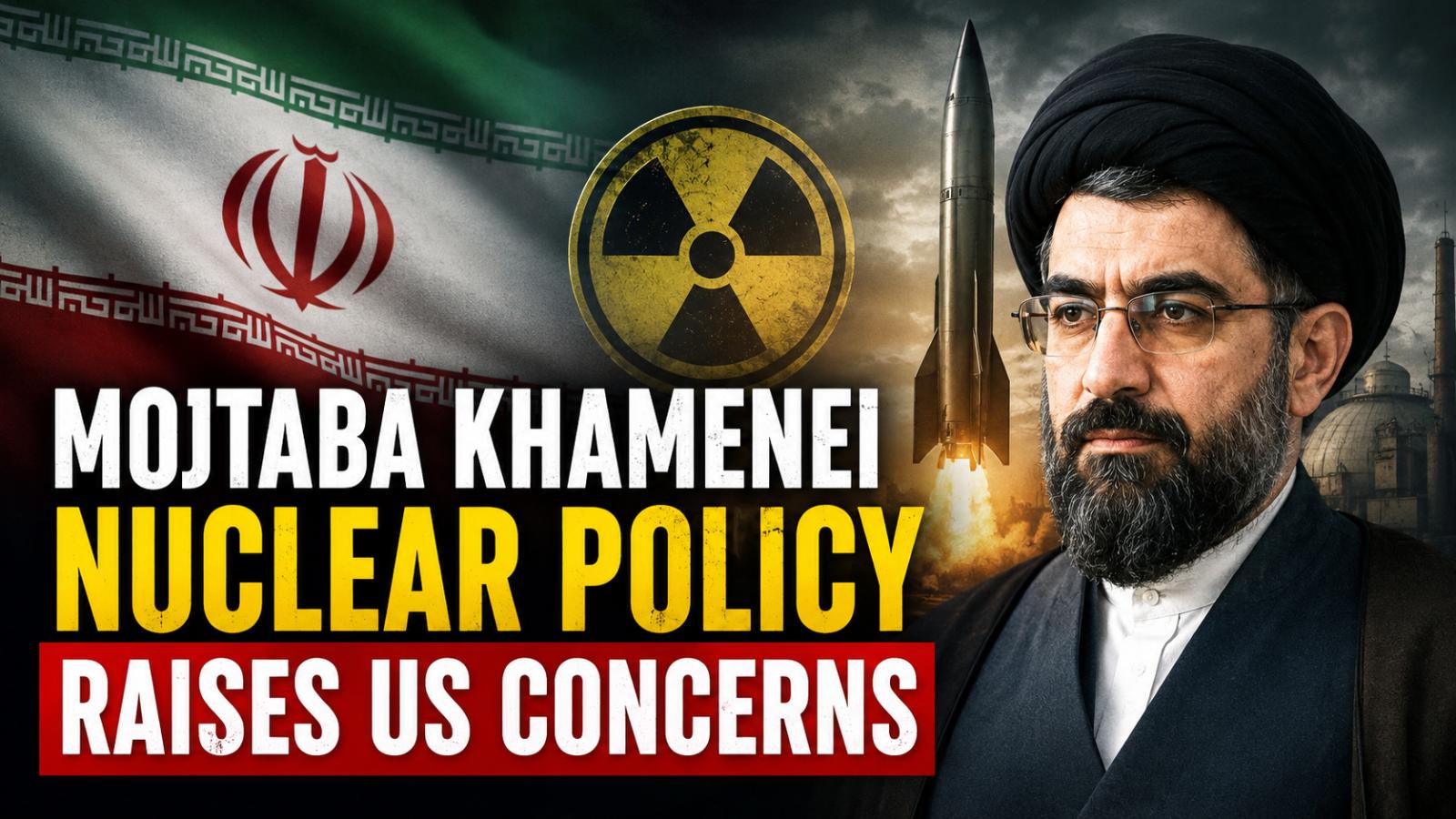
Mojtaba Khamenei nuclear policy has come under renewed scrutiny after a reported US intelligence assessment suggested that Iran’s supreme leader may be more willing than his father to consider developing nuclear weapons. The claim raises fresh questions about Iran’s nuclear doctrine, missile ambitions and regional security.
Iran Nuclear Weapons Assessment
People described as familiar with US intelligence assessments reportedly believe Mojtaba Khamenei is more inclined than his father, Ali Khamenei, to support the eventual development of a nuclear weapon.
However, the Office of the Director of National Intelligence has not publicly released an assessment confirming Mojtaba Khamenei’s personal position. The reported conclusion is said to rely partly on statements and private discussions examined before the latest Israel-Iran conflict.
That timing matters. Intelligence assessments can change as new information becomes available, particularly after a war, leadership transition or major shift in national security policy. Publicly available US intelligence testimony has described Iran’s government as weakened but still functioning following attacks on its leadership and military capabilities.
Iran Nuclear Doctrine
Ali Khamenei had long maintained that nuclear weapons were prohibited under Islam. Iranian officials repeatedly cited his religious ruling as evidence that the country’s nuclear programme served peaceful energy, medical and scientific purposes.
The reported US assessment suggests Mojtaba Khamenei may not share the same reluctance. Analysts reportedly believe he could see nuclear weapons as a stronger deterrent against future attacks by Israel or the United States.
This remains an intelligence judgment rather than a publicly confirmed Iranian policy. Mojtaba Khamenei has not openly called for the production, testing or deployment of a nuclear weapon.
Missile Warhead Concerns
The assessment reportedly distinguishes between a basic nuclear device and a smaller warhead designed for missile delivery. A crude device could provide symbolic deterrence but would be difficult to deploy during a military conflict.
A compact warhead mounted on a long-range missile would represent a more advanced and strategically significant capability. Developing such a weapon would require additional design, testing and delivery-system work beyond producing weapons-grade nuclear material.
US policy formally seeks to prevent Iran from obtaining both nuclear weapons and nuclear-capable long-range missiles. The White House has also accused Tehran of obstructing safeguards and concealing activities linked to sensitive nuclear research.
US Intelligence Iran Review
Earlier US intelligence estimates indicated that Iran could need roughly a year to produce a weapon after deciding to pursue one, although such timelines depend heavily on the condition of its facilities, technical expertise and access to nuclear material.
The International Atomic Energy Agency remains responsible for verifying Iran’s declared nuclear material and monitoring compliance with safeguards. Any loss of inspector access or reliable monitoring would make it harder to determine whether Tehran had shifted from enrichment toward weapon development.
Regional Security Risk
A change in Mojtaba Khamenei nuclear policy could intensify military pressure on Iran and reduce the prospects for diplomacy. Israel has repeatedly treated a potential Iranian nuclear weapon as a major security threat, while Tehran maintains that its programme is peaceful.
For now, the reported assessment should be presented carefully. It indicates what some US analysts may believe about Mojtaba Khamenei’s intentions, but it does not prove that Iran has ordered the construction of a nuclear weapon.