India Defends Indus Waters Treaty Suspension
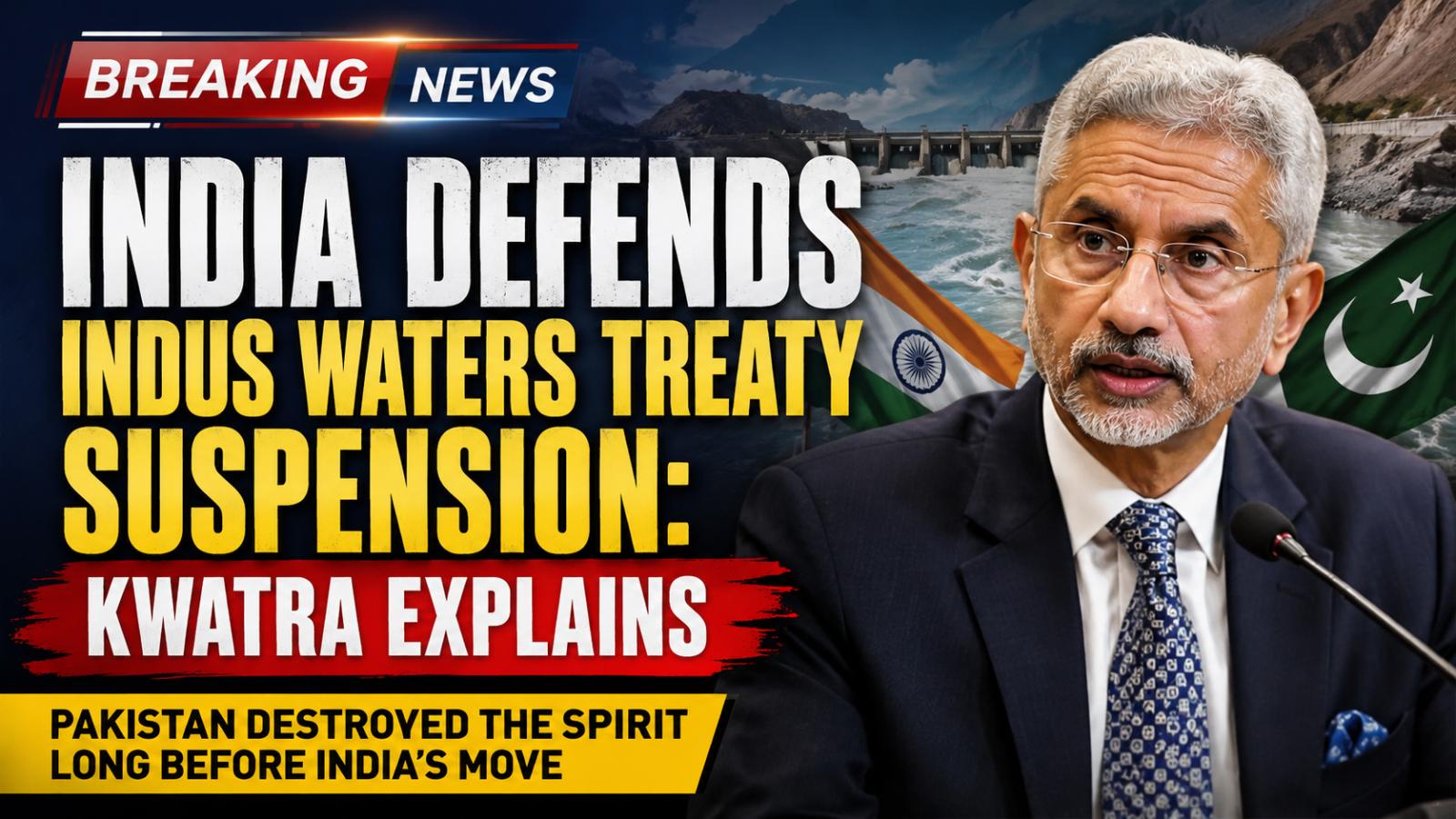
India has defended its decision to keep the Indus Waters Treaty (IWT) in abeyance, arguing that Pakistan weakened the agreement over several decades through hostility, terrorism and repeated refusal to address India's concerns. The latest remarks came from India's Ambassador to the United States, Vinay Mohan Kwatra, who said the move reflects a reality created by Pakistan's own conduct rather than a sudden policy shift. The statements were made in an opinion article published in an international magazine and follow renewed criticism from Pakistan over India's decision after the April 2025 Pahalgam terror attack.
Vinay Mohan Kwatra Statement
Ambassador Vinay Mohan Kwatra said the Indus Waters Treaty was built on goodwill and friendship, values clearly mentioned in its preamble. According to him, Pakistan steadily eroded those principles through decades of conflict, cross-border terrorism and unwillingness to modernize the agreement.
Kwatra argued that placing the treaty in abeyance simply recognizes what had already happened over time. He also criticized recent comments made during a conference in Islamabad, where, according to his statement, a former Pakistani foreign minister warned of conflict if Pakistan's demands over the Indus river system were not met. The ambassador said such threats have become a recurring pattern whenever Islamabad faces internal challenges.
Indus Waters Treaty Abeyance
Signed in 1960, the Indus Waters Treaty divided the six rivers of the Indus basin between India and Pakistan. India received rights over the eastern rivers, while Pakistan gained control over the western rivers, accounting for nearly 80 percent of the basin's water.
Kwatra noted that India continued to respect the treaty for decades despite the unequal distribution. He added that repeated Indian proposals to update the agreement in line with modern technology and expand hydropower development were consistently opposed by Pakistan. He also referred to attacks on Indian infrastructure projects, including the 2012 terrorist attack linked to the Tulbul Navigation Project, as examples of obstacles that limited India's ability to exercise its treaty rights.
The ambassador further cited a long history of military conflicts and terrorist attacks, including the 1965, 1971 and 1999 wars, the Parliament attack in 2001, the Mumbai attacks in 2008, the Pathankot and Uri attacks in 2016, the Pulwama attack in 2019 and the Pahalgam attack in 2025. He said these incidents steadily weakened the trust required for the treaty to function effectively.
Pakistan Water Management Issues
Responding to accusations that India is using water as a strategic weapon, Kwatra rejected the claim and said Pakistan's water shortages are primarily the result of domestic mismanagement. He stated that only about 40 percent of the country's available water reaches agricultural fields, while a significant amount is lost during transportation or flows unused into the sea.
He also questioned repeated international calls for dialogue, arguing that earlier rounds of engagement failed to stop terrorism or resolve long-standing concerns. Referring to Prime Minister Narendra Modi's position, he reiterated that terrorism and meaningful cooperation cannot progress together.
Pahalgam Terror Attack Impact
India placed the Indus Waters Treaty in abeyance one day after the April 22, 2025 terrorist attack in Pahalgam, Jammu and Kashmir, in which 26 civilians, including one Nepalese national, were killed. Indian authorities linked the attack to the Pakistan-based terrorist group Lashkar-e-Taiba. Security forces later announced that those responsible had been eliminated during counterterrorism operations.
The Indian government maintains that its decision reflects broader national security concerns rather than a single incident. The latest remarks from Ambassador Kwatra reinforce New Delhi's position that Pakistan's long record of terrorism, treaty disputes and refusal to address evolving challenges ultimately undermined the foundation of the agreement.