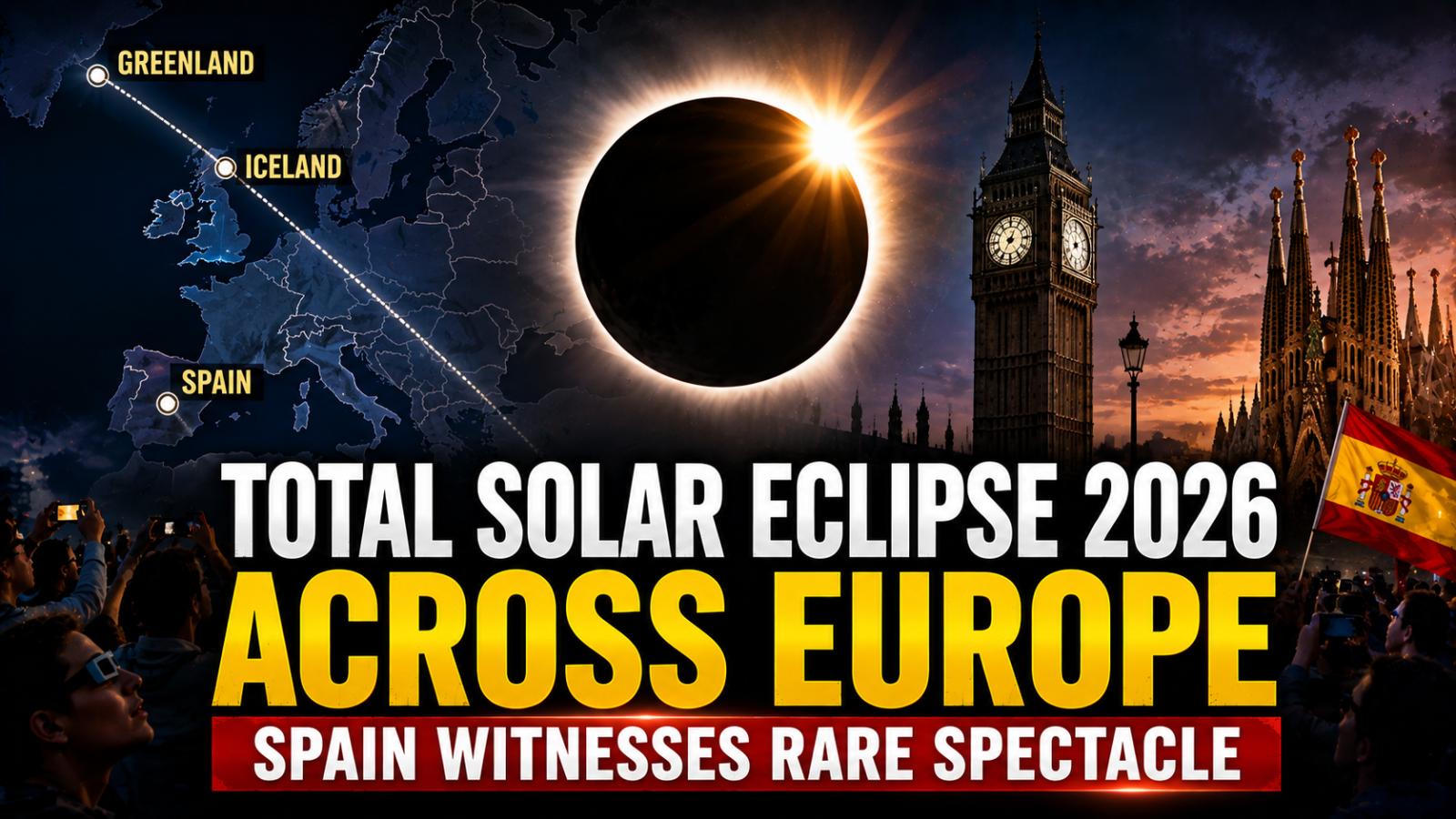
The total solar eclipse 2026 delivered a dramatic celestial spectacle on August 12 as the Moon's shadow crossed Greenland, Iceland and northern Spain. Millions across Europe watched varying phases of the eclipse, while India missed the event because it occurred after sunset there.
Spain witnesses total solar eclipse 2026
Spain became one of the major viewing destinations for the August 12 eclipse, with the path of totality crossing northern parts of the country shortly before sunset. Residents, tourists and astronomy enthusiasts gathered at viewing locations to watch the Moon completely cover the Sun for a brief period.
The event carried particular significance for Europe. It was the first total solar eclipse visible from mainland Europe since August 11, 1999, ending a 27-year wait for totality on the continent.
A total solar eclipse happens when the Moon passes directly between Earth and the Sun and appears large enough to completely cover the Sun's bright surface. During totality, daylight rapidly fades and the Sun's outer atmosphere, known as the corona, becomes visible around the Moon.
The August 12 eclipse followed a path across the Arctic and North Atlantic, passing through Greenland and Iceland before reaching Spain. The timing near sunset made the Spanish phase particularly striking, although local weather conditions played a major role in visibility.
Europe eclipse brings millions outside
Beyond the narrow path of totality, a much larger part of Europe experienced a partial solar eclipse. In these areas, the Moon covered only part of the Sun but still produced a dramatic change in its appearance.
Skywatchers in Switzerland gathered at observation sites, including the Chasseral region, to follow the partial phase. Hungary also witnessed the event, with astronomy enthusiasts assembling at locations such as the Dinnyés Observation Tower near Agárd.
Across Europe, observatories and astronomy organisations reminded viewers that looking directly at the Sun without certified eclipse glasses can permanently damage eyesight. Normal sunglasses do not provide sufficient protection for observing a partial solar eclipse.
UK eclipse covers most of the Sun
Britain was outside the path of totality but still experienced a major partial eclipse. Depending on location, a large portion of the Sun was obscured, with the coverage increasing toward the north and west of the country.
The eclipse provided striking views across the UK as the partially covered Sun appeared above familiar landmarks. The event was also visible during outdoor sporting and public events, drawing attention well beyond dedicated astronomy communities.
However, describing the UK event simply as “more than 90%” everywhere would be misleading because eclipse magnitude and obscuration varied significantly by location.
Why India could not see the eclipse
India was unable to witness the August 12 solar eclipse because the event took place after sunset across the country. By the time the Moon began moving across the Sun from Earth's perspective, the Sun was already below the Indian horizon.
This is an important distinction: India was not outside the eclipse simply because it was geographically distant from the path of totality. The timing meant neither the total nor partial phase was visible from Indian territory.
For Indian astronomy enthusiasts, the event therefore remained an online spectacle, with livestreams and images from Europe, Greenland and Iceland providing the best opportunity to follow the eclipse.
Rare celestial event draws global attention
Solar eclipses occur because of an extraordinary apparent coincidence: although the Sun is roughly 400 times wider than the Moon, it is also approximately 400 times farther from Earth. As a result, the two objects can appear almost identical in size in our sky.
Only observers inside the Moon's relatively narrow central shadow experience totality. People across the much broader surrounding region see a partial eclipse, while much of the rest of the world sees no eclipse at all.
The August 12 spectacle offered Europe an unusually memorable astronomical event, particularly in Spain, Iceland and Greenland. For millions who gathered beneath the eclipse path, a few minutes of changing light provided a vivid demonstration of the precise orbital movements of the Sun, Moon and Earth.