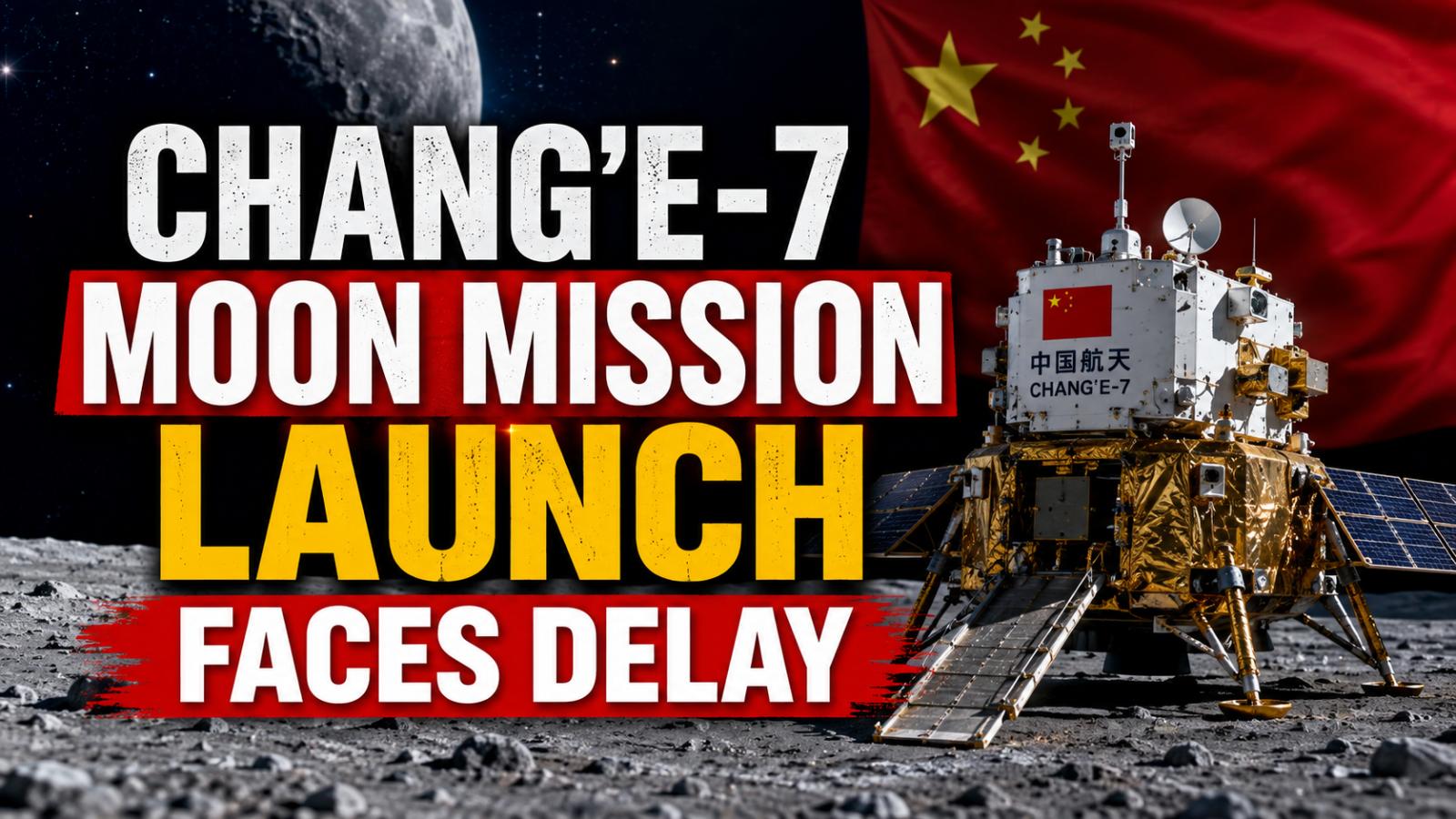
China’s Chang’e-7 mission, an ambitious robotic expedition designed to investigate the moon’s south pole and search for evidence of water ice, is facing uncertainty over its launch schedule. However, the latest publicly available official update from China’s space agency still described the spacecraft as being prepared for launch rather than confirming a postponement.
Chang’e-7 launch preparations at Wenchang
The China National Space Administration said the Chang’e-7 probe and its Long March 5 carrier rocket completed a vertical transfer to the launch area at the Wenchang Space Launch Site in Hainan on August 19.
According to the agency, the spacecraft arrived at the launch site in April and the rocket followed in July. Assembly, testing and other preparations were subsequently carried out. CNSA said launch-site facilities were in good condition and that final functional checks, joint testing and propellant loading would follow ahead of a planned launch in the coming days.
That official statement is important because reports claiming the mission has now failed to meet launch conditions would represent a newer development. Until China’s space authorities formally confirm such a change, the mission’s status should be described cautiously.
China moon mission targets lunar south pole
Chang’e-7 is part of the fourth phase of China’s Lunar Exploration Program and is designed to conduct an extensive investigation of the lunar south polar region.
Official mission documents identify the investigation of the lunar surface environment, water ice and volatile materials among its central scientific goals. China also plans to gather remote-sensing and in-situ scientific data that could support future lunar exploration.
The lunar south pole has become one of the most strategically important destinations in space exploration because permanently shadowed areas may preserve water ice and other volatile materials.
Chang’e-7 will search for moon water ice
Chang’e-7 is more complex than a conventional lunar lander. CNSA material describes a mission architecture involving multiple spacecraft elements intended to study the moon both from orbit and on its surface. Official information has previously described components including an orbiter, lander, rover and a small mobile probe.
Finding and characterising accessible lunar water could have major scientific importance. Ice preserves information about the moon’s history, while future explorers could potentially investigate whether lunar resources can support longer-duration missions.
Lunar south pole becomes a major exploration target
Chang’e-7 also forms part of China’s broader lunar strategy. The country plans to follow it with Chang’e-8, which is scheduled around 2028 and will conduct scientific exploration and technology demonstrations in the lunar south-pole region. CNSA documents say Chang’e-8 will include experiments related to in-situ resource utilisation, among other scientific objectives.
Together, the missions are intended to expand China’s scientific understanding of the lunar south pole while developing capabilities relevant to future exploration.