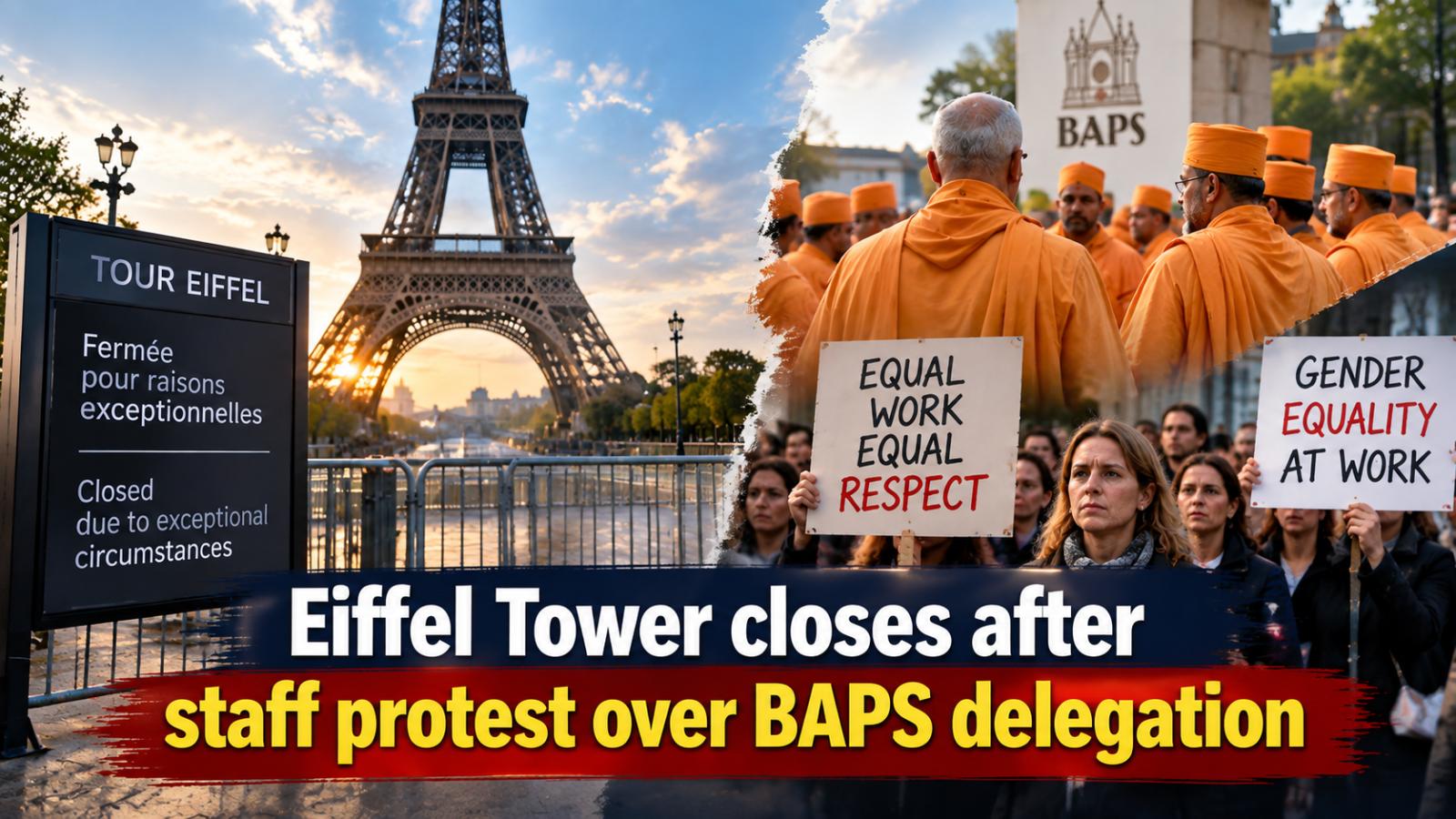
Eiffel Tower staff protest over BAPS group visit triggered a temporary Eiffel Tower closure in Paris, with the BAPS Paris visit sparking a gender equality row, staff walkout and wider debate over religious accommodation.
Eiffel Tower closure follows protest over workplace equality
The Eiffel Tower was temporarily closed after employees staged a walkout over claims that female staff members were moved from some of their usual positions during a visit by a Hindu religious delegation linked to BAPS. The Eiffel Tower staff protest over BAPS group visit quickly became a wider controversy over workplace equality, staff rights and how religious requests should be handled at one of the world’s best-known public landmarks.
The delegation was associated with the Bochasanwasi Akshar Purushottam Swaminarayan Sanstha, commonly known as BAPS. According to employee representatives, some women working at the monument were allegedly reassigned or asked to avoid direct interaction with members of the visiting group.
SETE, the company that operates the Eiffel Tower, temporarily shut the monument as the staff walkout disrupted normal operations. The closure affected visitors and drew immediate attention because of the Eiffel Tower’s status as one of the most visited attractions in France.
Union representatives argued that women should not be made less visible at their workplace or moved from their normal duties because of visitors’ religious preferences. They said any such arrangement would raise serious concerns about equal treatment and workplace rules.
SETE reportedly acknowledged that certain arrangements had been made in connection with the group’s visit. The operator later indicated that such conditions should not have been accepted, adding further scrutiny to how the situation had been handled.
Paris officials also became involved, with authorities indicating that the circumstances surrounding the incident would be reviewed. The controversy has therefore shifted from a short-lived Paris monument closure to a broader discussion about staff protections and institutional responsibility.
BAPS Paris visit fuels religious accommodation debate
The BAPS Paris visit has intensified debate over where the line should be drawn between respecting religious practices and protecting workplace equality.
BAPS responded to the controversy by expressing regret over any hurt or inconvenience caused. The organisation said the large delegation’s visit had been coordinated with Eiffel Tower officials and maintained that it did not intend to discriminate against employees.
The group is part of the Swaminarayan Hindu tradition and operates temples and cultural centres across several countries. The incident came shortly after the inauguration of a major BAPS temple in France, which had already drawn significant public and political attention.
That timing gave the controversy even greater visibility. However, for Eiffel Tower employees, the central issue remained whether religious accommodation had been allowed to affect women’s ability to perform their normal professional duties.
The dispute has also highlighted a difficult challenge for major international attractions. Institutions serving visitors from different cultural and religious backgrounds often try to accommodate reasonable requests, but those accommodations can become problematic when they appear to conflict with employment standards or equal-treatment policies.
Staff representatives have argued that visitor preferences should not override workplace protections. Supporters of religious accommodation, meanwhile, may argue that institutions should make reasonable efforts to respect religious practices where possible. The key question is whether such requests can be accommodated without placing unequal restrictions on employees.
Paris authorities are expected to examine how the arrangements were approved, whether standard procedures were followed and what safeguards may be needed to prevent similar disputes.
The Eiffel Tower controversy now goes beyond a temporary closure. It has become a debate about how public-facing institutions should balance religious accommodation, workplace equality and staff rights while continuing to welcome visitors from different backgrounds.