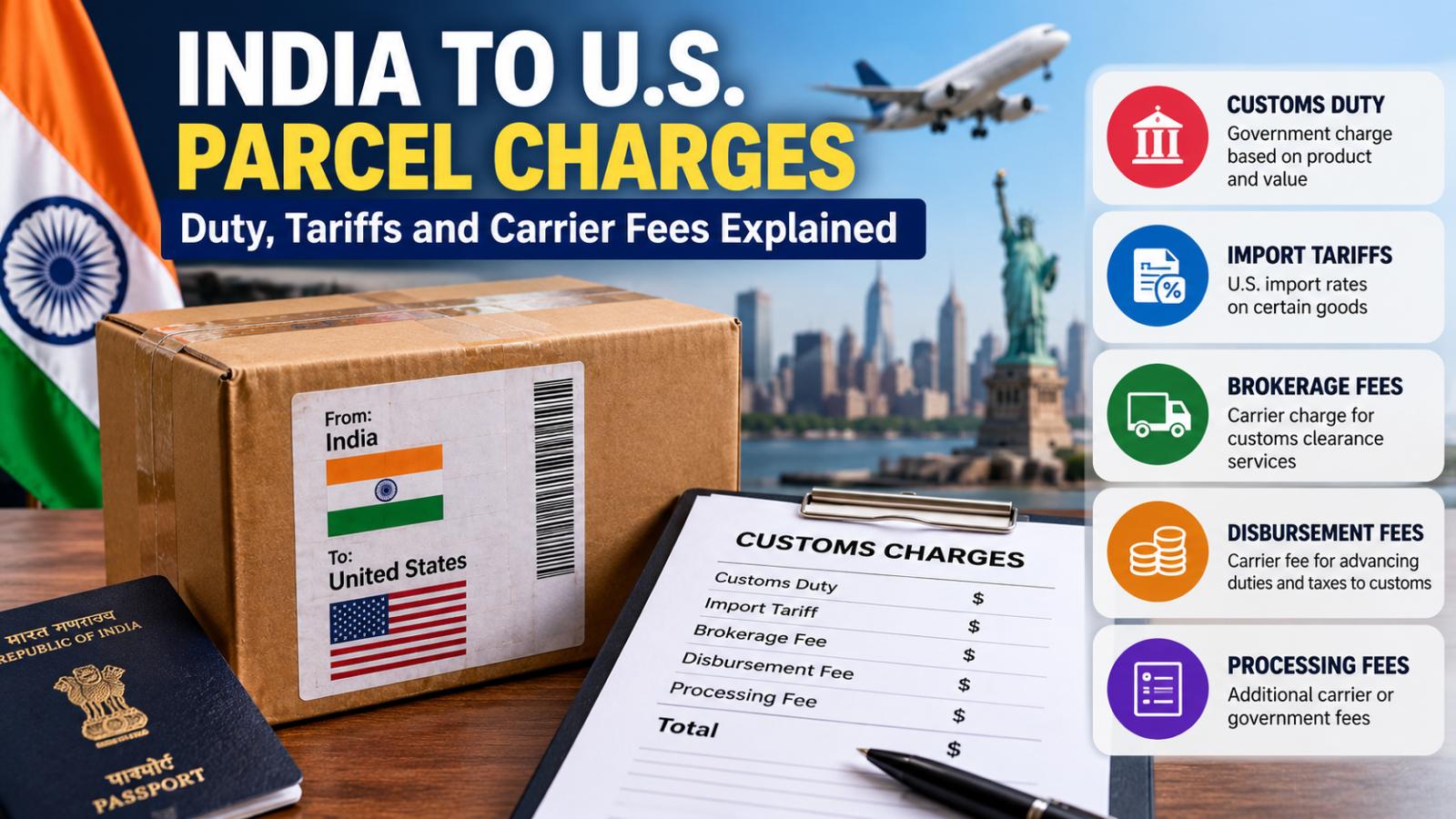
India to U.S. parcel charges can include government customs duties and separate carrier fees. This guide explains tariffs, customs duty, brokerage, disbursement and processing costs, and why the amount due can vary by product, value, entry type and shipping carrier.
A parcel sent from India to the United States can generate more than one type of import charge. A bill may combine government customs charges with courier fees for clearing the shipment or advancing money to customs.
Customs duty and tariffs
A tariff is a government-set import rate or trade measure applied to certain goods. Customs duty is the amount assessed on an imported shipment under the applicable tariff rules and classification.
For the broader rule change, read why parcels from India to the U.S. may now face customs duty under the current U.S. import rules.
U.S. Customs and Border Protection determines whether duties are owed based on factors such as the goods, country of origin and value. Since August 29, 2025, goods valued at $800 or less are no longer broadly eligible for de minimis duty-free treatment, so low-value parcels can also face applicable duties, taxes and fees.
Brokerage and disbursement fees
Not every amount on a courier invoice is a government tariff. FedEx says it may pay duties and taxes to customs on behalf of the responsible party and then charge a disbursement fee for advancing that money.
In some cases, the recipient may receive these charges later, so it is useful to understand why a customs bill can arrive after your parcel is delivered.
UPS describes brokerage fees as charges for customs-clearance work, including preparing documentation, calculating duties and taxes and facilitating release of the shipment. These carrier charges are different from the customs duty itself.
Other U.S. import fees
CBP also collects certain user fees depending on the type of customs entry and transportation method. One example is the Merchandise Processing Fee, which can apply to formal and informal entries, though exemptions or alternative fees apply in some cases.
Two parcels with similar values can therefore produce different final bills depending on how they enter the country and how the carrier processes them.
Why the final amount varies
If the parcel was sent as a personal gift, check whether gifts from India to the U.S. may qualify for a customs-duty exemption.
The duty owed is influenced by the product's tariff classification and customs value. CBP says the commercial invoice should generally reflect the price paid for the goods, while classification determines the applicable duty treatment.
Because collection methods differ by courier, see who collects customs duty on India parcels through FedEx, UPS, DHL or USPS.
Recipients should review each invoice line separately. A customs duty, government processing fee and courier brokerage or disbursement fee are not necessarily the same charge. With broad de minimis treatment no longer available, checking these details before sending a parcel from India can help avoid an unexpected total.
If you received the charge through email or text, learn how to verify whether a customs duty payment request is genuine or a scam before paying.