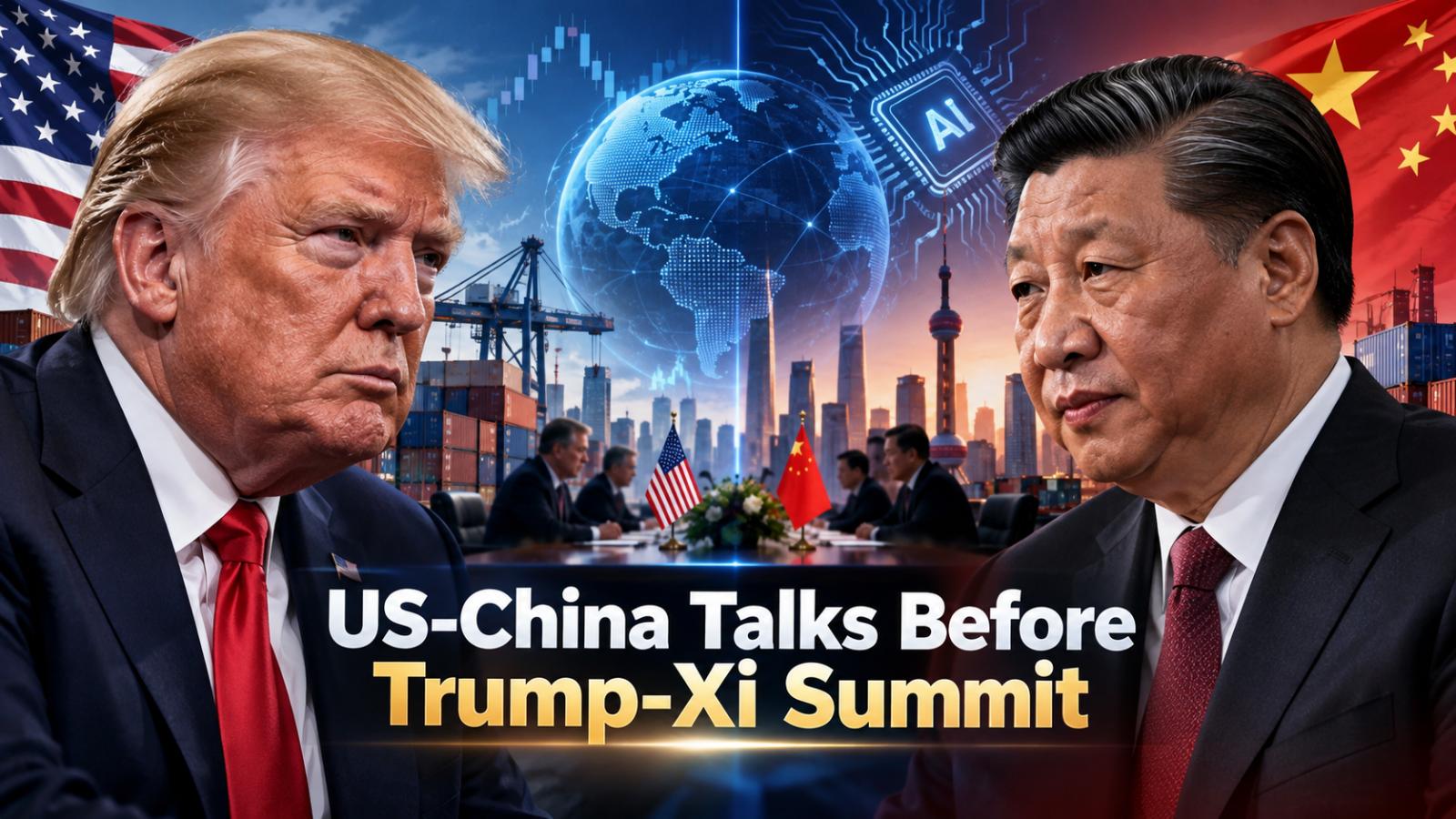
US China trade talks moved into a crucial phase in New York as Treasury Secretary Scott Bessent and Chinese Vice Premier He Lifeng discussed artificial intelligence, tariffs and critical minerals ahead of Donald Trump and Xi Jinping’s September 24 White House meeting.
US China trade talks prepare Trump-Xi summit
Bessent and He met on September 20 at JPMorgan Chase’s headquarters in Manhattan, with US Trade Representative Jamieson Greer also participating. JPMorgan provided the venue but was not involved in setting the agenda, according to people familiar with the arrangements.
The talks were designed to prepare possible agreements before Trump hosts Xi in Washington later this week. Bessent said he expected focused and constructive discussions capable of laying the groundwork for the leaders’ meeting.
One clarification is important: the Trump-Xi summit is scheduled for Washington, not New York. Xi’s US visit comes as the two governments try to stabilize economic relations without resolving their broader competition over technology, manufacturing and security.
AI safety talks introduce new risk mechanism
Artificial intelligence has emerged as one of the most significant new items on the bilateral agenda. During the New York talks, the United States proposed a notification mechanism under which Washington and Beijing could alert each other about major AI incidents with potential national-security consequences.
The proposal does not amount to a broad AI agreement, and US officials said export controls were not part of these particular discussions. Instead, the focus was on whether the two countries could establish limited safeguards around shared risks while continuing to compete aggressively in advanced AI and semiconductors.
Trade truce and rare earths remain unresolved
The current US-China trade truce expires on November 10, making an extension another major subject for the summit. Washington has also raised concerns about the flow of Chinese rare-earth magnets and critical minerals that American manufacturers depend on.
The two sides are additionally examining possible tariff reductions for non-sensitive products. Agriculture remains important: China previously committed to additional US farm purchases, including about $17 billion annually in non-soy agricultural goods through 2028. Aircraft purchases from Boeing are another unresolved commercial issue.
These issues matter beyond headline tariff rates. Rare-earth access affects autos, electronics and defence manufacturing, while agricultural purchases carry significant consequences for US exporters.
Iran sanctions add another strategic issue
Iran is also expected to feature in the wider Trump-Xi discussions. China’s energy relationship with Iran makes Beijing an important factor as Washington expands economic pressure through Operation Economic Outcast.
The US Treasury has recently used the campaign to sanction financial, aviation and digital-asset networks it says help Iran evade restrictions and obtain funding.
China’s cooperation is not guaranteed, however, and US-China disagreements over sanctions policy remain substantial. That means the Iran issue is likely to sit alongside trade and AI as another test of whether the two governments can secure limited cooperation while remaining strategic competitors.
The New York talks therefore serve as preparation rather than a final settlement. The more consequential decisions — on the trade truce, AI safeguards, critical minerals and other unresolved economic issues — are expected when Trump and Xi meet in Washington.