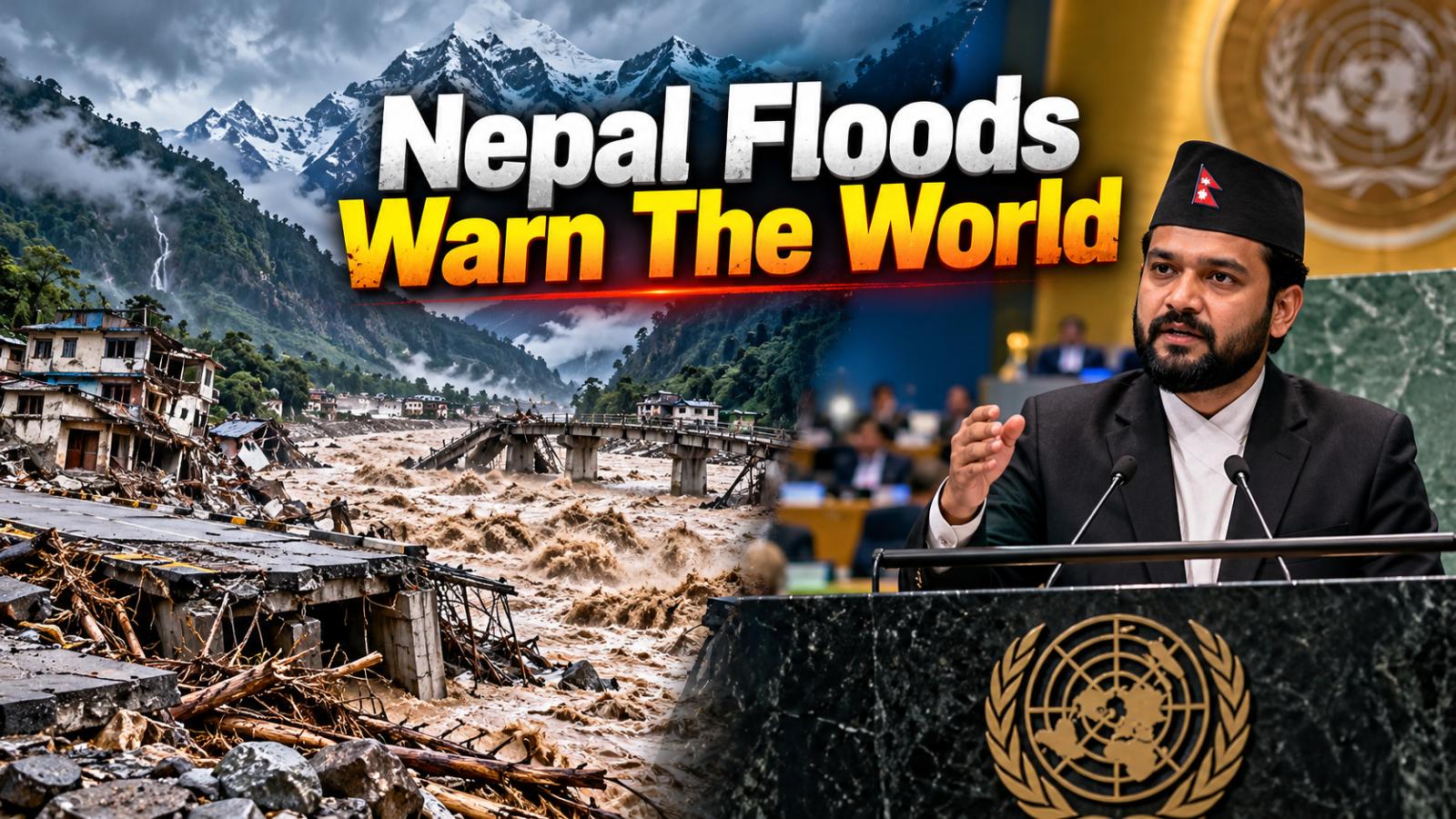
Nepal Prime Minister Balendra Shah has used the United Nations General Assembly to describe last month’s devastating floods as a warning that extends far beyond Nepal. He said rising temperatures are increasing pressure on the Himalayan environment and urged wealthier nations to help vulnerable countries finance adaptation and recovery.
Himalaya faces growing climate risk
Addressing the 81st UN General Assembly in New York, Shah said the Bhotekoshi-Trishuli disaster was “not just a local tragedy” but a warning to the world. He linked the growing danger to a warming climate that is destabilizing Himalayan ecosystems through glacier retreat and permafrost thaw.
Scientists with World Weather Attribution have also described the disaster as a compound crisis rather than a single weather event. Their analysis found that long-term warming, thinning glaciers, thawing permafrost and geological instability all contributed to the conditions behind the catastrophic collapse and flooding.
Resilience needs international support
Shah told the UN that Nepal could not build resilience alone against a crisis intensified by global climate pressures. His appeal focused on climate finance, technology, stronger early-warning systems and international support for rebuilding infrastructure capable of withstanding future disasters.
Nepal contributes only a small share of global greenhouse gas emissions but faces major risks from melting glaciers, unstable mountain slopes and extreme rainfall. That imbalance has become central to Nepal’s argument for climate justice and greater financial assistance.
Flood toll shows scale of disaster
The August 26 disaster devastated communities along Himalayan river systems, damaging homes, bridges, schools, health facilities and hydropower projects. By September 24, Nepalese reporting based on official figures put the death toll at at least 1,436, with 5,644 people still missing.
Preliminary government assessments indicate that reconstruction and rehabilitation could require between $4 billion and $5 billion, an enormous burden for Nepal’s economy. Officials have said a detailed post-disaster assessment will determine the final figure.
Loss fund becomes key test
Nepal has also sought up to $20 million in emergency assistance from the international Fund for Responding to Loss and Damage following the floods. That request remains separate from another $20 million allocation that Nepal had already secured under earlier proposals submitted to the fund.
The emergency application is significant because current funding rules generally allow individual requests of between $5 million and $20 million. Even the maximum amount, however, would cover only a small part of Nepal’s overall recovery needs.
Glacier thaw drives wider concern
The scientific findings give Nepal’s diplomatic appeal added weight. Researchers say climate change has already weakened high-altitude landscapes by thinning glaciers and thawing frozen ground, increasing the risk that natural geological instability can produce far more destructive outcomes.
For Shah, the central message at the UN was that the Nepal floods should be treated as more than a national emergency. They are also a warning about how quickly climate-driven risks can overwhelm mountain communities and how difficult recovery can become without stronger global financing, preparedness and cooperation.