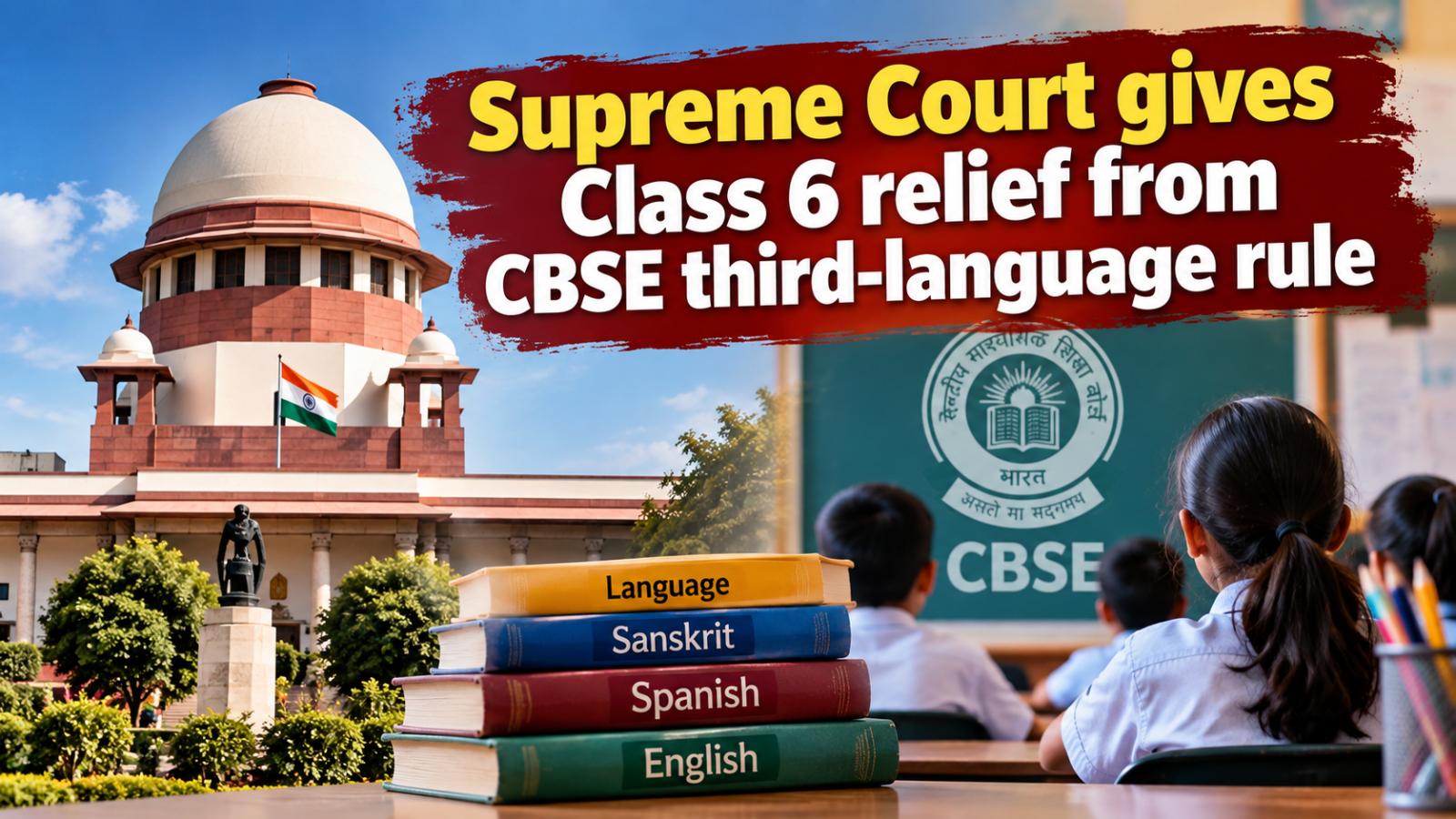
Supreme Court Class 6 CBSE third-language relief gives the current batch temporary exemption from the mandatory language rule. The court cited student comfort, while CBSE third-language policy implementation for them will begin from April 1, 2027.
The Supreme Court has directed CBSE to extend relief from the three-language requirement to students currently studying in Class 6, bringing them in line with students in Classes 7, 8 and 9 who had already received simi
Supreme Court Class 6 CBSE third-language relief gives the current batch temporary exemption from the mandatory language rule. The court cited student comfort, while CBSE third-language policy implementation for them will begin from April 1, 2027.
The Supreme Court has directed CBSE to extend relief from the three-language requirement to students currently studying in Class 6, bringing them in line with students in Classes 7, 8 and 9 who had already received simi
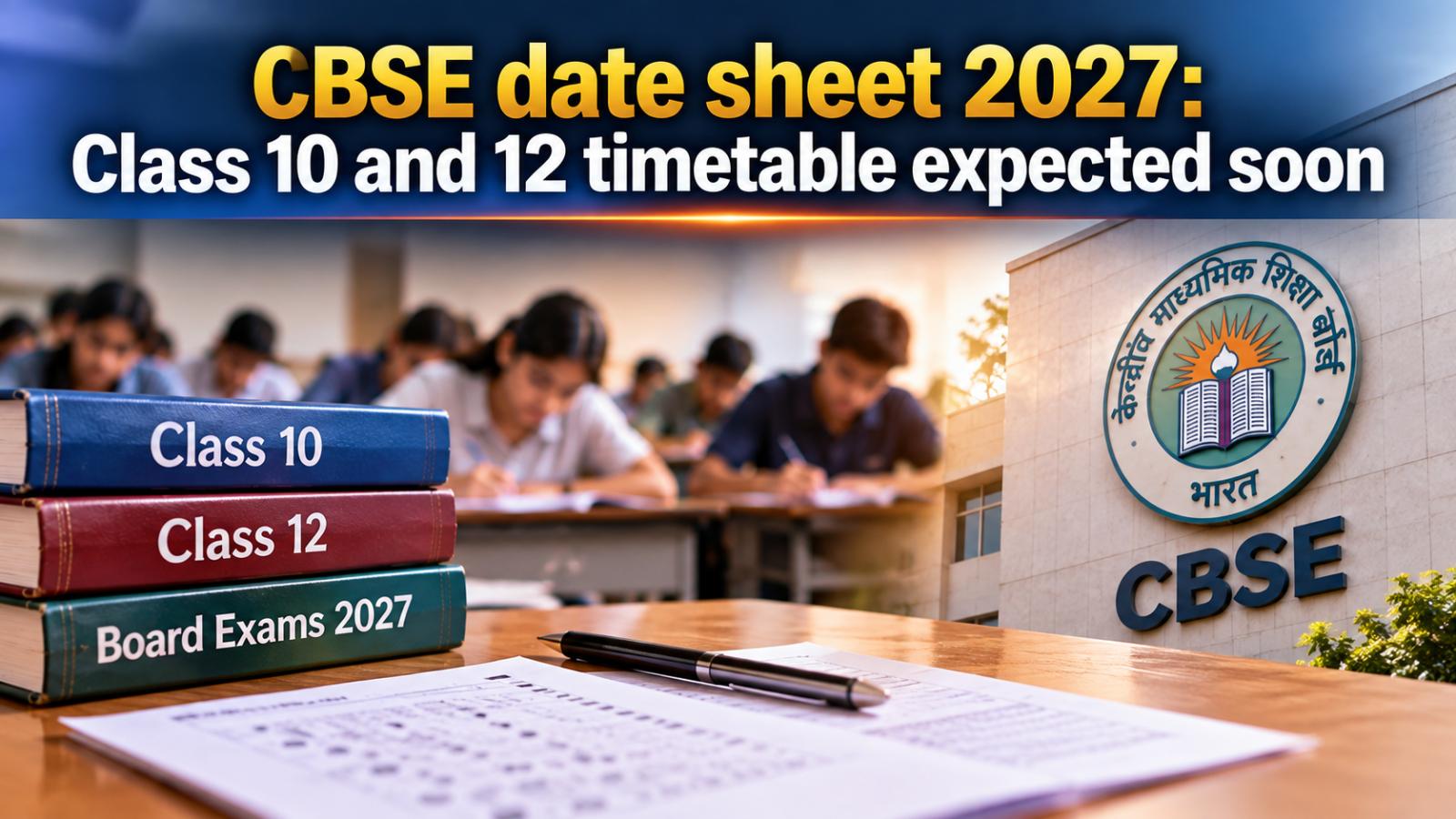
The Central Board of Secondary Education is expected to release the CBSE date sheet 2027 for Class 10 and 12 students soon on its official website, cbse.gov.in. The timetable will be an important update for lakhs of students preparing for the 2027 board examinations, as it will provide the subject-wise exam dates, paper timings, subject codes and other important instructions.
An early release of the timetable will give st
The Central Board of Secondary Education is expected to release the CBSE date sheet 2027 for Class 10 and 12 students soon on its official website, cbse.gov.in. The timetable will be an important update for lakhs of students preparing for the 2027 board examinations, as it will provide the subject-wise exam dates, paper timings, subject codes and other important instructions.
An early release of the timetable will give st
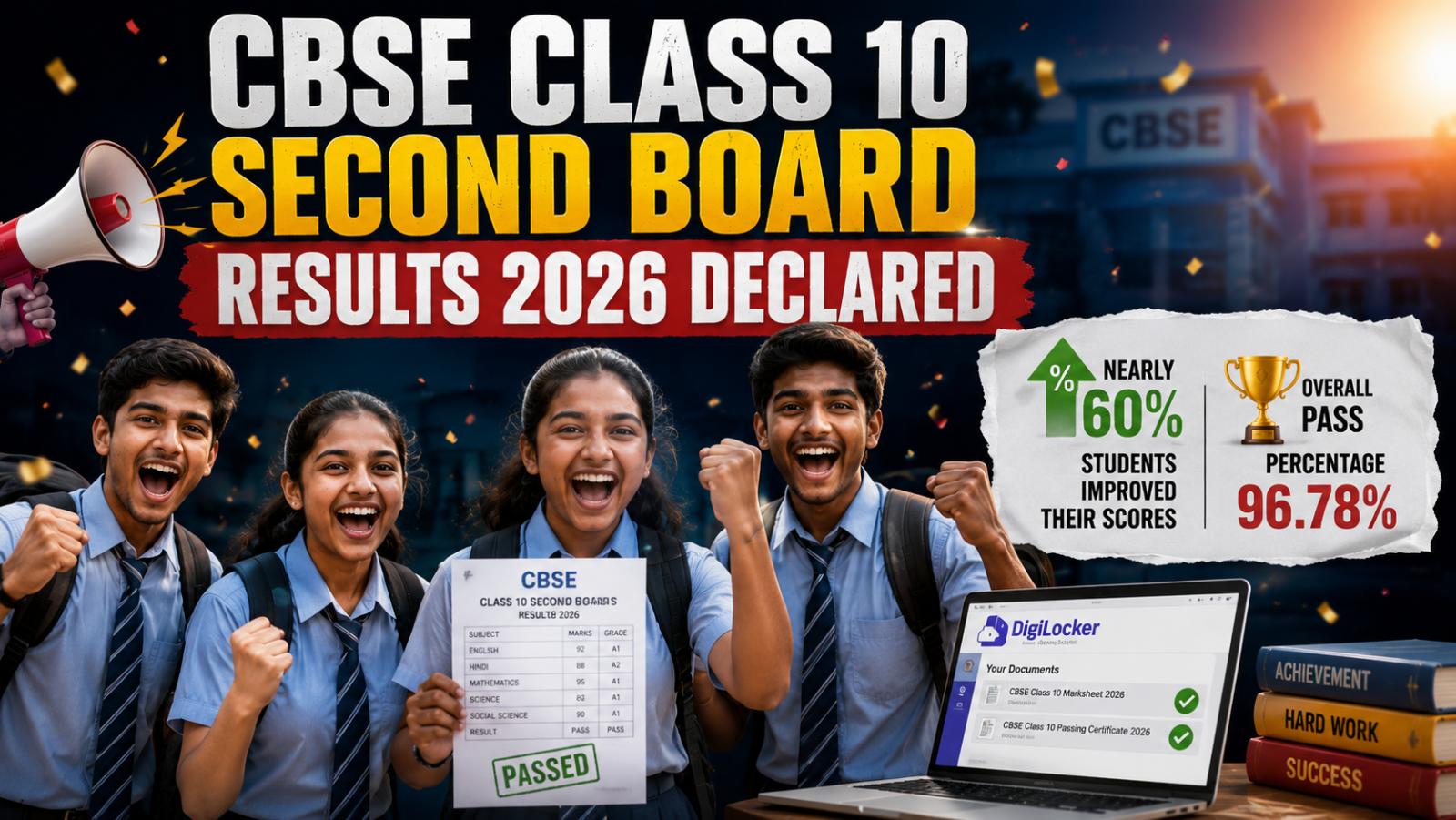
CBSE Class 10 Second Board Results 2026 have been declared, with nearly 60% of score-improvement candidates raising their marks. The combined pass percentage from the main and second examinations has reached 96.78%.
CBSE Class 10 Second Board Results 2026 Declared
The Central Board of Secondary Education has announced the CBSE Class 10 Second Board Results 2026. Introduced under the National Educat
CBSE Class 10 Second Board Results 2026 have been declared, with nearly 60% of score-improvement candidates raising their marks. The combined pass percentage from the main and second examinations has reached 96.78%.
CBSE Class 10 Second Board Results 2026 Declared
The Central Board of Secondary Education has announced the CBSE Class 10 Second Board Results 2026. Introduced under the National Educat
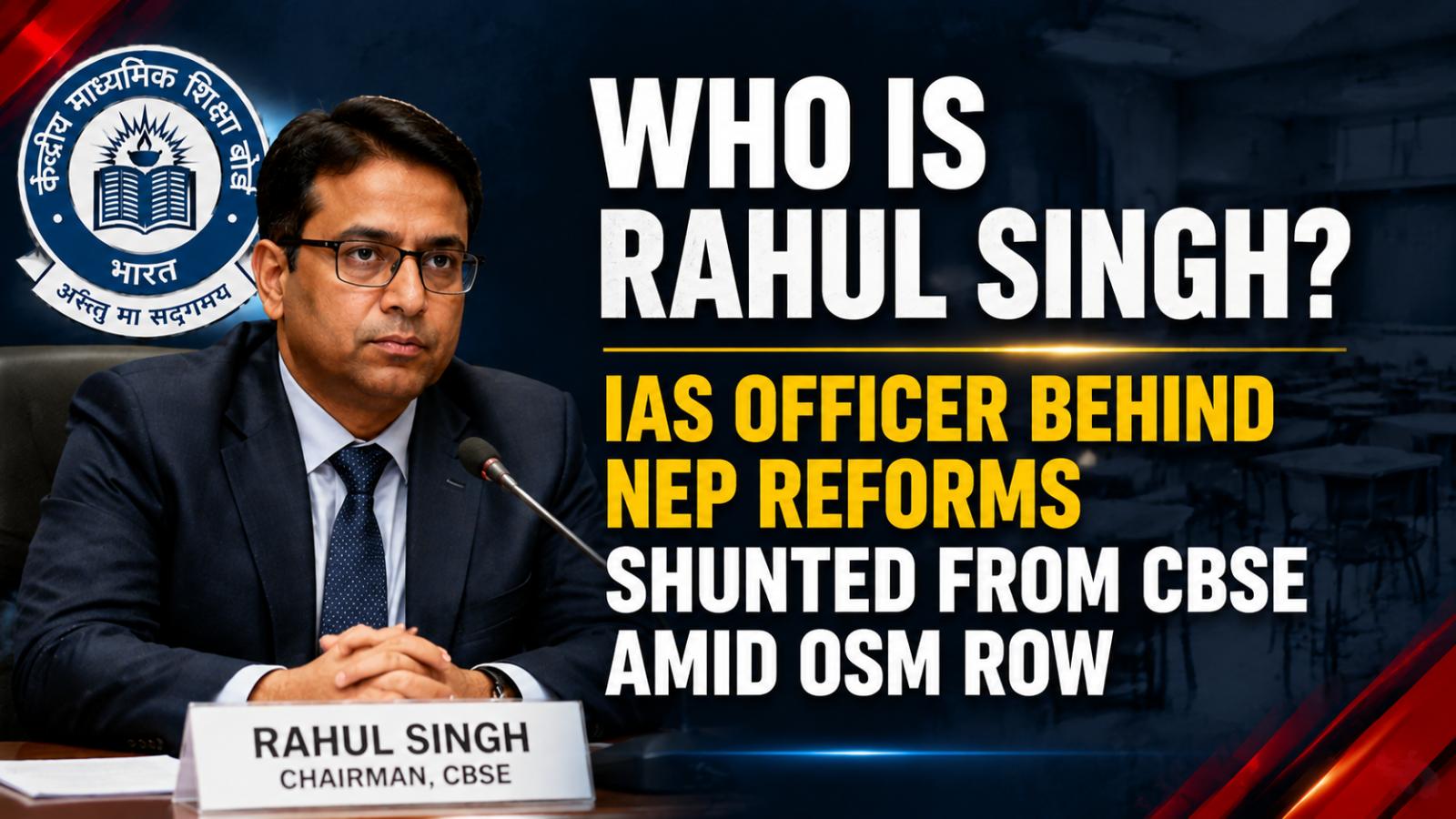
Rahul Singh, a 1996-batch IAS officer of the Bihar cadre, was removed as CBSE Chairman on June 2, 2026, following controversies around the Class 12 board exams. Singh, who assumed office in 2024, oversaw the implementation of several reforms under the National Education Policy (NEP) 2020 and the National Curriculum Framework for School Education (NCFSE).
During his tenure, Singh introduced mother tongue instruction for pre-primary to Class 5 students, in line with NEP guidance that
Rahul Singh, a 1996-batch IAS officer of the Bihar cadre, was removed as CBSE Chairman on June 2, 2026, following controversies around the Class 12 board exams. Singh, who assumed office in 2024, oversaw the implementation of several reforms under the National Education Policy (NEP) 2020 and the National Curriculum Framework for School Education (NCFSE).
During his tenure, Singh introduced mother tongue instruction for pre-primary to Class 5 students, in line with NEP guidance that
CBSE Revaluation Row Puts Digital Evaluation Under Scrutiny
CBSE’s Class 12 revaluation process is facing fresh questions after students raised concerns over answer-sheet mismatches, portal glitches, and the On-Screen Marking system. The issue began when some students claimed that scanned answer sheets shown during verification did not match their handwriting. CBSE later acknowledged discrepancies and started a review, but questions remain over how the mix-up ha
CBSE Revaluation Row Puts Digital Evaluation Under Scrutiny
CBSE’s Class 12 revaluation process is facing fresh questions after students raised concerns over answer-sheet mismatches, portal glitches, and the On-Screen Marking system. The issue began when some students claimed that scanned answer sheets shown during verification did not match their handwriting. CBSE later acknowledged discrepancies and started a review, but questions remain over how the mix-up ha
The Central Board of Secondary Education (CBSE) has taken a significant step towards modernizing India’s education system by introducing artificial intelligence learning for students starting from Class 3. This move reflects the growing importance of digital literacy and emerging technologies in shaping the future workforce. By incorporating AI concepts at an early stage, CBSE aims to ensure that students are not just consumers of technology but also understand its fundamentals and applications. The initiative is part of a broader effort to align school education with global technological trends and prepare students for a rapidly evolving digital world.
Under this new curriculum, young learners will be introduced to basic concepts of artificial intelligence through interactive and activity-based learning methods. Instead of complex coding, the focus will be on developing logical thinking, problem-solving skills, and an understanding of how AI impacts everyday life. Students will engage in simple exercises, games, and real-life examples to grasp how machines can learn and make decisions. This foundational approach ensures that children build curiosity and confidence in technology without feeling overwhelmed.
Curriculum Focus and Implementation
The AI curriculum for primary classes is designed to be age-appropriate and engaging. CBSE has collaborated with education experts and technology partners to create content that is both informative and easy to understand. Teachers will also receive specialized training to effectively deliver AI-related lessons in classrooms. The board plans to integrate AI topics with existing subjects, making learning more interdisciplinary and practical. This approach will help students connect theoretical knowledge with real-world applications, enhancing their overall learning experience.
Impact on Students and Future Education
Introducing AI learning at an early stage is expected to have a long-term impact on students’ academic and career paths. As industries increasingly rely on automation and data-driven technologies, early exposure to AI will give students a competitive edge. It will also encourage innovation and creativity among young minds, enabling them to think beyond traditional career options. Parents and educators have largely welcomed this move, seeing it as a progressive step toward building a tech-savvy generation.
With this initiative, CBSE reinforces its commitment to evolving education standards and preparing students for the challenges of the future. The inclusion of artificial intelligence in the curriculum marks a shift from rote learning to skill-based education, ensuring that students are better equipped to navigate and contribute to a technology-driven world.
The Central Board of Secondary Education (CBSE) has taken a significant step towards modernizing India’s education system by introducing artificial intelligence learning for students starting from Class 3. This move reflects the growing importance of digital literacy and emerging technologies in shaping the future workforce. By incorporating AI concepts at an early stage, CBSE aims to ensure that students are not just consumers of technology but also understand its fundamentals and applications. The initiative is part of a broader effort to align school education with global technological trends and prepare students for a rapidly evolving digital world.
Under this new curriculum, young learners will be introduced to basic concepts of artificial intelligence through interactive and activity-based learning methods. Instead of complex coding, the focus will be on developing logical thinking, problem-solving skills, and an understanding of how AI impacts everyday life. Students will engage in simple exercises, games, and real-life examples to grasp how machines can learn and make decisions. This foundational approach ensures that children build curiosity and confidence in technology without feeling overwhelmed.
Curriculum Focus and Implementation
The AI curriculum for primary classes is designed to be age-appropriate and engaging. CBSE has collaborated with education experts and technology partners to create content that is both informative and easy to understand. Teachers will also receive specialized training to effectively deliver AI-related lessons in classrooms. The board plans to integrate AI topics with existing subjects, making learning more interdisciplinary and practical. This approach will help students connect theoretical knowledge with real-world applications, enhancing their overall learning experience.
Impact on Students and Future Education
Introducing AI learning at an early stage is expected to have a long-term impact on students’ academic and career paths. As industries increasingly rely on automation and data-driven technologies, early exposure to AI will give students a competitive edge. It will also encourage innovation and creativity among young minds, enabling them to think beyond traditional career options. Parents and educators have largely welcomed this move, seeing it as a progressive step toward building a tech-savvy generation.
With this initiative, CBSE reinforces its commitment to evolving education standards and preparing students for the challenges of the future. The inclusion of artificial intelligence in the curriculum marks a shift from rote learning to skill-based education, ensuring that students are better equipped to navigate and contribute to a technology-driven world.
Rising school fees are quickly becoming the biggest financial burden on India’s middle-class families. Ashish Singhal, co-founder of CoinSwitch and Lemonn, recently voiced his concerns on LinkedIn, calling the current fee structure “theft” and warning of a brewing crisis. “Parents are now taking EMIs for nursery,” he noted, adding that in Bengaluru, CBSE schools not international ones are charging up to ₹2.1 lakh for 3rd standar
Rising school fees are quickly becoming the biggest financial burden on India’s middle-class families. Ashish Singhal, co-founder of CoinSwitch and Lemonn, recently voiced his concerns on LinkedIn, calling the current fee structure “theft” and warning of a brewing crisis. “Parents are now taking EMIs for nursery,” he noted, adding that in Bengaluru, CBSE schools not international ones are charging up to ₹2.1 lakh for 3rd standar
In a major overhaul of its evaluation process, the Central Board of Secondary Education (CBSE) has officially implemented a relative grading system for Class 10 and 12 board examinations starting with the 2024 batch. This significant reform moves away from the traditional absolute marking method and aims to bring fairness, reduce student stress, and align Indian academic assessments with international practices.
Under the relative grading model, students' performance is assessed
In a major overhaul of its evaluation process, the Central Board of Secondary Education (CBSE) has officially implemented a relative grading system for Class 10 and 12 board examinations starting with the 2024 batch. This significant reform moves away from the traditional absolute marking method and aims to bring fairness, reduce student stress, and align Indian academic assessments with international practices.
Under the relative grading model, students' performance is assessed
Exam Commencement and Details:
The CBSE Class 10 and Class 12 board exams for 2025 will begin on February 15.
Around 42 lakh students are expected to appear for the exams across India and 26 countries abroad.
A live webcast on February 14 will guide exam officials about the procedures, while also informing students about the exam requirements.
Exam Schedule and Subject Information:
Exam Commencement and Details:
The CBSE Class 10 and Class 12 board exams for 2025 will begin on February 15.
Around 42 lakh students are expected to appear for the exams across India and 26 countries abroad.
A live webcast on February 14 will guide exam officials about the procedures, while also informing students about the exam requirements.
Exam Schedule and Subject Information:
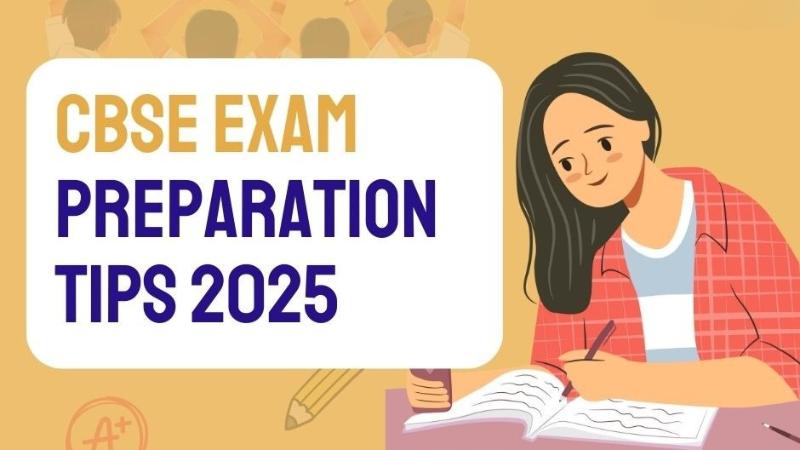
The Central Board of Secondary Education (CBSE) will begin the 2025 Class 10 and 12 board examinations on February 15. The exams will start at 10.30 am, and this year’s datesheet has been designed to help students manage both board and entrance exam schedules effectively. To reduce stress, CBSE has included sufficient gaps between exams for students taking common subjects, ensuring no overlap with Class 12 entrance exams.
Preparation Tips for Students:
The Central Board of Secondary Education (CBSE) will begin the 2025 Class 10 and 12 board examinations on February 15. The exams will start at 10.30 am, and this year’s datesheet has been designed to help students manage both board and entrance exam schedules effectively. To reduce stress, CBSE has included sufficient gaps between exams for students taking common subjects, ensuring no overlap with Class 12 entrance exams.
Preparation Tips for Students:
CTET 2024 Answer Key Release Details
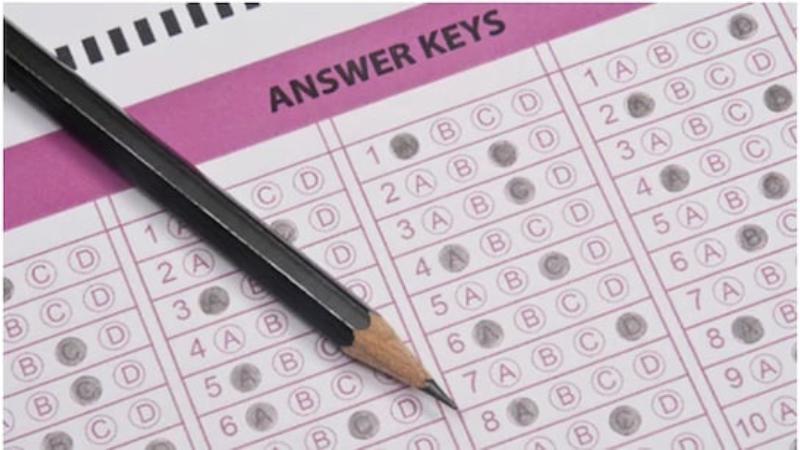
The Central Teacher Eligibility Test (CTET) 2024 answer key is expected to be released by the Central Board of Secondary Education (CBSE) on January 1 or 2, 2025. Candidates who appeared for the exam can access the answer key and their response sheets via the official CTET website. If they find any discrepancies or errors, candidates will have the opportunity to raise objections.
Steps to Check the CTET Answer Key
To
CTET 2024 Answer Key Release Details
The Central Teacher Eligibility Test (CTET) 2024 answer key is expected to be released by the Central Board of Secondary Education (CBSE) on January 1 or 2, 2025. Candidates who appeared for the exam can access the answer key and their response sheets via the official CTET website. If they find any discrepancies or errors, candidates will have the opportunity to raise objections.
Steps to Check the CTET Answer Key
To