







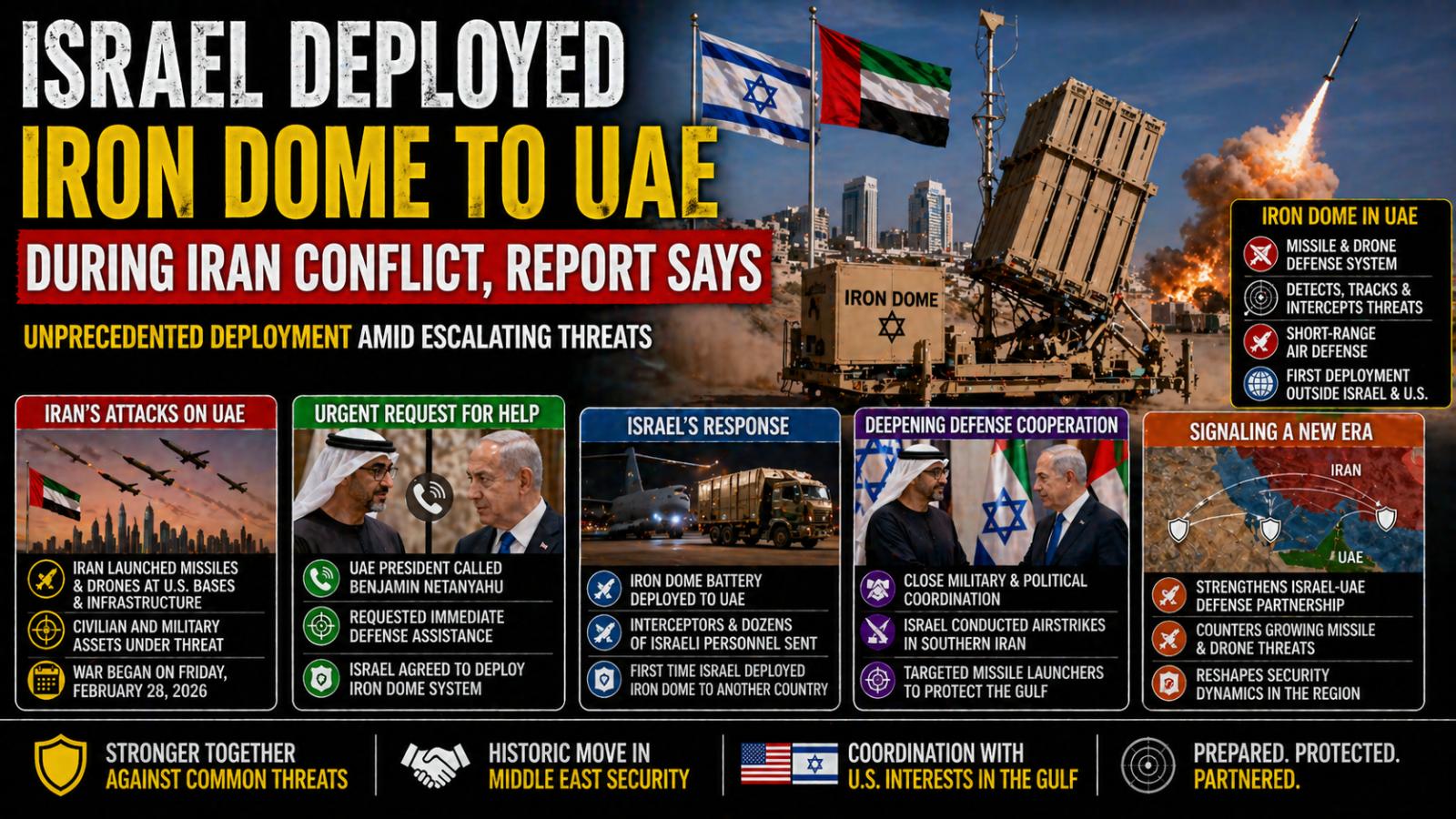
Israel deployed Iron Dome to UAE during Iran conflict, report says
Israel deployed Iron Dome to UAE during Iran conflict, report says, underscoring a previously undisclosed military move that signals deepening defense cooperation between the two countries during heightened tensions in the Gulf. According to a report citing U.S. and Israeli officials, the deployment occurred in the early phase of the war that began on Friday, February 28, 2026, when the United Arab Emirate
Israel deployed Iron Dome to UAE during Iran conflict, report says
Israel deployed Iron Dome to UAE during Iran conflict, report says, underscoring a previously undisclosed military move that signals deepening defense cooperation between the two countries during heightened tensions in the Gulf. According to a report citing U.S. and Israeli officials, the deployment occurred in the early phase of the war that began on Friday, February 28, 2026, when the United Arab Emirate
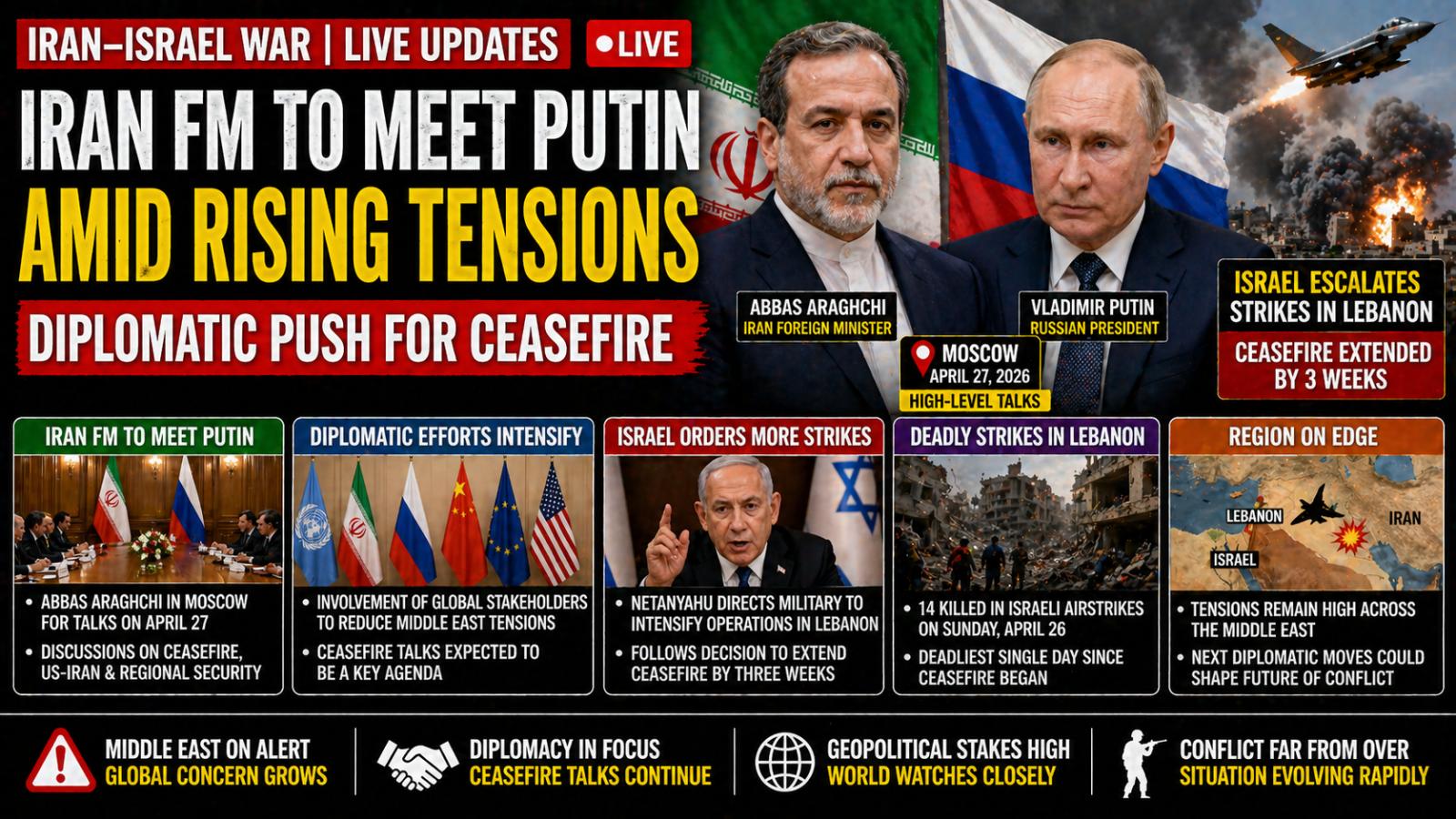
Iran-Israel war live updates: Iran FM to meet Putin amid rising tensions
Iran’s foreign minister Abbas Araghchi meets Vladimir Putin in Moscow on Monday, April 27, for ceasefire talks as Israel intensifies strikes on Hezbollah in Lebanon, where 14 were killed Sunday, April 26, marking the deadliest day since the truce began. Iran-Israel war live updates: Iran FM to meet Putin amid rising tensions as Abbas Araghchi prepares for high-level tal
Iran-Israel war live updates: Iran FM to meet Putin amid rising tensions
Iran’s foreign minister Abbas Araghchi meets Vladimir Putin in Moscow on Monday, April 27, for ceasefire talks as Israel intensifies strikes on Hezbollah in Lebanon, where 14 were killed Sunday, April 26, marking the deadliest day since the truce began. Iran-Israel war live updates: Iran FM to meet Putin amid rising tensions as Abbas Araghchi prepares for high-level tal
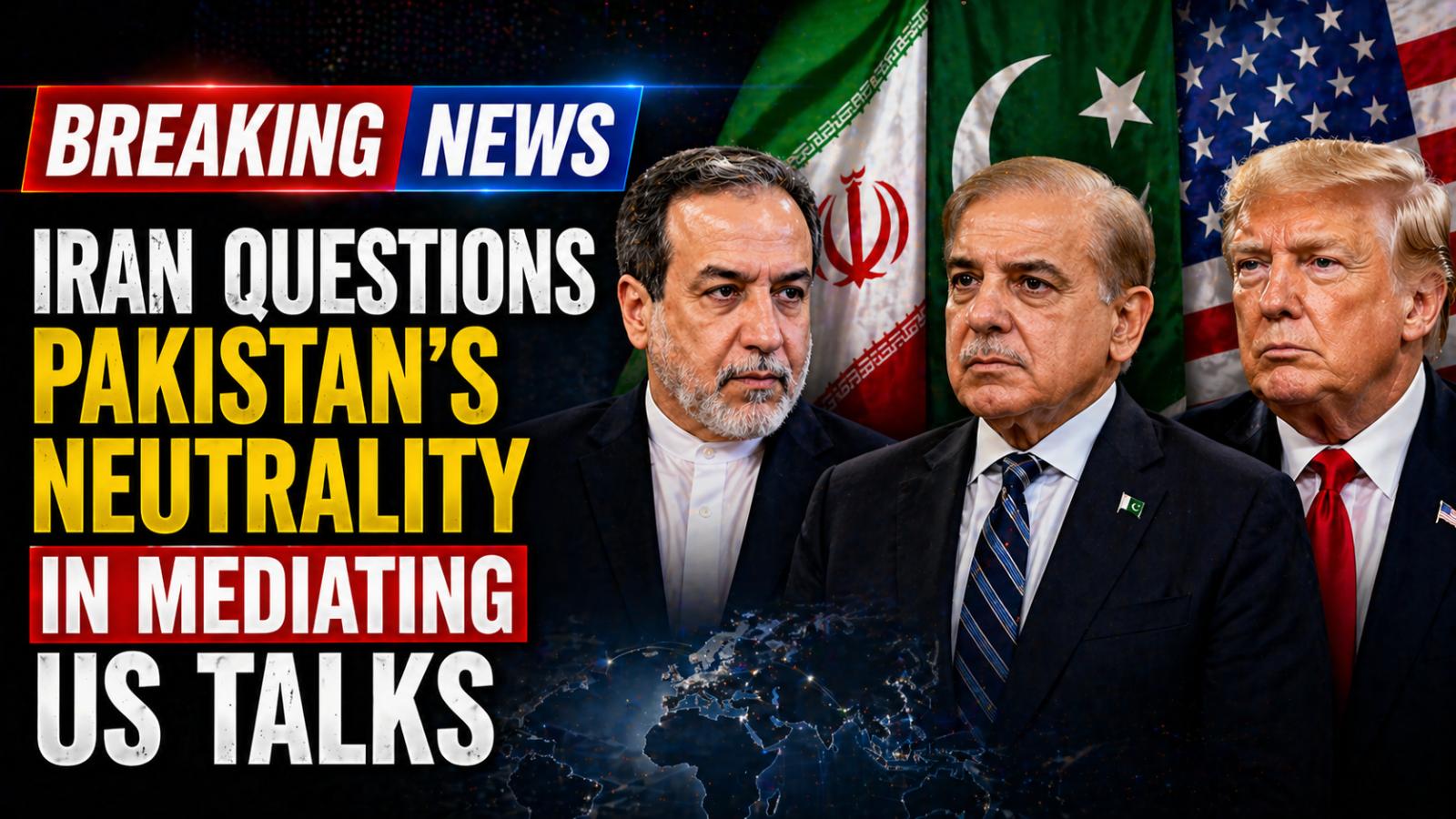
Tehran Raises Doubts Over Pakistan Role in US-Iran Negotiations
Iran has raised concerns about Pakistan’s role as a mediator in ongoing diplomatic efforts with the United States, with officials questioning Islamabad’s neutrality. Ebrahim Rezaei, spokesperson for Iran’s National Security and Foreign Policy Commission, said Pakistan lacks the credibility required to act as an impartial intermediary in sensitive negotiations. Rezaei argued that Paki
Tehran Raises Doubts Over Pakistan Role in US-Iran Negotiations
Iran has raised concerns about Pakistan’s role as a mediator in ongoing diplomatic efforts with the United States, with officials questioning Islamabad’s neutrality. Ebrahim Rezaei, spokesperson for Iran’s National Security and Foreign Policy Commission, said Pakistan lacks the credibility required to act as an impartial intermediary in sensitive negotiations. Rezaei argued that Paki
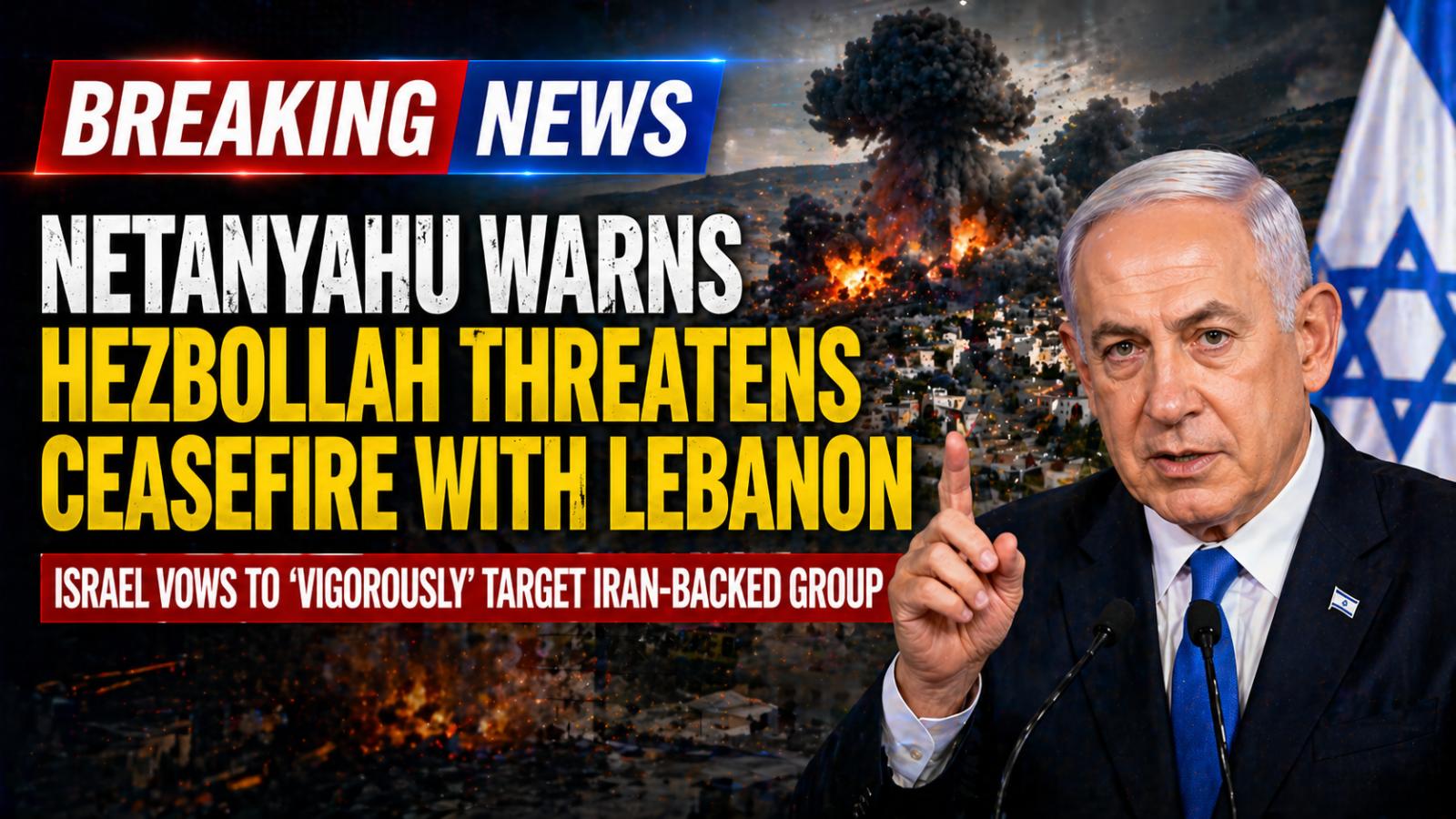
Israel Accuses Hezbollah of Violating Ceasefire Amid Rising Tensions
Israeli Prime Minister Benjamin Netanyahu has warned that ongoing actions by Hezbollah are placing the fragile ceasefire between Israel and Lebanon under increasing strain. Speaking during a weekly Cabinet meeting, Netanyahu stated that repeated violations by the Iran-backed group were effectively undermining the agreement intended to reduce hostilities along the border. In a separate statement, the Israeli military said recent activity attributed to Hezbollah represented a direct breach of ceasefire understandings. The Israel Defense Forces confirmed that it conducted overnight strikes on multiple structures in southern Lebanon, describing them as locations used by Hezbollah for operational purposes. These developments come amid heightened tensions despite ongoing diplomatic efforts to stabilize the region. The ceasefire arrangement, initially agreed upon for a limited period, was recently extended following discussions in Washington. During those talks, US President Donald Trump described the negotiations as productive, while acknowledging the complexities posed by Hezbollah’s involvement. The agreement aimed to provide additional time for de-escalation and further dialogue between the parties. Despite these efforts, reports of violations have continued to emerge from both sides since the truce came into effect. The situation remains fluid, with both Israel and Hezbollah accusing each other of actions that could destabilize the agreement. The initial ceasefire period, originally set to expire soon after its implementation, has faced mounting challenges as regional dynamics continue to shift. Observers note that the involvement of Iran-backed forces and the broader geopolitical context add complexity to maintaining the ceasefire. With both sides remaining on alert, the risk of escalation persists, even as diplomatic channels remain open.
Israel Accuses Hezbollah of Violating Ceasefire Amid Rising Tensions
Israeli Prime Minister Benjamin Netanyahu has warned that ongoing actions by Hezbollah are placing the fragile ceasefire between Israel and Lebanon under increasing strain. Speaking during a weekly Cabinet meeting, Netanyahu stated that repeated violations by the Iran-backed group were effectively undermining the agreement intended to reduce hostilities along the border. In a separate statement, the Israeli military said recent activity attributed to Hezbollah represented a direct breach of ceasefire understandings. The Israel Defense Forces confirmed that it conducted overnight strikes on multiple structures in southern Lebanon, describing them as locations used by Hezbollah for operational purposes. These developments come amid heightened tensions despite ongoing diplomatic efforts to stabilize the region. The ceasefire arrangement, initially agreed upon for a limited period, was recently extended following discussions in Washington. During those talks, US President Donald Trump described the negotiations as productive, while acknowledging the complexities posed by Hezbollah’s involvement. The agreement aimed to provide additional time for de-escalation and further dialogue between the parties. Despite these efforts, reports of violations have continued to emerge from both sides since the truce came into effect. The situation remains fluid, with both Israel and Hezbollah accusing each other of actions that could destabilize the agreement. The initial ceasefire period, originally set to expire soon after its implementation, has faced mounting challenges as regional dynamics continue to shift. Observers note that the involvement of Iran-backed forces and the broader geopolitical context add complexity to maintaining the ceasefire. With both sides remaining on alert, the risk of escalation persists, even as diplomatic channels remain open.
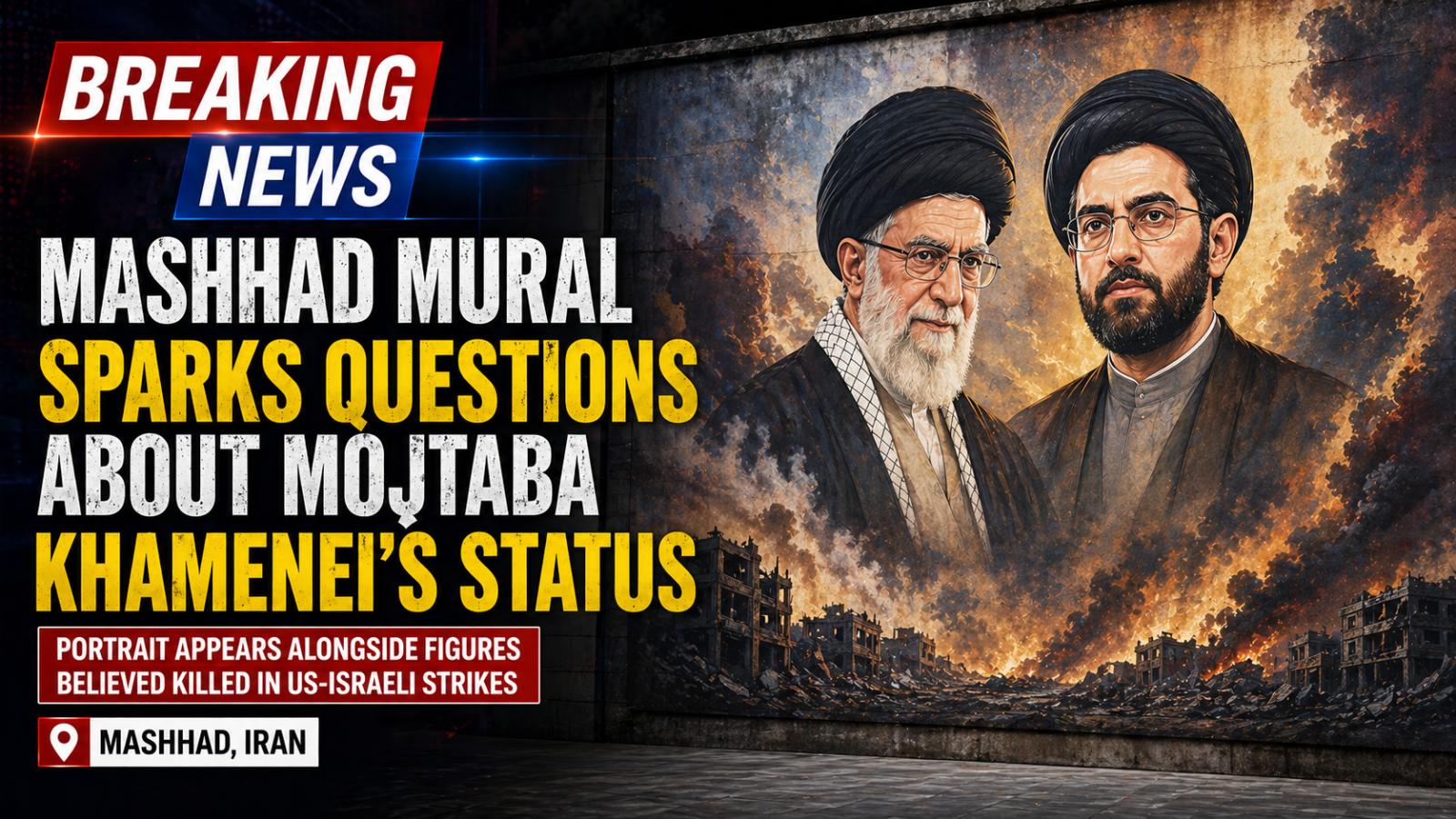
Iran Mural Raises Speculation Over Mojtaba Khamenei Health Condition
A newly unveiled mural in Mashhad, Iran, has drawn attention and sparked renewed speculation about the status of Mojtaba Khamenei, a key figure in Iran’s leadership. The artwork, revealed during a public ceremony attended by officials, features his portrait alongside several military and political figures believed to have died in recent US-Israeli airstrikes. The inclusion has prompted questions, as such murals in Iran are typically used to honor individuals associated with significan
Iran Mural Raises Speculation Over Mojtaba Khamenei Health Condition
A newly unveiled mural in Mashhad, Iran, has drawn attention and sparked renewed speculation about the status of Mojtaba Khamenei, a key figure in Iran’s leadership. The artwork, revealed during a public ceremony attended by officials, features his portrait alongside several military and political figures believed to have died in recent US-Israeli airstrikes. The inclusion has prompted questions, as such murals in Iran are typically used to honor individuals associated with significan
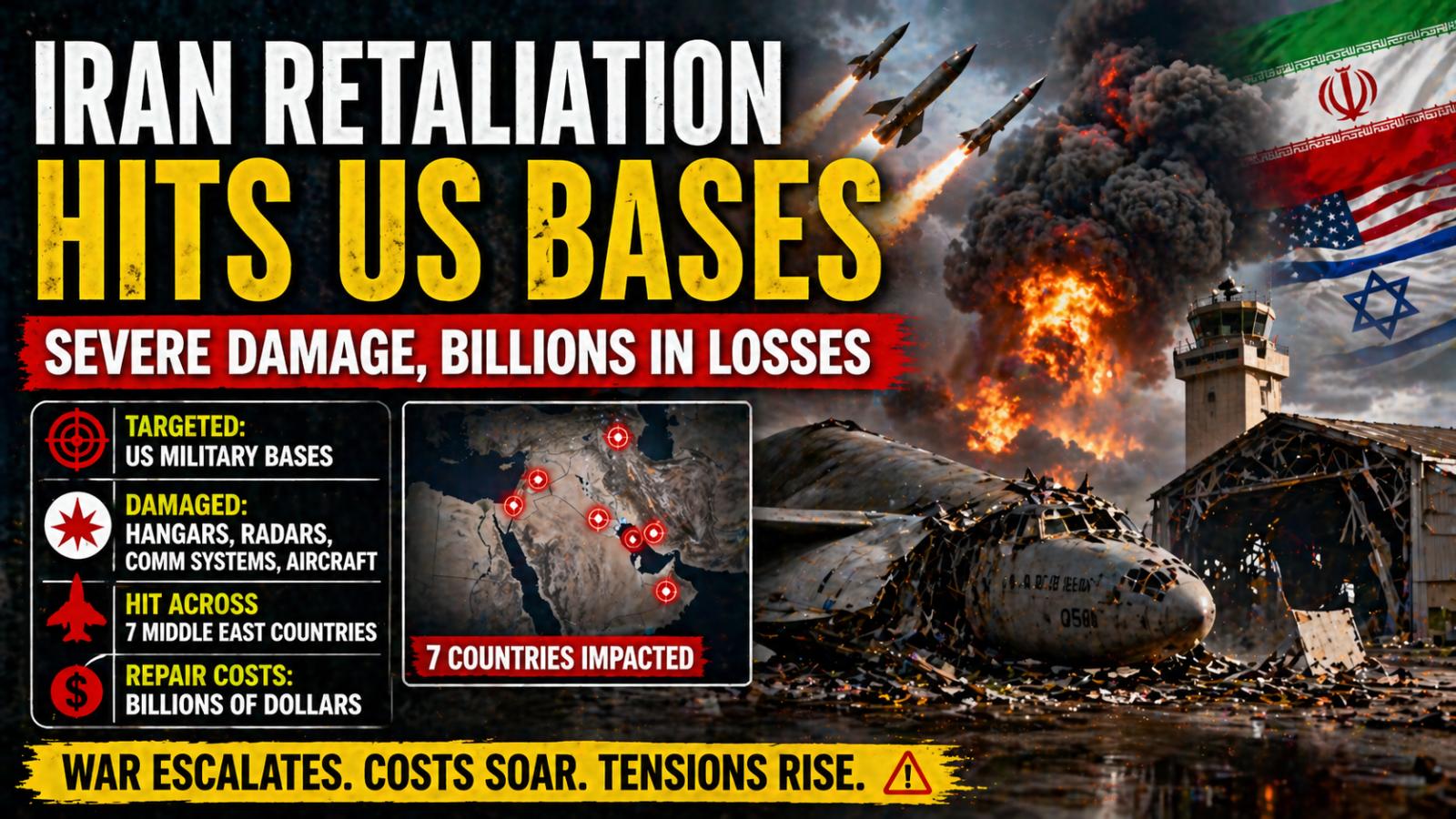
What damage did Iran war cause? US bases hit hard after airstrikes
The Iran war, which began on Friday, February 28, 2026, following joint airstrikes by the United States and Israel, has led to widespread infrastructure destruction across Iran while also triggering significant retaliation. New reporting indicates that Iranian counterattacks have caused extensive damage to US military installations across the Middle East, raising concerns about escalating defense costs and regional instability. Escalation after joint US-Israel airstrikes on
What damage did Iran war cause? US bases hit hard after airstrikes
The Iran war, which began on Friday, February 28, 2026, following joint airstrikes by the United States and Israel, has led to widespread infrastructure destruction across Iran while also triggering significant retaliation. New reporting indicates that Iranian counterattacks have caused extensive damage to US military installations across the Middle East, raising concerns about escalating defense costs and regional instability. Escalation after joint US-Israel airstrikes on
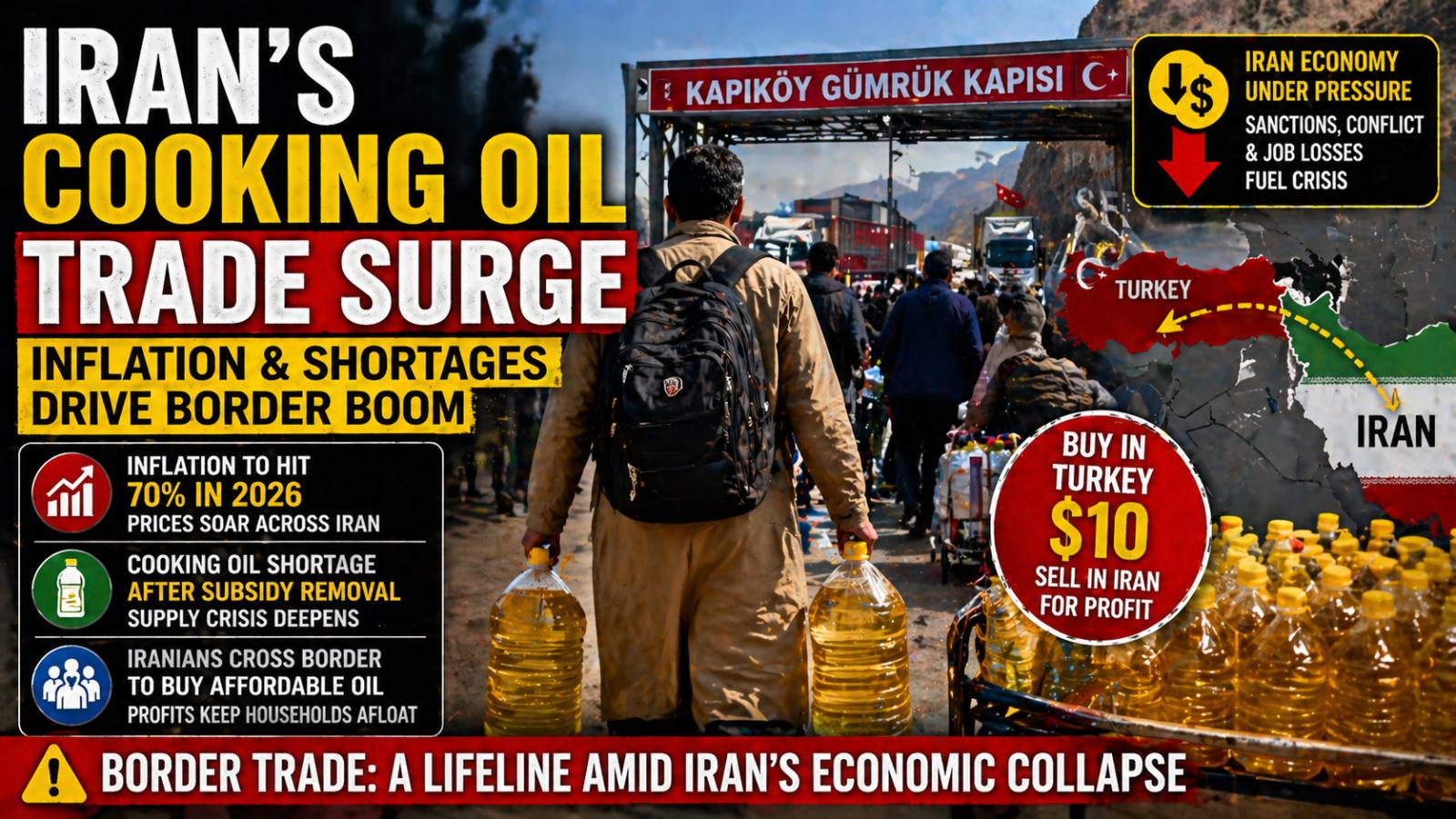
What is driving Iran’s cooking oil trade surge? Inflation and shortages at the border
On Turkey’s bustling border crossing with Iran, inflation and shortages are driving a surge in cooking oil trade as economic pressures deepen inside Iran. At the Kapikoy crossing near Van in eastern Turkey, merchants and travelers described a growing demand for basic goods, particularly cooking oil, as Iranian consumers grapple with soaring prices and limited supply. Shopkeepers at the crossing said demand has risen sharply in recent days, with dozens of individuals carrying multiple large bottles of oil back into Iran. The trade has become a small but vital source of income for both Turkish vendors and Iranian buyers seeking to resell or use the goods domestically. Rising food prices and subsidy reforms reshape consumer behavior Iran’s inflation crisis, projected by the International Monetary Fund to approach 70 percent in 2026, has significantly eroded purchasing power. Cooking oil prices surged after the government removed subsidies on certain essential imports in January, a move intended to reduce state spending amid ongoing sanctions. Iranian officials, including President Masoud Pezeshkian, have defended the policy, arguing that subsidies were being exploited without effectively lowering prices. However, many consumers report difficulty finding affordable cooking oil in local markets, forcing them to look beyond the country’s borders. Border trade becomes a lifeline for struggling households For some Iranians, cross-border trade offers a modest financial cushion. Individuals interviewed at the crossing described buying cooking oil in Turkey for just over $10 per five-liter bottle and reselling it in Iran at slightly lower prices than domestic shops, earning small profits. The Kapikoy crossing has remained one of the few consistent links between Iran and the outside world during recent disruptions, including airspace closures and an ongoing internet shutdown that has limited access to information within the country. Economic strain intensifies amid conflict and job losses Beyond inflation, Iran’s economy is facing additional strain from conflict-related disruptions and layoffs. The country’s minimum wage, roughly $108 per month, has failed to keep pace with rising living costs, leaving many households under severe financial pressure. Recent protests driven by economic discontent have been met with government crackdowns, adding to an atmosphere of uncertainty. While the government has introduced monthly cash payments equivalent to about $7 to offset rising costs, analysts say the measure is unlikely to significantly ease the burden on most families. Limited relief despite growing cross-border activity Although the increase in cross-border trade highlights the resilience of individuals adapting to economic hardship, the overall impact remains limited. The modest profits generated by transporting goods like cooking oil do little to offset the broader challenges posed by inflation, unemployment, and supply shortages. For many Iranians, the scenes at the Turkey-Iran border underscore a deeper economic crisis, where even basic necessities require creative—and often difficult—solutions to obtain.
What is driving Iran’s cooking oil trade surge? Inflation and shortages at the border
On Turkey’s bustling border crossing with Iran, inflation and shortages are driving a surge in cooking oil trade as economic pressures deepen inside Iran. At the Kapikoy crossing near Van in eastern Turkey, merchants and travelers described a growing demand for basic goods, particularly cooking oil, as Iranian consumers grapple with soaring prices and limited supply. Shopkeepers at the crossing said demand has risen sharply in recent days, with dozens of individuals carrying multiple large bottles of oil back into Iran. The trade has become a small but vital source of income for both Turkish vendors and Iranian buyers seeking to resell or use the goods domestically. Rising food prices and subsidy reforms reshape consumer behavior Iran’s inflation crisis, projected by the International Monetary Fund to approach 70 percent in 2026, has significantly eroded purchasing power. Cooking oil prices surged after the government removed subsidies on certain essential imports in January, a move intended to reduce state spending amid ongoing sanctions. Iranian officials, including President Masoud Pezeshkian, have defended the policy, arguing that subsidies were being exploited without effectively lowering prices. However, many consumers report difficulty finding affordable cooking oil in local markets, forcing them to look beyond the country’s borders. Border trade becomes a lifeline for struggling households For some Iranians, cross-border trade offers a modest financial cushion. Individuals interviewed at the crossing described buying cooking oil in Turkey for just over $10 per five-liter bottle and reselling it in Iran at slightly lower prices than domestic shops, earning small profits. The Kapikoy crossing has remained one of the few consistent links between Iran and the outside world during recent disruptions, including airspace closures and an ongoing internet shutdown that has limited access to information within the country. Economic strain intensifies amid conflict and job losses Beyond inflation, Iran’s economy is facing additional strain from conflict-related disruptions and layoffs. The country’s minimum wage, roughly $108 per month, has failed to keep pace with rising living costs, leaving many households under severe financial pressure. Recent protests driven by economic discontent have been met with government crackdowns, adding to an atmosphere of uncertainty. While the government has introduced monthly cash payments equivalent to about $7 to offset rising costs, analysts say the measure is unlikely to significantly ease the burden on most families. Limited relief despite growing cross-border activity Although the increase in cross-border trade highlights the resilience of individuals adapting to economic hardship, the overall impact remains limited. The modest profits generated by transporting goods like cooking oil do little to offset the broader challenges posed by inflation, unemployment, and supply shortages. For many Iranians, the scenes at the Turkey-Iran border underscore a deeper economic crisis, where even basic necessities require creative—and often difficult—solutions to obtain.
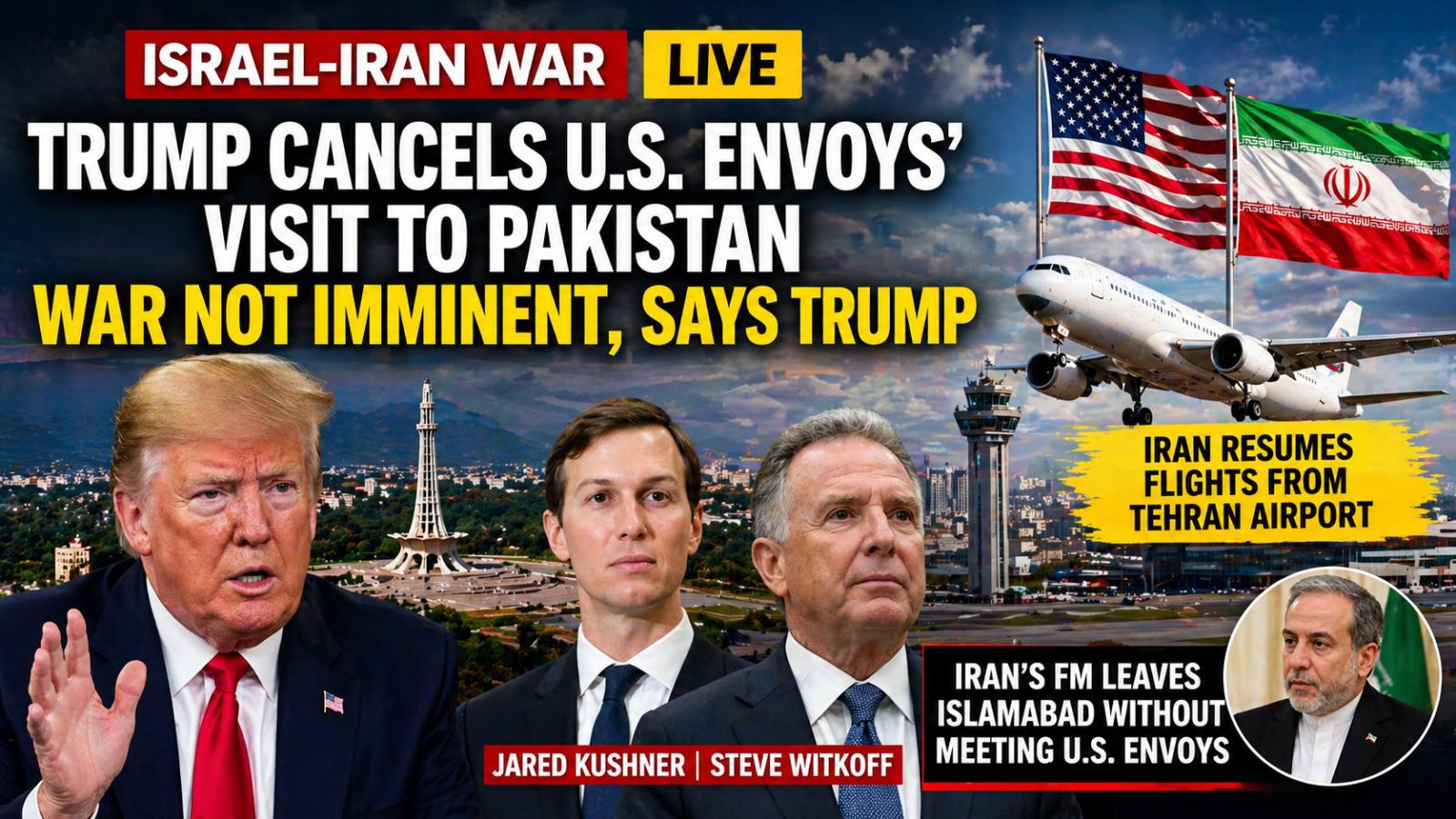
Israel-Iran War LIVE: Trump Cancels Pakistan Talks, Says War Not Imminent
U.S. President Donald Trump has cancelled a planned visit by American envoys to Pakistan for talks with Iran, in a move that raises fresh uncertainty around ongoing diplomatic efforts tied to the Israel-Iran conflict. According to reports , the cancelled trip would have involved senior envoys
Israel-Iran War LIVE: Trump Cancels Pakistan Talks, Says War Not Imminent
U.S. President Donald Trump has cancelled a planned visit by American envoys to Pakistan for talks with Iran, in a move that raises fresh uncertainty around ongoing diplomatic efforts tied to the Israel-Iran conflict. According to reports , the cancelled trip would have involved senior envoys
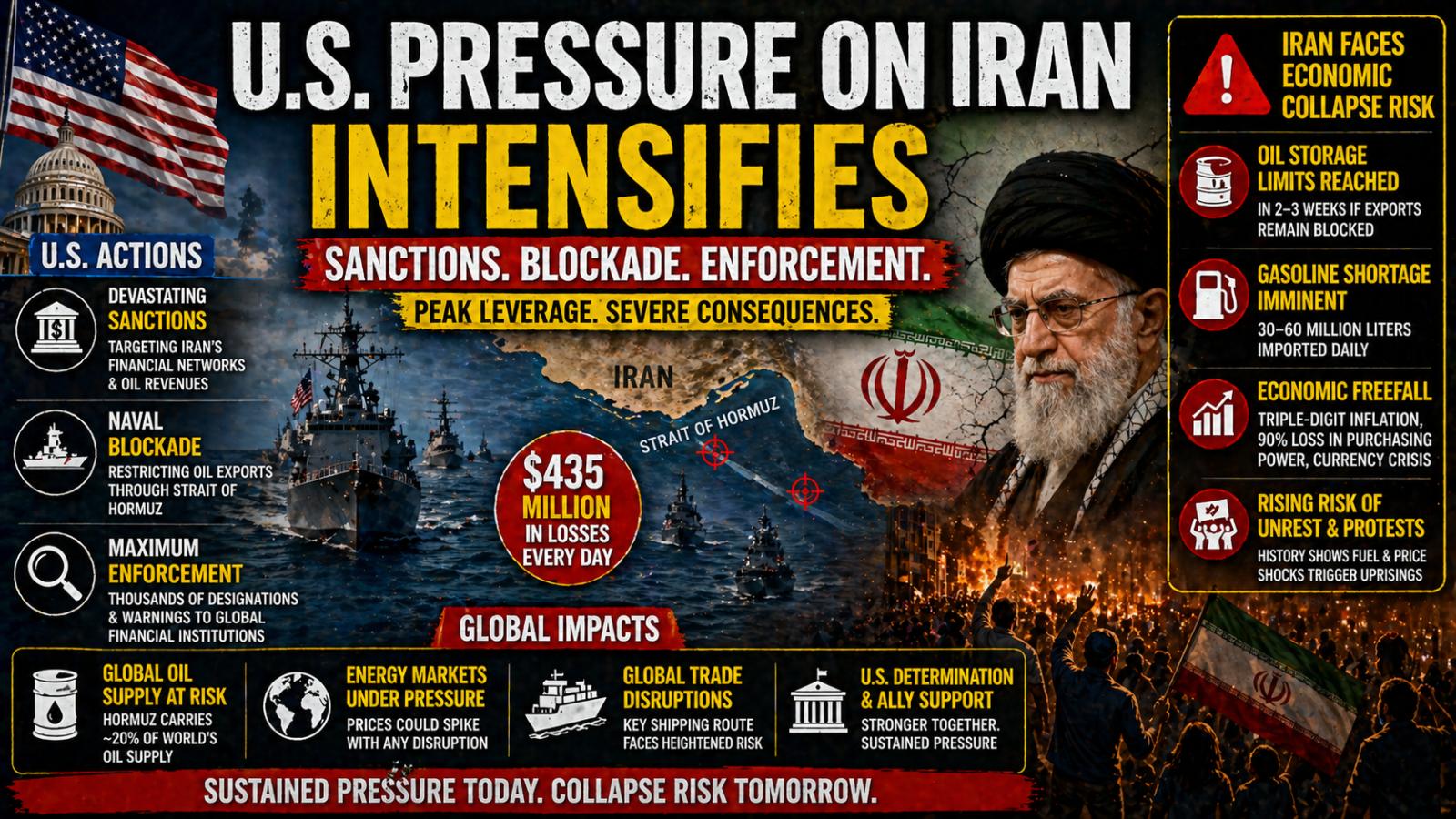
How is U.S. pressure on Iran intensifying? It combines sanctions, blockade, and enforcement
How is U.S. pressure on Iran intensifying? It combines sanctions, blockade, and enforcement as economic and geopolitical forces converge to place unprecedented strain on Tehran, according to a former U.S. Treasury sanctions expert who described the current moment as a rare alignment of leverage. Converging tools create peak economic pressure Miad Maleki, a former Treasury Department sanctions specialist, said the United States is applying multiple pressu
How is U.S. pressure on Iran intensifying? It combines sanctions, blockade, and enforcement
How is U.S. pressure on Iran intensifying? It combines sanctions, blockade, and enforcement as economic and geopolitical forces converge to place unprecedented strain on Tehran, according to a former U.S. Treasury sanctions expert who described the current moment as a rare alignment of leverage. Converging tools create peak economic pressure Miad Maleki, a former Treasury Department sanctions specialist, said the United States is applying multiple pressu
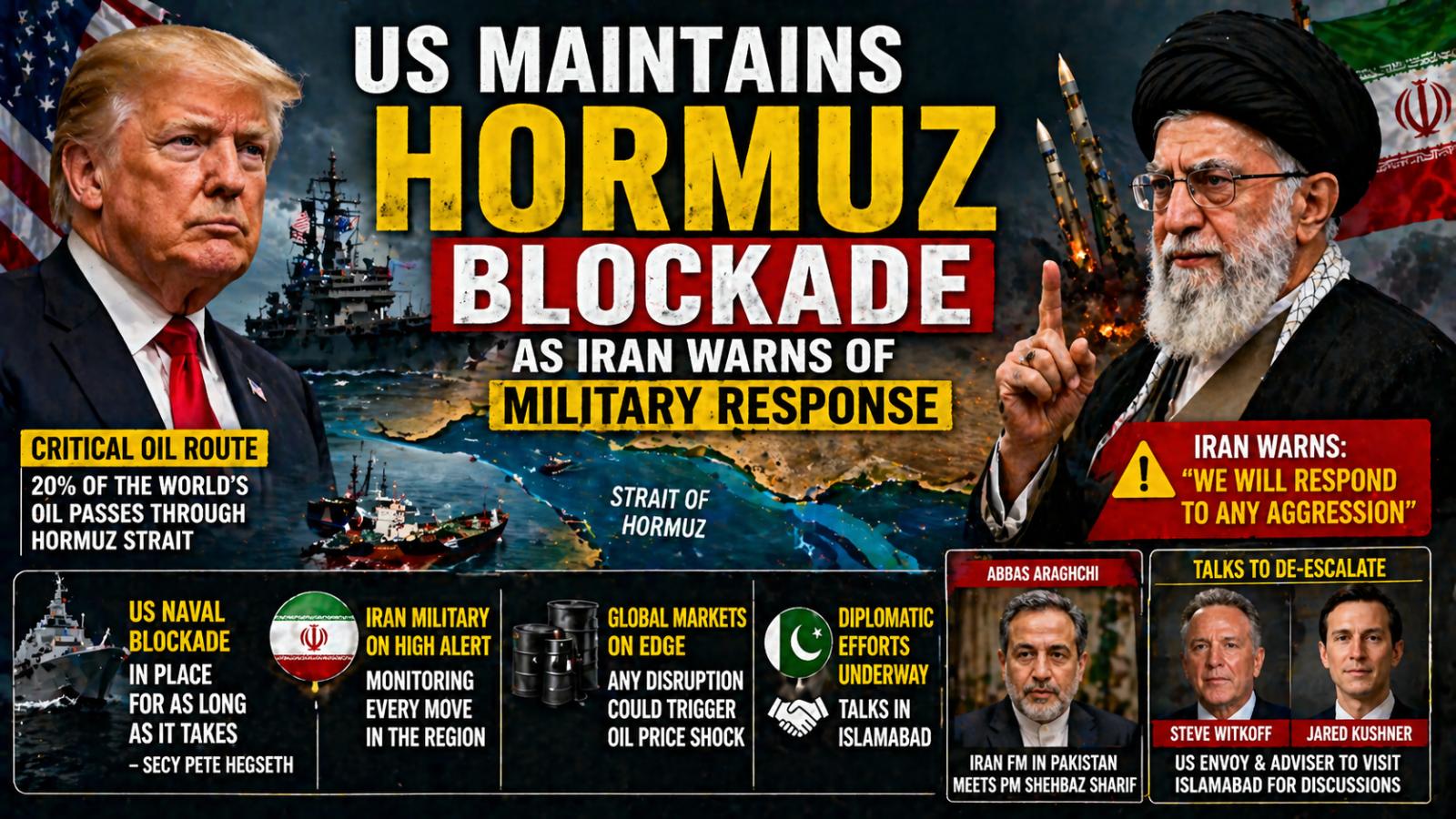
US maintains Hormuz blockade as Iran warns of military response
US maintains Hormuz blockade as Iran warns of retaliation, escalating tensions over a key global oil route while both sides pursue parallel diplomatic talks in Pakistan. US maintains Hormuz blockade as Iran warns of military response as tensions escalated on Saturday, April 25, 2026, when Iranian officials warned they would respond if U.S. naval actions targeting Iranian ports continue. The statement, issued through state-run media, described the U.S. presence in t
US maintains Hormuz blockade as Iran warns of military response
US maintains Hormuz blockade as Iran warns of retaliation, escalating tensions over a key global oil route while both sides pursue parallel diplomatic talks in Pakistan. US maintains Hormuz blockade as Iran warns of military response as tensions escalated on Saturday, April 25, 2026, when Iranian officials warned they would respond if U.S. naval actions targeting Iranian ports continue. The statement, issued through state-run media, described the U.S. presence in t
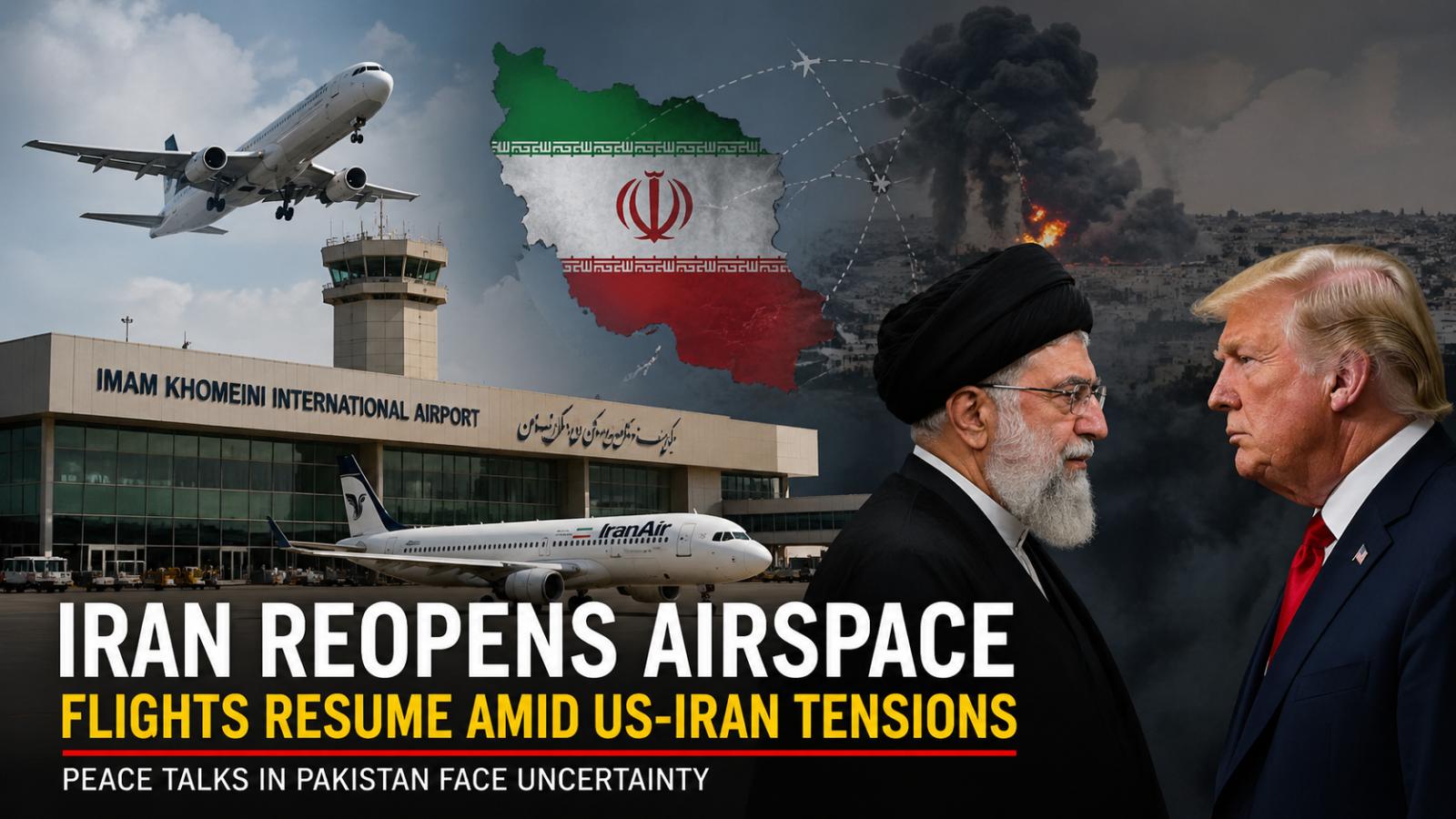
Iran airspace resumes operations amid ongoing US-Iran conflict tensions
Iran airspace has resumed operations nearly two months after being shut down following joint airstrikes by the United States and Israel, marking a cautious step toward normalcy amid ongoing regional tensions. The reopening of Imam Khomeini International Airport on April 25 signals a gradual recovery in Iran’s aviation sector, even as diplomatic uncertainty continues to cloud the broader US-Iran conflict. The airspace closure was enforced on February 28 after coordinated military action escalated into a wider confrontation, forcing Iran to halt civilian aviation across the country. With security assessments and operational preparations now underway, authorities have begun restoring flight services in phases. Initial departures from Tehran include routes to Medina, Muscat, and Istanbul, reflecting limited but significant progress in reconnecting international travel corridors. Iran’s Civil Aviation Authority has indicated that full restoration of aviation services will depend on continued coordination between military and civilian agencies. Earlier, on April 18, Iran reopened its eastern airspace to international flights, allowing transit operations to resume and easing pressure on regional air traffic routes. Officials emphasize that passenger safety remains the top priority during this phased reopening. At the same time, diplomatic efforts to de-escalate the US-Iran war have encountered fresh complications. A delegation linked to former US President Donald Trump, including envoy Steve Witkoff and adviser Jared Kushner, is currently in Pakistan for a second round of peace talks. However, Iran has clearly denied any direct engagement with US representatives during this visit, raising doubts about the progress of negotiations. Iran’s Foreign Ministry has clarified that its position will be conveyed through Pakistani intermediaries, with Foreign Minister Abbas Araghchi actively involved in discussions aimed at reducing tensions. Tehran continues to describe the conflict as “an externally imposed war of aggression”, stressing the importance of restoring regional stability and easing sanctions pressure. Previous negotiations collapsed after Iran strongly objected to US demands to maintain sanctions and naval restrictions during talks. As both sides remain firm in their positions, the reopening of Iran airspace stands as a significant operational step, even as broader geopolitical challenges remain unresolved.
Iran airspace resumes operations amid ongoing US-Iran conflict tensions
Iran airspace has resumed operations nearly two months after being shut down following joint airstrikes by the United States and Israel, marking a cautious step toward normalcy amid ongoing regional tensions. The reopening of Imam Khomeini International Airport on April 25 signals a gradual recovery in Iran’s aviation sector, even as diplomatic uncertainty continues to cloud the broader US-Iran conflict. The airspace closure was enforced on February 28 after coordinated military action escalated into a wider confrontation, forcing Iran to halt civilian aviation across the country. With security assessments and operational preparations now underway, authorities have begun restoring flight services in phases. Initial departures from Tehran include routes to Medina, Muscat, and Istanbul, reflecting limited but significant progress in reconnecting international travel corridors. Iran’s Civil Aviation Authority has indicated that full restoration of aviation services will depend on continued coordination between military and civilian agencies. Earlier, on April 18, Iran reopened its eastern airspace to international flights, allowing transit operations to resume and easing pressure on regional air traffic routes. Officials emphasize that passenger safety remains the top priority during this phased reopening. At the same time, diplomatic efforts to de-escalate the US-Iran war have encountered fresh complications. A delegation linked to former US President Donald Trump, including envoy Steve Witkoff and adviser Jared Kushner, is currently in Pakistan for a second round of peace talks. However, Iran has clearly denied any direct engagement with US representatives during this visit, raising doubts about the progress of negotiations. Iran’s Foreign Ministry has clarified that its position will be conveyed through Pakistani intermediaries, with Foreign Minister Abbas Araghchi actively involved in discussions aimed at reducing tensions. Tehran continues to describe the conflict as “an externally imposed war of aggression”, stressing the importance of restoring regional stability and easing sanctions pressure. Previous negotiations collapsed after Iran strongly objected to US demands to maintain sanctions and naval restrictions during talks. As both sides remain firm in their positions, the reopening of Iran airspace stands as a significant operational step, even as broader geopolitical challenges remain unresolved.
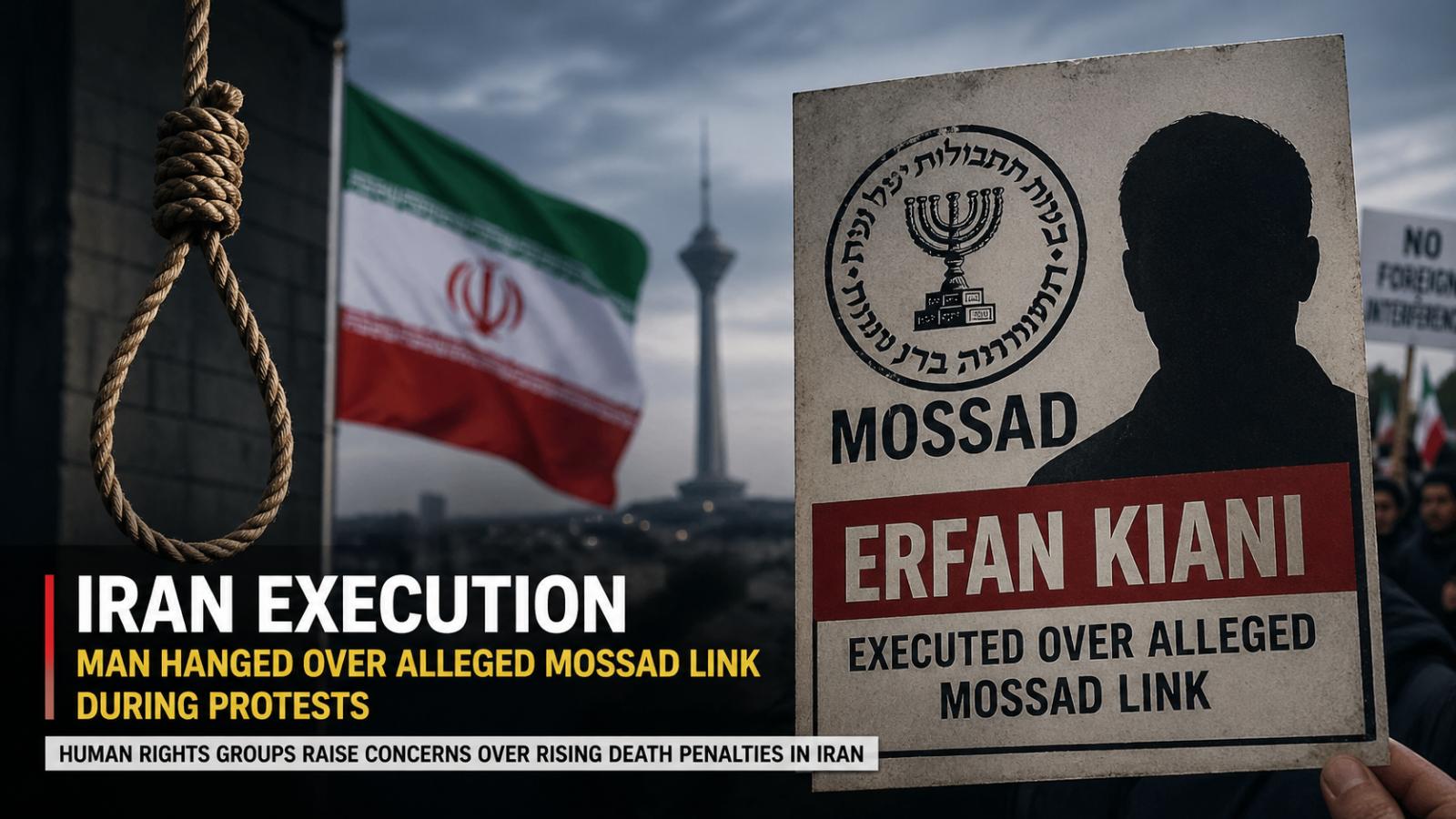
Iran executes man over alleged Mossad link during protests
Iran execution of a protest-linked man accused of working with Mossad has drawn global attention, as authorities continue to enforce strict measures following unrest earlier this year. Officials confirmed on Saturday that Erfan Kiani was executed after being convicted of carrying out activities linked to Israeli intelligence during January protests, highlighting the country’s ongoing crackdown amid rising regional tensions. According to Iran’s j
Iran executes man over alleged Mossad link during protests
Iran execution of a protest-linked man accused of working with Mossad has drawn global attention, as authorities continue to enforce strict measures following unrest earlier this year. Officials confirmed on Saturday that Erfan Kiani was executed after being convicted of carrying out activities linked to Israeli intelligence during January protests, highlighting the country’s ongoing crackdown amid rising regional tensions. According to Iran’s j
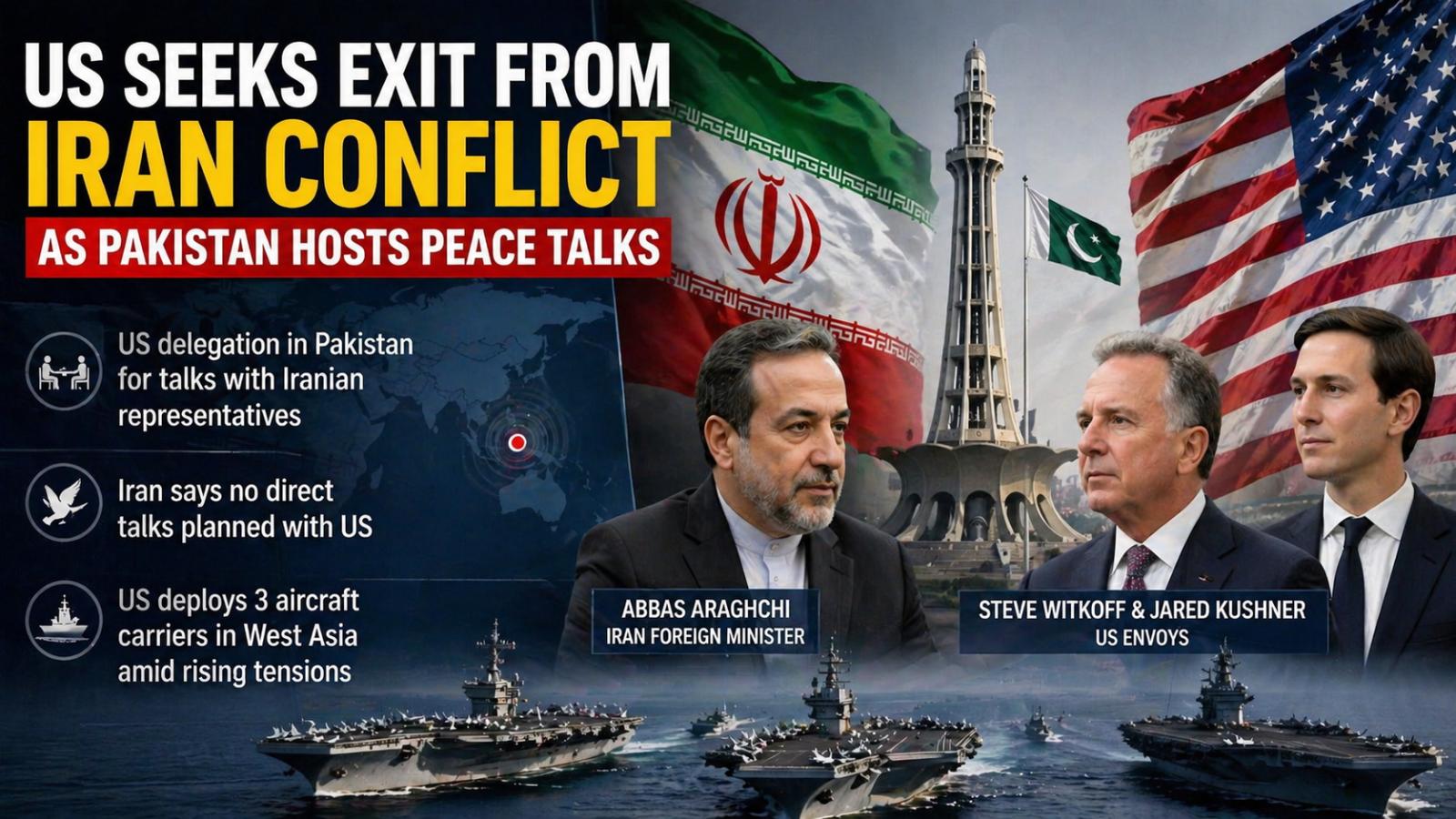
West Asia tensions rise as US envoys head to Pakistan for Iran talks
The US Iran conflict has entered a critical phase as Iran’s Defence Ministry claimed that the United States is seeking a “face-saving” way to exit the war, even as Washington sends a delegation to Pakistan for peace talks. The statement highlights growing diplomatic activity alongside rising military tensions in West Asia, with Pakistan emerging as a key mediator in the crisis. According to Iranian media reports, a defence ministry spokesperson said that Iran’s military strength has become dominant in the region, forcing the United States to look for a way out of what it described as a prolonged and difficult conflict. The remarks come at a time when US envoys Steve Witkoff and Jared Kushner are heading to Pakistan for discussions that the White House said would include talks with Iranian representatives. However, Iran has publicly denied plans for direct negotiations with the United States. Iranian Foreign Minister Abbas Araghchi arrived in Islamabad for an official visit and is scheduled to meet senior Pakistani officials. Iranian Foreign Ministry spokesperson Esmaeil Baqaei clarified that the visit is focused on consultations with Pakistan as part of its mediation efforts and not on direct dialogue with the US. He added that Iran’s position would be communicated through Pakistani channels. The diplomatic developments unfold against a backdrop of intensifying West Asia tensions, particularly around the Strait of Hormuz, a vital global oil route. The United States has significantly increased its military presence in the region, deploying three aircraft carrier strike groups, marking the largest such deployment since the Iraq war in 2003. According to US Central Command, the deployment includes more than 200 aircraft and around 15,000 personnel. As both diplomatic and military activities escalate, uncertainty remains over whether meaningful progress toward de-escalation can be achieved. While Pakistan continues its mediation role, the absence of direct Iran-US talks suggests that a resolution may still be distant, keeping the region on edge.
West Asia tensions rise as US envoys head to Pakistan for Iran talks
The US Iran conflict has entered a critical phase as Iran’s Defence Ministry claimed that the United States is seeking a “face-saving” way to exit the war, even as Washington sends a delegation to Pakistan for peace talks. The statement highlights growing diplomatic activity alongside rising military tensions in West Asia, with Pakistan emerging as a key mediator in the crisis. According to Iranian media reports, a defence ministry spokesperson said that Iran’s military strength has become dominant in the region, forcing the United States to look for a way out of what it described as a prolonged and difficult conflict. The remarks come at a time when US envoys Steve Witkoff and Jared Kushner are heading to Pakistan for discussions that the White House said would include talks with Iranian representatives. However, Iran has publicly denied plans for direct negotiations with the United States. Iranian Foreign Minister Abbas Araghchi arrived in Islamabad for an official visit and is scheduled to meet senior Pakistani officials. Iranian Foreign Ministry spokesperson Esmaeil Baqaei clarified that the visit is focused on consultations with Pakistan as part of its mediation efforts and not on direct dialogue with the US. He added that Iran’s position would be communicated through Pakistani channels. The diplomatic developments unfold against a backdrop of intensifying West Asia tensions, particularly around the Strait of Hormuz, a vital global oil route. The United States has significantly increased its military presence in the region, deploying three aircraft carrier strike groups, marking the largest such deployment since the Iraq war in 2003. According to US Central Command, the deployment includes more than 200 aircraft and around 15,000 personnel. As both diplomatic and military activities escalate, uncertainty remains over whether meaningful progress toward de-escalation can be achieved. While Pakistan continues its mediation role, the absence of direct Iran-US talks suggests that a resolution may still be distant, keeping the region on edge.
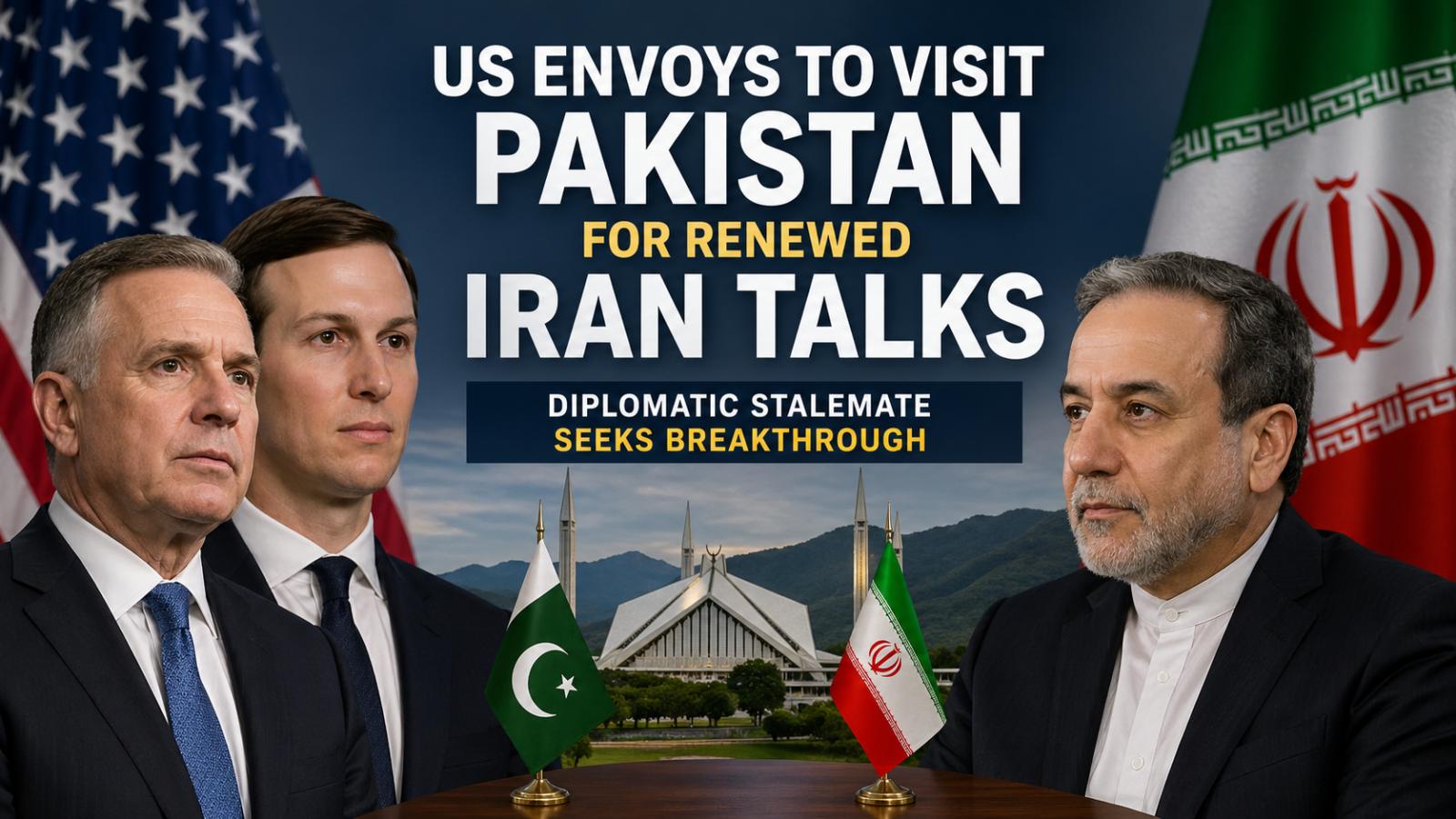
US envoys to visit Pakistan for renewed Iran talks amid ongoing tensions
After several days of diplomatic deadlock, the United States has confirmed that senior envoys Steve Witkoff and Jared Kushner will travel to Pakistan for a fresh round of negotiations with Iran, signaling a renewed effort to address escalating tensions between the two nations. The visit is scheduled for Saturday and follows Iran’s request for direct, in-person discussions. White House Press Secretary Karoline Leavitt stated that the move comes after Iran reached out for dialogue, aligning with earlier calls from US leadership to reopen communication channels. She emphasized that the envoys will assess the situation on the ground and report back to President Donald Trump and Vice President JD Vance, while additional officials remain on standby if required. The upcoming talks mark the second round of discussions in Pakistan, following initial meetings held earlier this month. However, notable figures such as Vice President Vance and Iranian parliamentary leader Mohammad Bagher Ghalibaf, who were involved previously, will not participate in this phase. Their absence highlights a shift in the structure of the negotiations. Iran’s Foreign Minister Abbas Araghchi recently announced a regional diplomatic tour that includes Pakistan, Oman, and Russia. His stated objective is to strengthen coordination with key partners on bilateral and regional issues, underlining Iran’s strategic engagement with neighboring countries during a period of heightened geopolitical tension. What are the main sticking points in the talks? The primary disagreements revolve around Iran’s nuclear program and control over the Strait of Hormuz. Iran has insisted it will not proceed with negotiations unless the United States lifts its blockade in the strategic waterway. In contrast, the US is demanding verifiable guarantees that Iran will halt its nuclear ambitions and ease its own restrictions in the region. At a recent Pentagon briefing, US Defense Secretary Pete Hegseth reiterated that the United States is not under pressure to finalize an agreement quickly. He indicated that Washington is prepared for prolonged negotiations, while also stressing that Iran has an opportunity to secure a favorable and pragmatic deal if it chooses to engage constructively. The renewed diplomatic effort in Pakistan reflects a cautious but significant step toward resolving one of the most critical international disputes, with both sides maintaining firm positions as negotiations resume.
US envoys to visit Pakistan for renewed Iran talks amid ongoing tensions
After several days of diplomatic deadlock, the United States has confirmed that senior envoys Steve Witkoff and Jared Kushner will travel to Pakistan for a fresh round of negotiations with Iran, signaling a renewed effort to address escalating tensions between the two nations. The visit is scheduled for Saturday and follows Iran’s request for direct, in-person discussions. White House Press Secretary Karoline Leavitt stated that the move comes after Iran reached out for dialogue, aligning with earlier calls from US leadership to reopen communication channels. She emphasized that the envoys will assess the situation on the ground and report back to President Donald Trump and Vice President JD Vance, while additional officials remain on standby if required. The upcoming talks mark the second round of discussions in Pakistan, following initial meetings held earlier this month. However, notable figures such as Vice President Vance and Iranian parliamentary leader Mohammad Bagher Ghalibaf, who were involved previously, will not participate in this phase. Their absence highlights a shift in the structure of the negotiations. Iran’s Foreign Minister Abbas Araghchi recently announced a regional diplomatic tour that includes Pakistan, Oman, and Russia. His stated objective is to strengthen coordination with key partners on bilateral and regional issues, underlining Iran’s strategic engagement with neighboring countries during a period of heightened geopolitical tension. What are the main sticking points in the talks? The primary disagreements revolve around Iran’s nuclear program and control over the Strait of Hormuz. Iran has insisted it will not proceed with negotiations unless the United States lifts its blockade in the strategic waterway. In contrast, the US is demanding verifiable guarantees that Iran will halt its nuclear ambitions and ease its own restrictions in the region. At a recent Pentagon briefing, US Defense Secretary Pete Hegseth reiterated that the United States is not under pressure to finalize an agreement quickly. He indicated that Washington is prepared for prolonged negotiations, while also stressing that Iran has an opportunity to secure a favorable and pragmatic deal if it chooses to engage constructively. The renewed diplomatic effort in Pakistan reflects a cautious but significant step toward resolving one of the most critical international disputes, with both sides maintaining firm positions as negotiations resume.
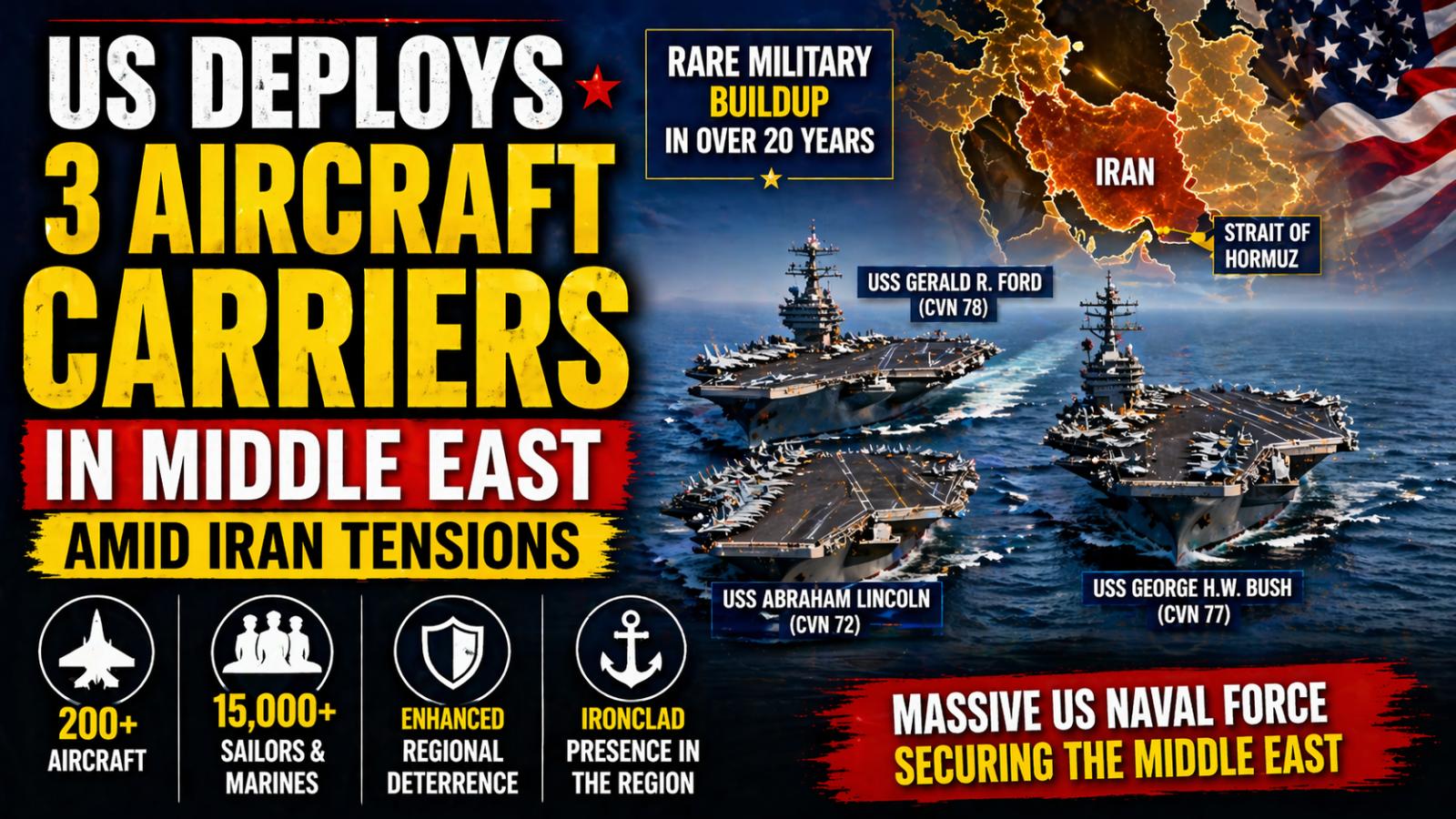
US deploys three aircraft carriers to Middle East amid Iran tensions
US deploys three aircraft carriers to the Middle East amid Iran tensions, expanding naval operations and reinforcing security in key maritime routes including the Strait of Hormuz. US deploys three aircraft carriers to Middle East amid Iran tensions as Washington significantly expands its military footprint across the region, marking one of the largest naval concentrations in more than two decades. Officials confirmed that three carrier strike groups—the USS Abraham Lincoln, USS Gerald R. Ford, and USS George H.W. Bush—are operating simultaneously, supported by more than 200 aircraft and approximately 15,000 sailors and Marines. A statement from US Central Command on Thursday confirmed the rare deployment, describing it as a significant concentration of naval power aimed at maintaining operational readiness amid rising tensions involving Iran. The carrier groups and their air wings are conducting coordinated missions, underscoring the strategic importance of key maritime routes in the Middle East and reinforcing a broader posture of deterrence. The announcement coincided with remarks from Donald Trump on Thursday, who declined to provide a timeline for a potential resolution to the Iran conflict. He indicated that any agreement would depend on conditions favorable to US interests, highlighting ongoing uncertainty surrounding diplomatic efforts. The absence of a clear timeline has aligned with increased military activity and messaging focused on regional stability. Defense officials stated on Friday that the US blockade of Iranian vessels in the Strait of Hormuz remains “ironclad,” with additional naval assets expected to join the operation in the coming days. The expanding mission signals a broader enforcement effort in one of the world’s most critical shipping corridors. The USS George H.W. Bush, commissioned in 2009, is among the newest Nimitz-class carriers involved, measuring nearly 1,000 feet in length and powered by two nuclear reactors, with the capacity to carry more than 80 aircraft and support a crew exceeding 5,500 personnel.
US deploys three aircraft carriers to Middle East amid Iran tensions
US deploys three aircraft carriers to the Middle East amid Iran tensions, expanding naval operations and reinforcing security in key maritime routes including the Strait of Hormuz. US deploys three aircraft carriers to Middle East amid Iran tensions as Washington significantly expands its military footprint across the region, marking one of the largest naval concentrations in more than two decades. Officials confirmed that three carrier strike groups—the USS Abraham Lincoln, USS Gerald R. Ford, and USS George H.W. Bush—are operating simultaneously, supported by more than 200 aircraft and approximately 15,000 sailors and Marines. A statement from US Central Command on Thursday confirmed the rare deployment, describing it as a significant concentration of naval power aimed at maintaining operational readiness amid rising tensions involving Iran. The carrier groups and their air wings are conducting coordinated missions, underscoring the strategic importance of key maritime routes in the Middle East and reinforcing a broader posture of deterrence. The announcement coincided with remarks from Donald Trump on Thursday, who declined to provide a timeline for a potential resolution to the Iran conflict. He indicated that any agreement would depend on conditions favorable to US interests, highlighting ongoing uncertainty surrounding diplomatic efforts. The absence of a clear timeline has aligned with increased military activity and messaging focused on regional stability. Defense officials stated on Friday that the US blockade of Iranian vessels in the Strait of Hormuz remains “ironclad,” with additional naval assets expected to join the operation in the coming days. The expanding mission signals a broader enforcement effort in one of the world’s most critical shipping corridors. The USS George H.W. Bush, commissioned in 2009, is among the newest Nimitz-class carriers involved, measuring nearly 1,000 feet in length and powered by two nuclear reactors, with the capacity to carry more than 80 aircraft and support a crew exceeding 5,500 personnel.
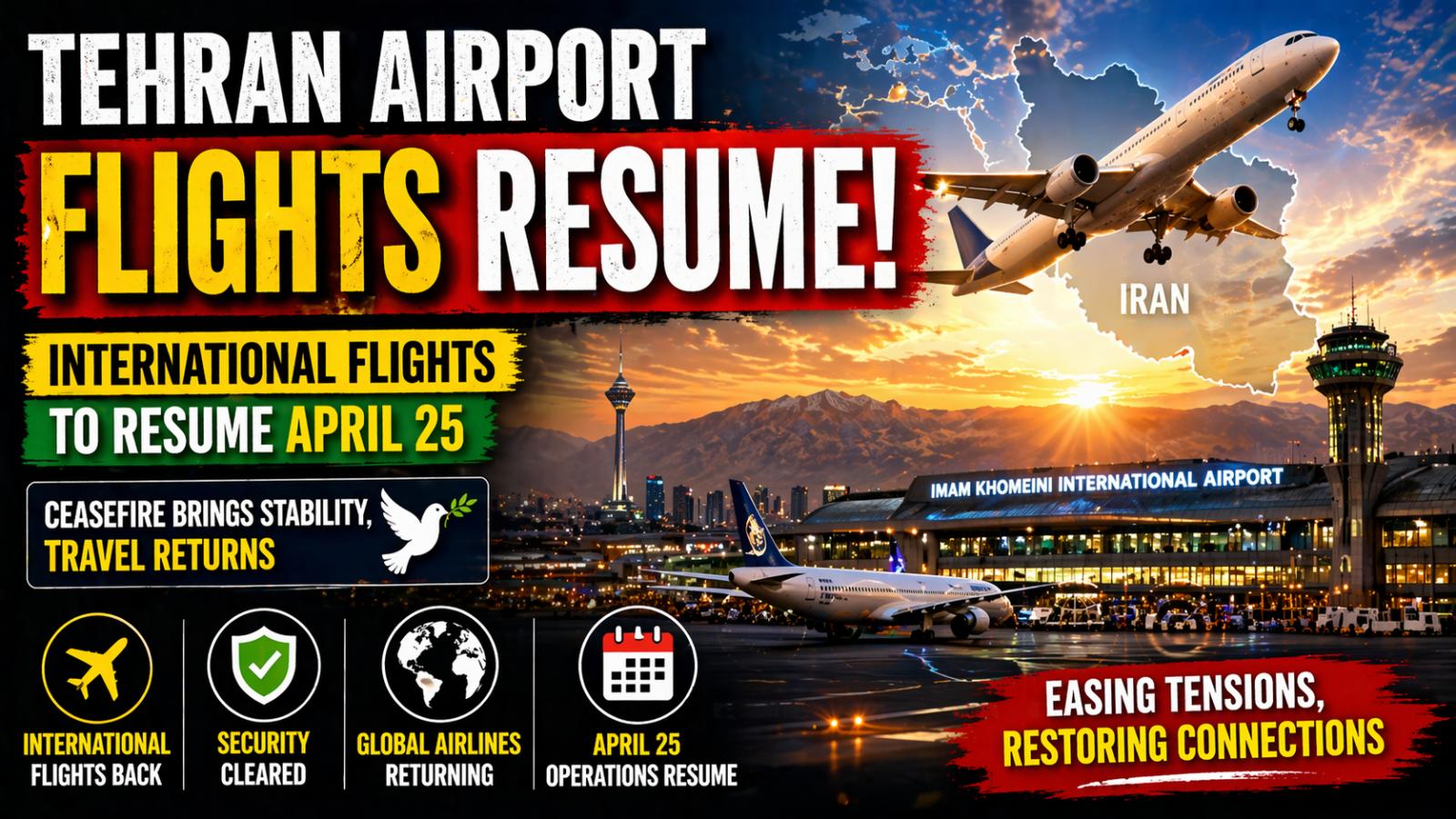
What does Tehran airport reopening signal? It marks easing regional tensions
What does Tehran airport reopening signal? It marks easing regional tensions, Tehran’s primary international gateway is preparing to resume global flight operations on Saturday, April 25, 2026, according to Iranian aviation authorities, marking a significant step toward restoring stability after a week-long suspension tied to heightened regional tensions. Airport reopening follows week-long aviation shutdown Imam Khomeini International
What does Tehran airport reopening signal? It marks easing regional tensions
What does Tehran airport reopening signal? It marks easing regional tensions, Tehran’s primary international gateway is preparing to resume global flight operations on Saturday, April 25, 2026, according to Iranian aviation authorities, marking a significant step toward restoring stability after a week-long suspension tied to heightened regional tensions. Airport reopening follows week-long aviation shutdown Imam Khomeini International
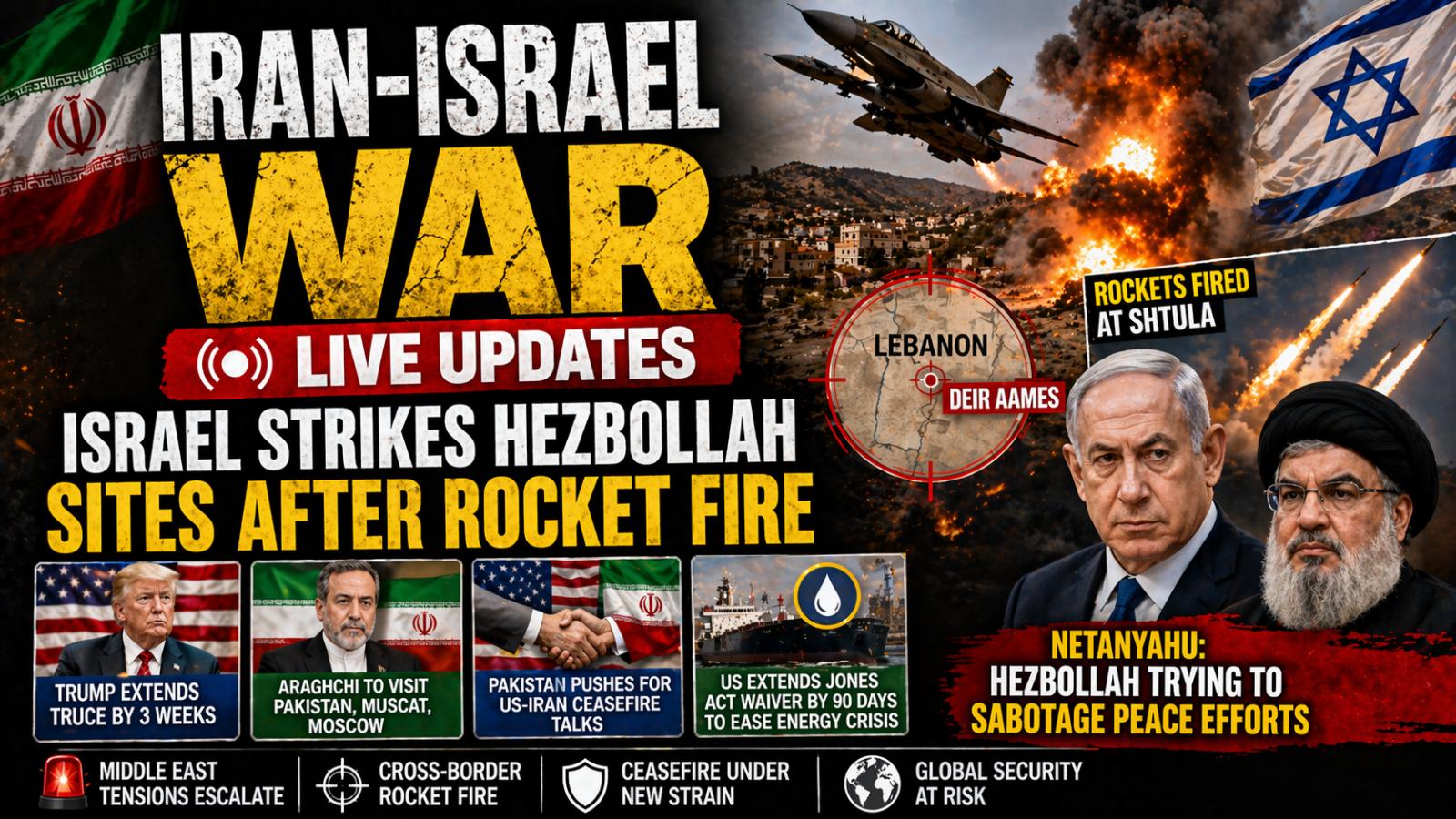
Netanyahu accuses Hezbollah of sabotaging Israel-Lebanon peace efforts
Israel strikes Hezbollah targets after rocket fire from Lebanon as tensions persist despite a truce extension, while diplomatic efforts and US energy measures reflect widening regional impact. Iran-Israel war live updates: Israel strikes Hezbollah sites after rocket fire as regional tensions escalated on Friday, April 24, 2026, with the Israeli military confirming strikes on Hezbollah-linked locations in southern Lebanon following cross-border rocket launches. The Israeli military stated that it targeted sites near the town of Deir Aames after rockets were fired toward the Israeli town of Shtula a day earlier. Deir Aames lies outside the designated border buffer zone that Israeli forces have continued to occupy even after a 10-day ceasefire agreement implemented the previous week. Earlier on Friday, April 24, 2026, the military issued evacuation warnings urging residents to leave the area before the strikes. The renewed hostilities come despite diplomatic efforts to maintain calm. U.S. President Donald Trump announced on Thursday, April 23, 2026, a three-week extension of the Israel-Hezbollah truce. However, both sides have continued intermittent exchanges of fire, raising concerns about the durability of the ceasefire. Israeli Prime Minister Benjamin Netanyahu accused Hezbollah of undermining peace efforts, stating on Friday, April 24, 2026, that the group was attempting to “sabotage” negotiations aimed at reaching a long-term agreement between Israel and Lebanon. His remarks marked his first public comments following the truce extension. Meanwhile, diplomatic activity continued across the region. Iranian Foreign Minister Abbas Araghchi said his upcoming visits to Islamabad, Muscat, and Moscow are intended to coordinate with regional partners and discuss evolving developments. While he did not directly address potential talks with the United States, officials in Pakistan have recently intensified efforts to facilitate renewed ceasefire negotiations between Washington and Tehran. In Washington, the White House announced an extension of a waiver to the Jones Act by 90 days on Friday, April 24, 2026. The measure is designed to ease domestic energy supply pressures amid disruptions linked to the broader West Asia conflict. Officials said the extension would help maintain the flow of oil and natural gas within the United States by allowing greater flexibility in maritime transport. The combination of military actions, diplomatic outreach, and economic measures underscores the widening impact of the conflict, with regional instability continuing to influence global security and energy markets.
Netanyahu accuses Hezbollah of sabotaging Israel-Lebanon peace efforts
Israel strikes Hezbollah targets after rocket fire from Lebanon as tensions persist despite a truce extension, while diplomatic efforts and US energy measures reflect widening regional impact. Iran-Israel war live updates: Israel strikes Hezbollah sites after rocket fire as regional tensions escalated on Friday, April 24, 2026, with the Israeli military confirming strikes on Hezbollah-linked locations in southern Lebanon following cross-border rocket launches. The Israeli military stated that it targeted sites near the town of Deir Aames after rockets were fired toward the Israeli town of Shtula a day earlier. Deir Aames lies outside the designated border buffer zone that Israeli forces have continued to occupy even after a 10-day ceasefire agreement implemented the previous week. Earlier on Friday, April 24, 2026, the military issued evacuation warnings urging residents to leave the area before the strikes. The renewed hostilities come despite diplomatic efforts to maintain calm. U.S. President Donald Trump announced on Thursday, April 23, 2026, a three-week extension of the Israel-Hezbollah truce. However, both sides have continued intermittent exchanges of fire, raising concerns about the durability of the ceasefire. Israeli Prime Minister Benjamin Netanyahu accused Hezbollah of undermining peace efforts, stating on Friday, April 24, 2026, that the group was attempting to “sabotage” negotiations aimed at reaching a long-term agreement between Israel and Lebanon. His remarks marked his first public comments following the truce extension. Meanwhile, diplomatic activity continued across the region. Iranian Foreign Minister Abbas Araghchi said his upcoming visits to Islamabad, Muscat, and Moscow are intended to coordinate with regional partners and discuss evolving developments. While he did not directly address potential talks with the United States, officials in Pakistan have recently intensified efforts to facilitate renewed ceasefire negotiations between Washington and Tehran. In Washington, the White House announced an extension of a waiver to the Jones Act by 90 days on Friday, April 24, 2026. The measure is designed to ease domestic energy supply pressures amid disruptions linked to the broader West Asia conflict. Officials said the extension would help maintain the flow of oil and natural gas within the United States by allowing greater flexibility in maritime transport. The combination of military actions, diplomatic outreach, and economic measures underscores the widening impact of the conflict, with regional instability continuing to influence global security and energy markets.
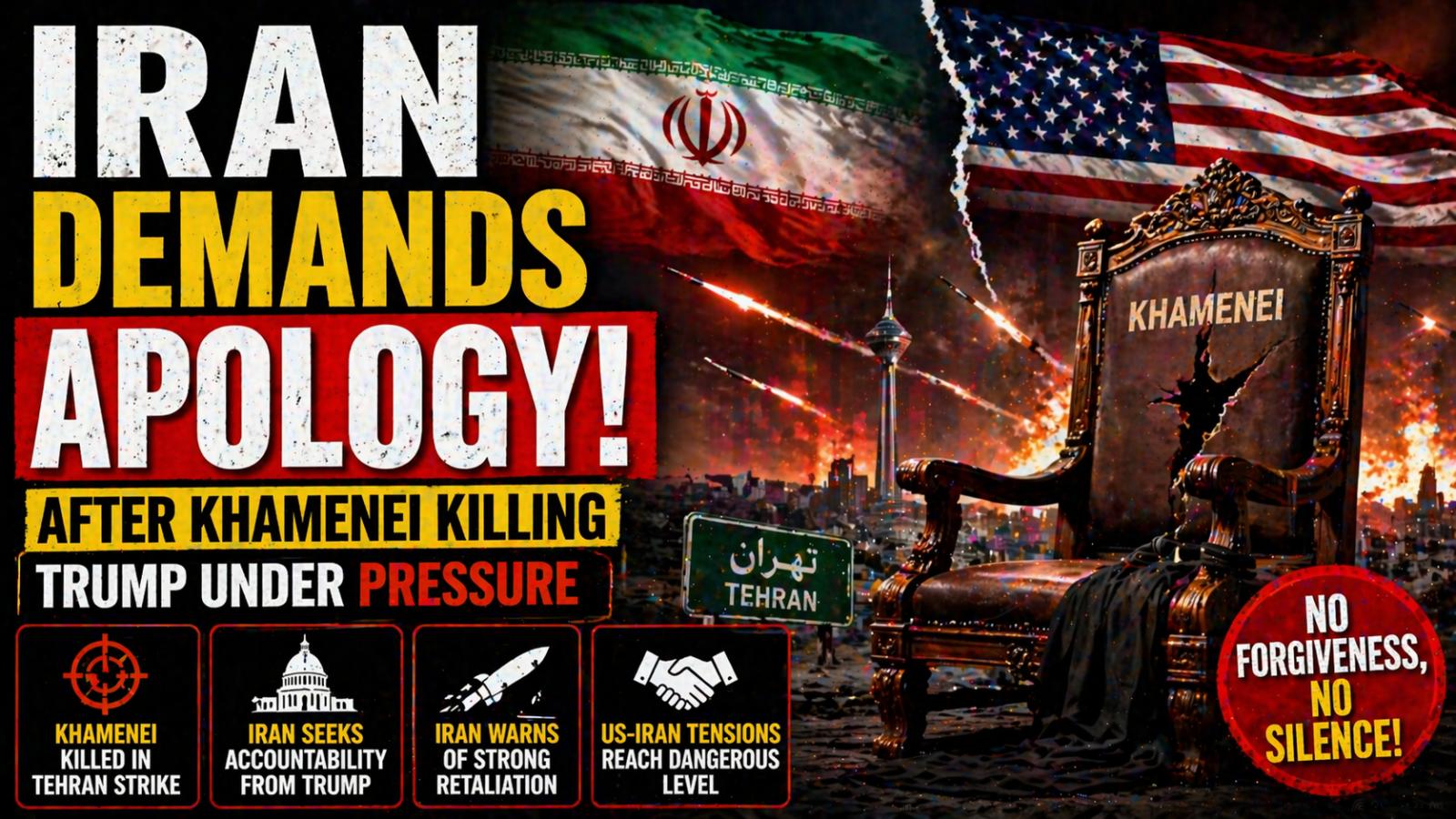
Why did Ali Shirazi demand an apology from Donald Trump? Iran seeks accountability after Khamenei killing
Escalating diplomatic tensions after Tehran strike Why did Ali Shirazi demand an apology from Donald Trump? Iran seeks accountability after Khamenei killing, as senior Iranian cleric Ali Shirazi called on U.S. President Donald Trump to publicly acknowledge wrongdoing following t
Why did Ali Shirazi demand an apology from Donald Trump? Iran seeks accountability after Khamenei killing
Escalating diplomatic tensions after Tehran strike Why did Ali Shirazi demand an apology from Donald Trump? Iran seeks accountability after Khamenei killing, as senior Iranian cleric Ali Shirazi called on U.S. President Donald Trump to publicly acknowledge wrongdoing following t
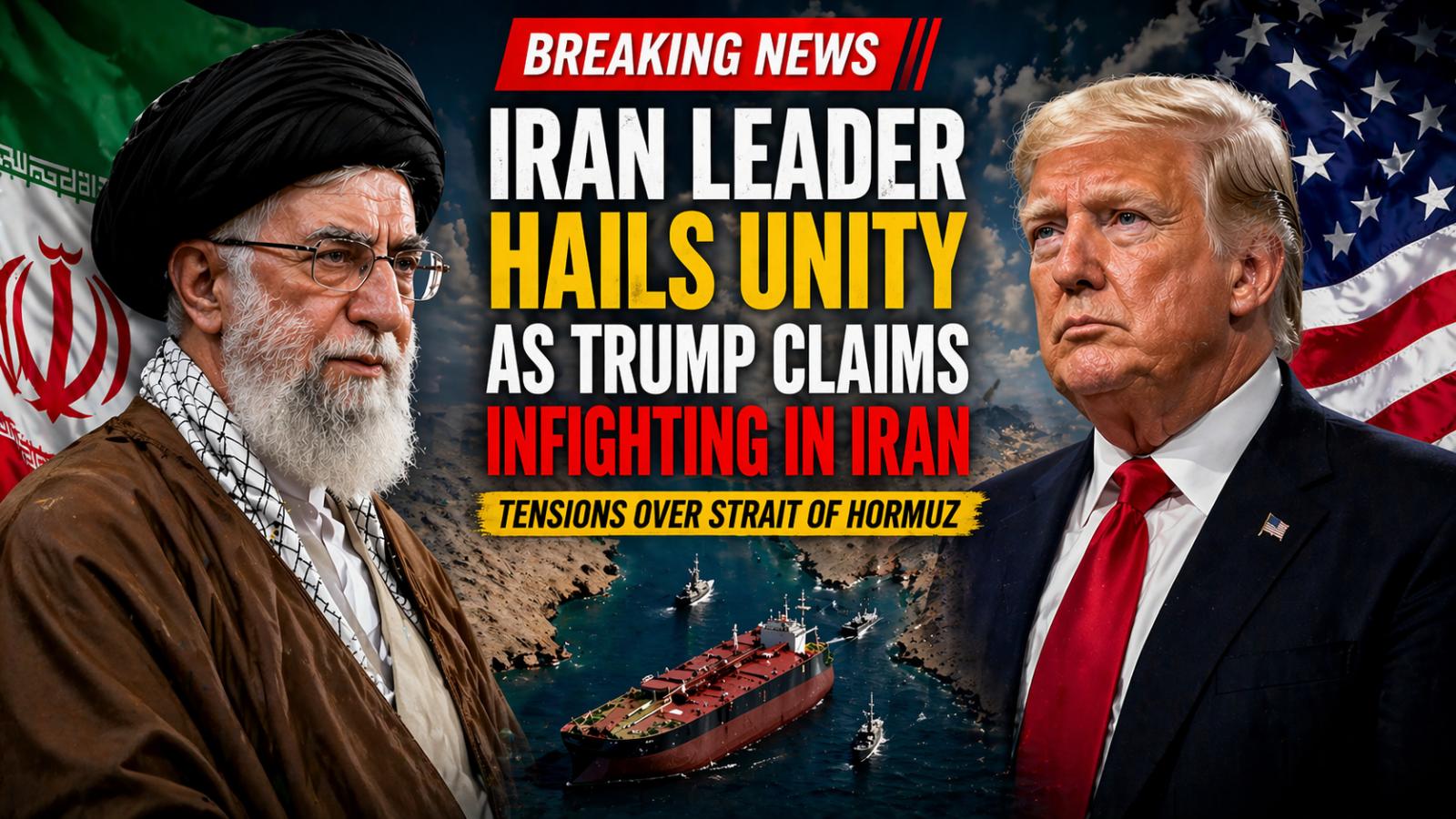
Khamenei Praises National Cohesion Amid Rising US-Iran Tensions
Mojtaba Khamenei has emphasized national unity in Iran, stating that collective cohesion among citizens has strengthened the country’s position amid ongoing tensions with the United States. In a public message, he described unity as a decisive factor in countering external pressure, urging continued commitment to national solidarity. Khamenei’s remarks come as
Khamenei Praises National Cohesion Amid Rising US-Iran Tensions
Mojtaba Khamenei has emphasized national unity in Iran, stating that collective cohesion among citizens has strengthened the country’s position amid ongoing tensions with the United States. In a public message, he described unity as a decisive factor in countering external pressure, urging continued commitment to national solidarity. Khamenei’s remarks come as
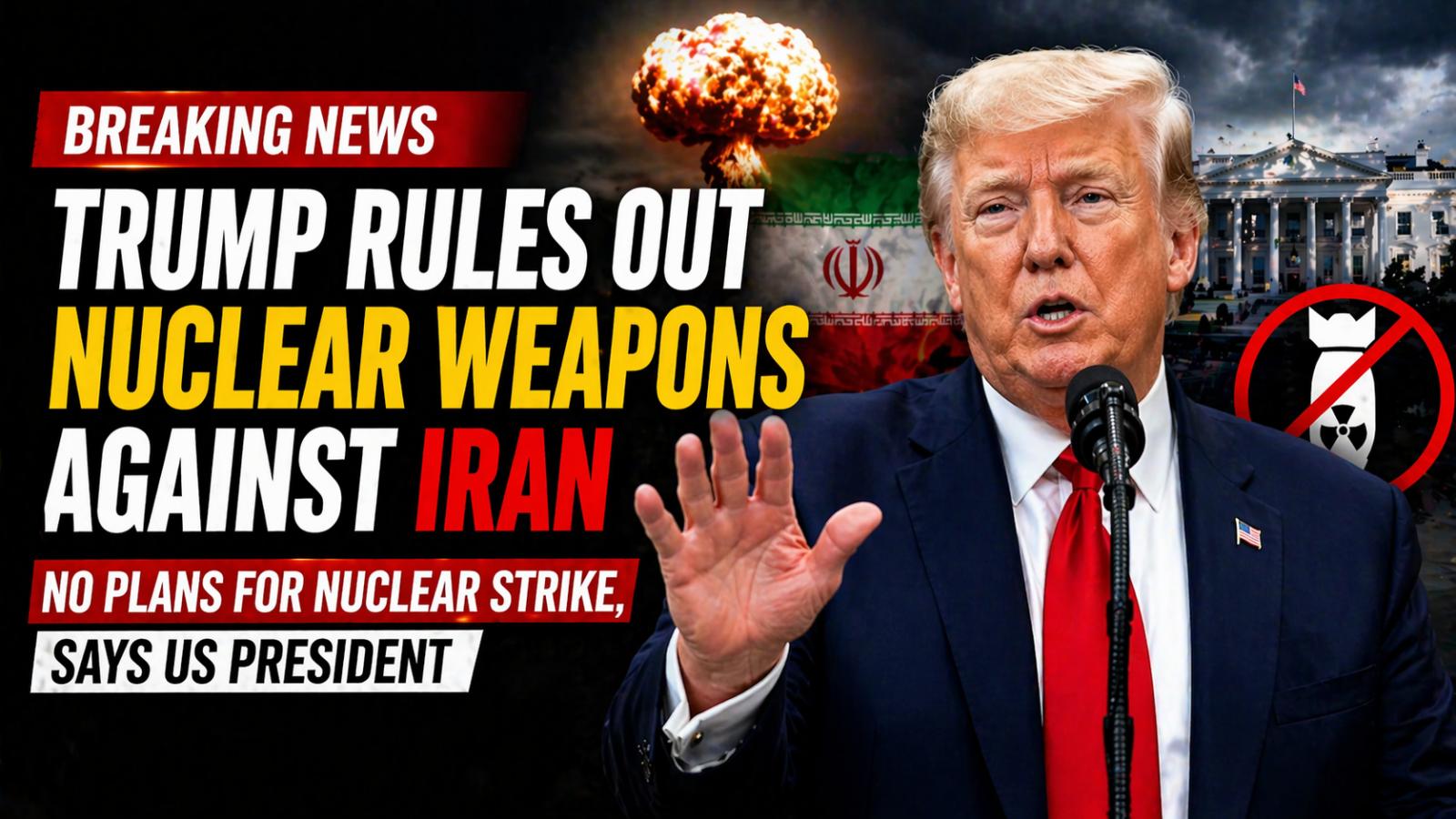
US President Says No Plans for Nuclear Strike on Iran
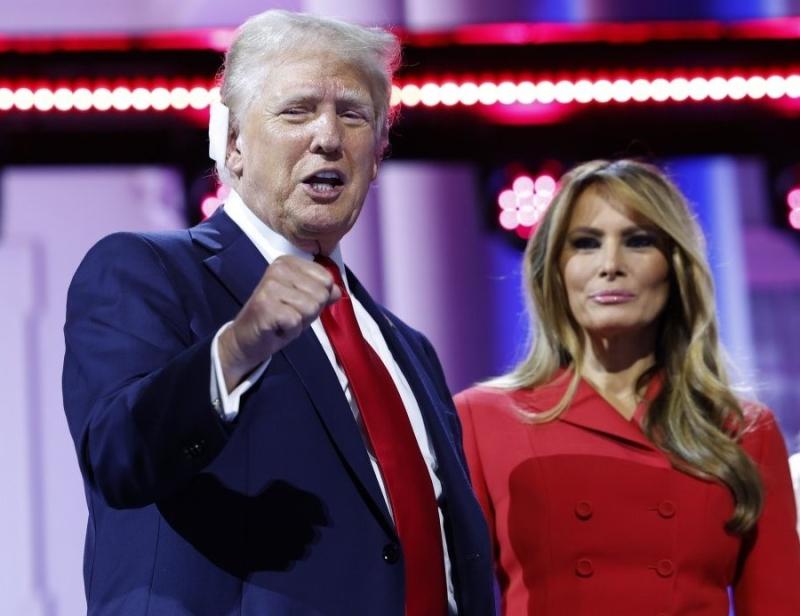
Donald Trump stated that the United States currently has no intention of using nuclear weapons against Iran, offering clarity on a key concern amid ongoing geopolitical tensions. Speaking to reporters at the White House, Trump emphasized that conventional military actions had already achieved significant results without the need for nuclear escalation. Addressing recent speculation, Trump said there was no justification for deploying nuclear weapons, noting that existing strategies had been effective. His remarks come after earlier statements that had drawn international attention, where strong rhetoric raised concerns about the potential use of extreme measures during the conflict that began earlier this year. The president reiterated that nuclear weapons should not be used by any nation, signaling a shift toward a more restrained public stance. At the same time, he underscored the administration’s objective of preventing Iran from developing nuclear capabilities that could pose a threat to regional and global security. Comments from senior officials have also contributed to the broader discussion. JD Vance had previously indicated that the United States was prepared to escalate its response if necessary, though the White House clarified that such remarks did not imply nuclear action. Trump’s latest statement appears to balance deterrence with reassurance, highlighting a focus on maintaining pressure through conventional means while avoiding the risks associated with nuclear engagement. As tensions persist, the administration continues to stress its commitment to preventing further escalation while safeguarding national interests and stability in the region.
US President Says No Plans for Nuclear Strike on Iran
Donald Trump stated that the United States currently has no intention of using nuclear weapons against Iran, offering clarity on a key concern amid ongoing geopolitical tensions. Speaking to reporters at the White House, Trump emphasized that conventional military actions had already achieved significant results without the need for nuclear escalation. Addressing recent speculation, Trump said there was no justification for deploying nuclear weapons, noting that existing strategies had been effective. His remarks come after earlier statements that had drawn international attention, where strong rhetoric raised concerns about the potential use of extreme measures during the conflict that began earlier this year. The president reiterated that nuclear weapons should not be used by any nation, signaling a shift toward a more restrained public stance. At the same time, he underscored the administration’s objective of preventing Iran from developing nuclear capabilities that could pose a threat to regional and global security. Comments from senior officials have also contributed to the broader discussion. JD Vance had previously indicated that the United States was prepared to escalate its response if necessary, though the White House clarified that such remarks did not imply nuclear action. Trump’s latest statement appears to balance deterrence with reassurance, highlighting a focus on maintaining pressure through conventional means while avoiding the risks associated with nuclear engagement. As tensions persist, the administration continues to stress its commitment to preventing further escalation while safeguarding national interests and stability in the region.










