











Trump Aide $45K Gifts Revealed in Financial Filings
President Donald Trump gave three White House aides $45,000 each as holiday cash gifts, according to annual financial disclosures filed by the officials. The payments to Natalie Harp, Chamberlain Harris and Margo Martin totaled $135,000 and were separate from their government salaries. Aides The three officials each reported receiving a $45
Trump Aide $45K Gifts Revealed in Financial Filings
President Donald Trump gave three White House aides $45,000 each as holiday cash gifts, according to annual financial disclosures filed by the officials. The payments to Natalie Harp, Chamberlain Harris and Margo Martin totaled $135,000 and were separate from their government salaries. Aides The three officials each reported receiving a $45

Texas gold scams: Warning signs families should know
Texas gold scams can take several forms, from overpriced precious-metals sales to government impersonation schemes that pressure victims to buy or surrender gold. Recent federal cases in Texas show why families should verify claims, reject urgent demands and report suspected fraud quickly. Gold-related fraud remains a concern for Texas families as federal authorities continue investigating schemes involving precious metals, re
Texas gold scams: Warning signs families should know
Texas gold scams can take several forms, from overpriced precious-metals sales to government impersonation schemes that pressure victims to buy or surrender gold. Recent federal cases in Texas show why families should verify claims, reject urgent demands and report suspected fraud quickly. Gold-related fraud remains a concern for Texas families as federal authorities continue investigating schemes involving precious metals, re
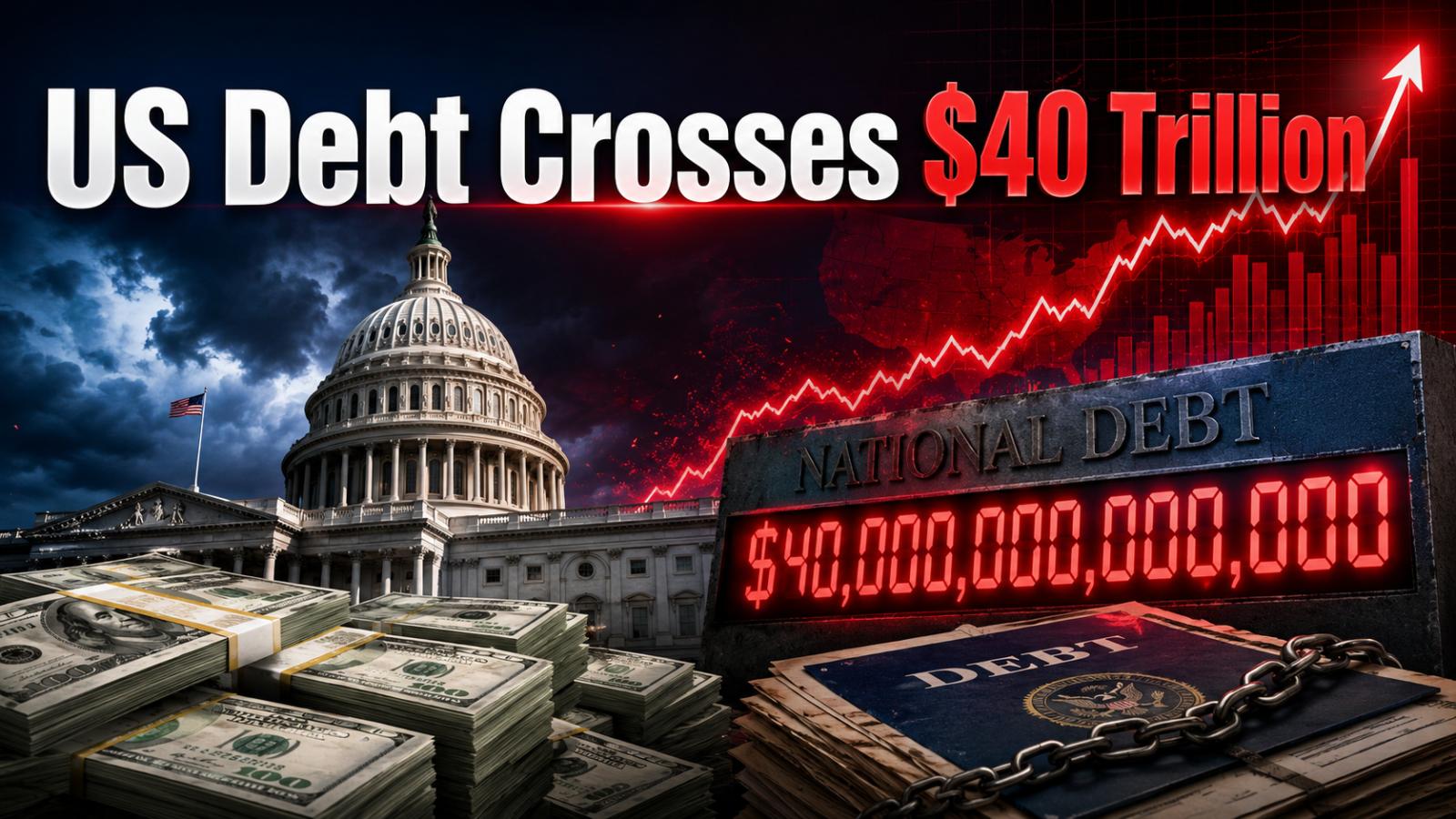
US Debt Crosses $40 Trillion as Borrowing Pressure Builds
The US debt has crossed $40 trillion for the first time, putting renewed focus on federal deficits, higher interest costs and Treasury yields. The milestone does not mean an immediate debt crisis, but it highlights how rapidly Washington’s borrowing burden is growing. Why US debt keeps rising The United States’ gross national debt reach
US Debt Crosses $40 Trillion as Borrowing Pressure Builds
The US debt has crossed $40 trillion for the first time, putting renewed focus on federal deficits, higher interest costs and Treasury yields. The milestone does not mean an immediate debt crisis, but it highlights how rapidly Washington’s borrowing burden is growing. Why US debt keeps rising The United States’ gross national debt reach

Ram Temple Donation Probe: SIT Report Likely Monday
The SIT investigating alleged irregularities in donations received by the Ram temple trust is likely to submit an interim status report to the Supreme Court on Monday, July 20, 2026. The team may also seek additional time to complete the investigation and recommend administrative reforms. SIT Interim Report Expected Before Supreme Court The Special Investigation Team examining alleged embezzlement of donations received by the Shri Ram Janm
Ram Temple Donation Probe: SIT Report Likely Monday
The SIT investigating alleged irregularities in donations received by the Ram temple trust is likely to submit an interim status report to the Supreme Court on Monday, July 20, 2026. The team may also seek additional time to complete the investigation and recommend administrative reforms. SIT Interim Report Expected Before Supreme Court The Special Investigation Team examining alleged embezzlement of donations received by the Shri Ram Janm
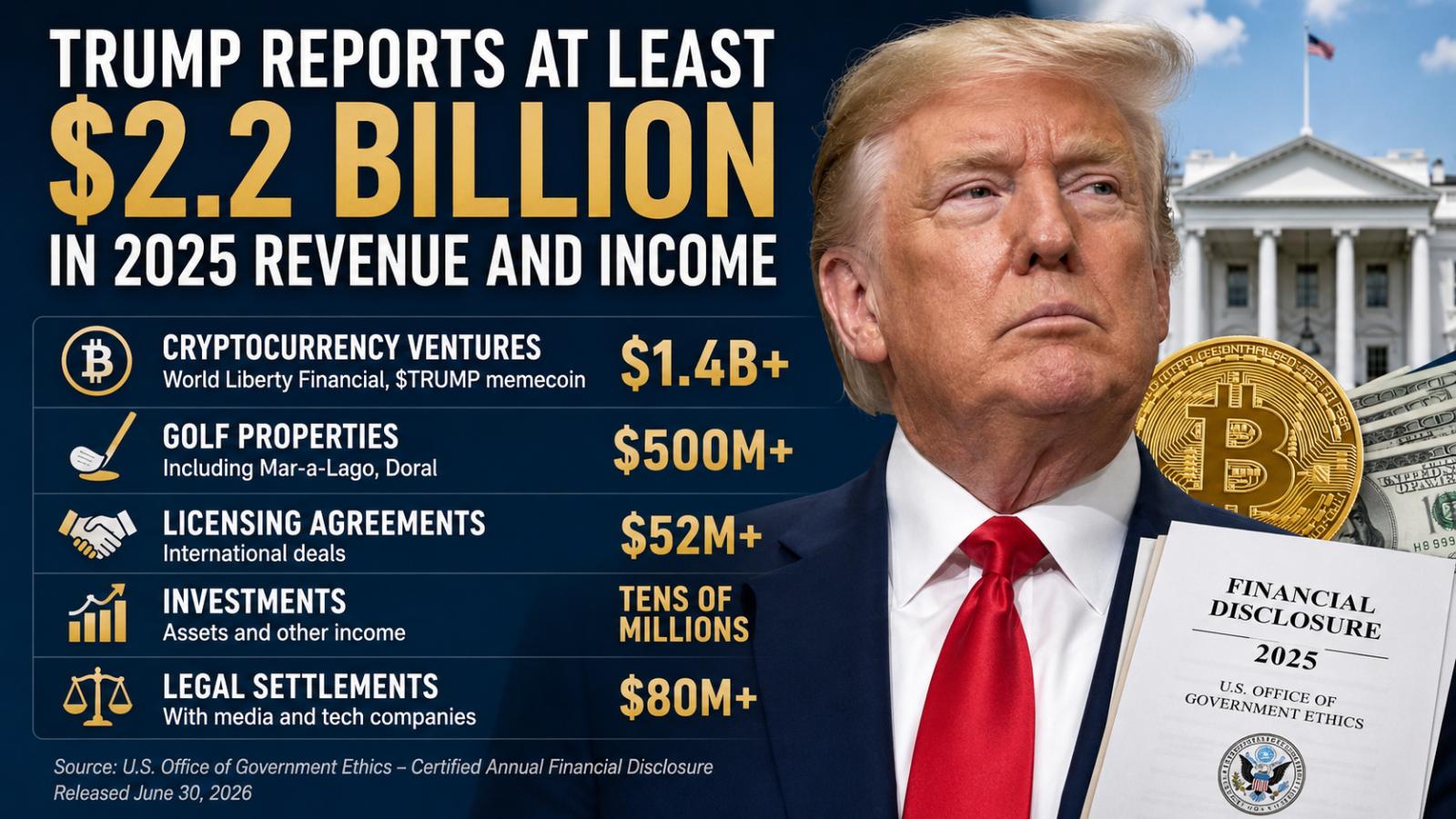
Trump Disclosure Shows $2.2 Billion in 2025 Revenue and Income
President Donald Trump’s 2025 financial disclosure shows more than $2.2 billion in reported revenue and income from cryptocurrency ventures, golf properties, licensing agreements, investments and legal settlements. The U.S. Office of Government Ethics released Trump’s certified annual financial disclosure on Tuesday, June 30, 2026. The nearly 1,000-page filing provides an extensive but incomplete picture of his businesses, assets and incom
Trump Disclosure Shows $2.2 Billion in 2025 Revenue and Income
President Donald Trump’s 2025 financial disclosure shows more than $2.2 billion in reported revenue and income from cryptocurrency ventures, golf properties, licensing agreements, investments and legal settlements. The U.S. Office of Government Ethics released Trump’s certified annual financial disclosure on Tuesday, June 30, 2026. The nearly 1,000-page filing provides an extensive but incomplete picture of his businesses, assets and incom

Indian Couple Reveals $850,000 Debt and 1,200-Day Payoff Plan
An Indian couple says $850,000 in debt accumulated through mortgages, a home renovation loan and credit card balances after years of lifestyle upgrades in the United States. The couple, who said they moved to the United States at age 22, has now announced a 1,200-day plan to become debt-free. They are documenting the effort through their Instagram account, @moneyharmony123. How the Indian Couple’s $850,000 Debt Accumulated According to figure
Indian Couple Reveals $850,000 Debt and 1,200-Day Payoff Plan
An Indian couple says $850,000 in debt accumulated through mortgages, a home renovation loan and credit card balances after years of lifestyle upgrades in the United States. The couple, who said they moved to the United States at age 22, has now announced a 1,200-day plan to become debt-free. They are documenting the effort through their Instagram account, @moneyharmony123. How the Indian Couple’s $850,000 Debt Accumulated According to figure

Pakistan’s FATF Grey-List History and What India’s New Role Means
Pakistan’s FATF grey-lit history has returned to attention following India’s election to the vice-presidency of the global financial-crime watchdog. Read more about India’s first election to the FATF vice-presidency and why the appointment matters. India’s new leadership position gives New Delhi greater visibility i
Pakistan’s FATF Grey-List History and What India’s New Role Means
Pakistan’s FATF grey-lit history has returned to attention following India’s election to the vice-presidency of the global financial-crime watchdog. Read more about India’s first election to the FATF vice-presidency and why the appointment matters. India’s new leadership position gives New Delhi greater visibility i

What Is FATF? Grey List, Black List and Global Power Explained
What is FATF, and why can its decisions affect governments, banks and investors worldwide? The Financial Action Task Force is the leading international body that sets standards for combating money laundering, terrorist financing and the financing of weapons proliferation. The organisation has received renewed attention after India was elected FAT
What Is FATF? Grey List, Black List and Global Power Explained
What is FATF, and why can its decisions affect governments, banks and investors worldwide? The Financial Action Task Force is the leading international body that sets standards for combating money laundering, terrorist financing and the financing of weapons proliferation. The organisation has received renewed attention after India was elected FAT

India Elected FATF Vice-President for First Time: Why It Matters
India has been elected FATF vice-president for the first time, placing senior official Vivek Aggarwal in a key leadership role at the global body that sets standards against money laundering, terrorist financing and proliferation financing. The Financial Action Task Force announced the appointment after its plenary meeting in Paris on Friday, June 19, 2026. Aggarwal, a 1994-batch Indian Administrative Service officer and secretary in India’s Ministry of Culture, will serve from Ju
India Elected FATF Vice-President for First Time: Why It Matters
India has been elected FATF vice-president for the first time, placing senior official Vivek Aggarwal in a key leadership role at the global body that sets standards against money laundering, terrorist financing and proliferation financing. The Financial Action Task Force announced the appointment after its plenary meeting in Paris on Friday, June 19, 2026. Aggarwal, a 1994-batch Indian Administrative Service officer and secretary in India’s Ministry of Culture, will serve from Ju

Student Loan Forgiveness 2026: New Bill Could Cut Repayment Time
Student Loan Forgiveness Update: What’s Changing? A new student loan forgiveness bill in 2026 could significantly shorten repayment timelines for millions of Americans. The proposal would allow unemployed borrowers to count jobless months toward loan forgiveness, even when they make $0 payments. Can Unemployment Count Toward Forgiveness? Yes — under the proposed law, borrowers in income-driven repayment (
Student Loan Forgiveness 2026: New Bill Could Cut Repayment Time
Student Loan Forgiveness Update: What’s Changing? A new student loan forgiveness bill in 2026 could significantly shorten repayment timelines for millions of Americans. The proposal would allow unemployed borrowers to count jobless months toward loan forgiveness, even when they make $0 payments. Can Unemployment Count Toward Forgiveness? Yes — under the proposed law, borrowers in income-driven repayment (

Regulators eye prediction markets after suspicious betting activity
Prediction markets, digital platforms that allow users to wager on future events, are drawing increasing scrutiny amid concerns over suspicious trading activity and the potential misuse of sensitive information. The issue has gained prominence following a case involving a US Army special forces soldier accused of leveraging classified intelligence to place bets linked to a mission targeting Venezuelan President Nicolas Maduro. What are prediction markets? Prediction markets such as Polymarket and Kalshi operate in a manner similar to gambling platforms, but instead of sports, they focus on real-world events. Users place wagers on outcomes ranging from political developments and economic shifts to weather patterns and online activity. Participants earn profits if their predictions are accurate, while platforms generate revenue through transaction fees. With millions of users globally, these platforms now facilitate billions of dollars in wagers across diverse subjects including elections, tariffs, and commodity prices. Are these markets legal? The legal status of prediction markets varies by region. Globally, many jurisdictions permit such platforms, but the regulatory framework in the United States remains complex. Polymarket had been restricted domestically for several years before resuming limited operations, while Kalshi operates under oversight from the Commodity Futures Trading Commission. Some users attempt to bypass restrictions through virtual private networks, raising additional compliance concerns. Unlike traditional bookmakers, these platforms position themselves as exchanges that enable trading rather than setting odds. Can prediction markets accurately forecast events? Research suggests that collective forecasting, often described as the “wisdom of crowds,” can provide valuable insights. By aggregating diverse opinions, prediction markets can sometimes outperform individual experts in anticipating political, economic, and global outcomes. What are the risks involved? Concerns have intensified regarding the potential use of insider information. In the recent case, the US soldier allegedly earned more than $400,000 by betting on outcomes tied to a military operation. Similar patterns have been observed before major geopolitical and entertainment events, where unusual betting activity accurately predicted outcomes. Such incidents have raised questions about whether privileged information is influencing market behavior. Regulatory response and growing oversight Authorities are responding to these developments with increased vigilance. Several US states have initiated measures to restrict or ban prediction markets, while platforms like Kalshi and Polymarket have introduced safeguards to prevent misuse. Kalshi has prohibited political candidates from betting on their own elections, and government agencies have cautioned officials against using insider knowledge for financial gain. A concept with historical roots Despite recent attention, prediction markets are not a new phenomenon. Early models such as the Iowa Electronic Markets, established in 1988, focused on political forecasting. In 2003, the Pentagon explored launching a platform to predict geopolitical events, including potential security threats, but the initiative was abandoned following public criticism. As scrutiny intensifies, the future of prediction markets will likely depend on how effectively regulators and platforms address concerns surrounding transparency, legality, and the ethical use of information.
Regulators eye prediction markets after suspicious betting activity
Prediction markets, digital platforms that allow users to wager on future events, are drawing increasing scrutiny amid concerns over suspicious trading activity and the potential misuse of sensitive information. The issue has gained prominence following a case involving a US Army special forces soldier accused of leveraging classified intelligence to place bets linked to a mission targeting Venezuelan President Nicolas Maduro. What are prediction markets? Prediction markets such as Polymarket and Kalshi operate in a manner similar to gambling platforms, but instead of sports, they focus on real-world events. Users place wagers on outcomes ranging from political developments and economic shifts to weather patterns and online activity. Participants earn profits if their predictions are accurate, while platforms generate revenue through transaction fees. With millions of users globally, these platforms now facilitate billions of dollars in wagers across diverse subjects including elections, tariffs, and commodity prices. Are these markets legal? The legal status of prediction markets varies by region. Globally, many jurisdictions permit such platforms, but the regulatory framework in the United States remains complex. Polymarket had been restricted domestically for several years before resuming limited operations, while Kalshi operates under oversight from the Commodity Futures Trading Commission. Some users attempt to bypass restrictions through virtual private networks, raising additional compliance concerns. Unlike traditional bookmakers, these platforms position themselves as exchanges that enable trading rather than setting odds. Can prediction markets accurately forecast events? Research suggests that collective forecasting, often described as the “wisdom of crowds,” can provide valuable insights. By aggregating diverse opinions, prediction markets can sometimes outperform individual experts in anticipating political, economic, and global outcomes. What are the risks involved? Concerns have intensified regarding the potential use of insider information. In the recent case, the US soldier allegedly earned more than $400,000 by betting on outcomes tied to a military operation. Similar patterns have been observed before major geopolitical and entertainment events, where unusual betting activity accurately predicted outcomes. Such incidents have raised questions about whether privileged information is influencing market behavior. Regulatory response and growing oversight Authorities are responding to these developments with increased vigilance. Several US states have initiated measures to restrict or ban prediction markets, while platforms like Kalshi and Polymarket have introduced safeguards to prevent misuse. Kalshi has prohibited political candidates from betting on their own elections, and government agencies have cautioned officials against using insider knowledge for financial gain. A concept with historical roots Despite recent attention, prediction markets are not a new phenomenon. Early models such as the Iowa Electronic Markets, established in 1988, focused on political forecasting. In 2003, the Pentagon explored launching a platform to predict geopolitical events, including potential security threats, but the initiative was abandoned following public criticism. As scrutiny intensifies, the future of prediction markets will likely depend on how effectively regulators and platforms address concerns surrounding transparency, legality, and the ethical use of information.

Federal Charges Filed in Case of Military Insider Trading and Crypto Bets
A United States Army soldier has been indicted on multiple federal charges after authorities alleged he used classified information tied to a covert military operation for personal financial gain. The case centers on claims that sensitive intelligence was exploited to place high-value prediction market bets before key developments became public. According to federal prosecutors, the accused, identified as Gannon Ken Van Dyke, was stationed in North Carolina and had access to restric
Federal Charges Filed in Case of Military Insider Trading and Crypto Bets
A United States Army soldier has been indicted on multiple federal charges after authorities alleged he used classified information tied to a covert military operation for personal financial gain. The case centers on claims that sensitive intelligence was exploited to place high-value prediction market bets before key developments became public. According to federal prosecutors, the accused, identified as Gannon Ken Van Dyke, was stationed in North Carolina and had access to restric
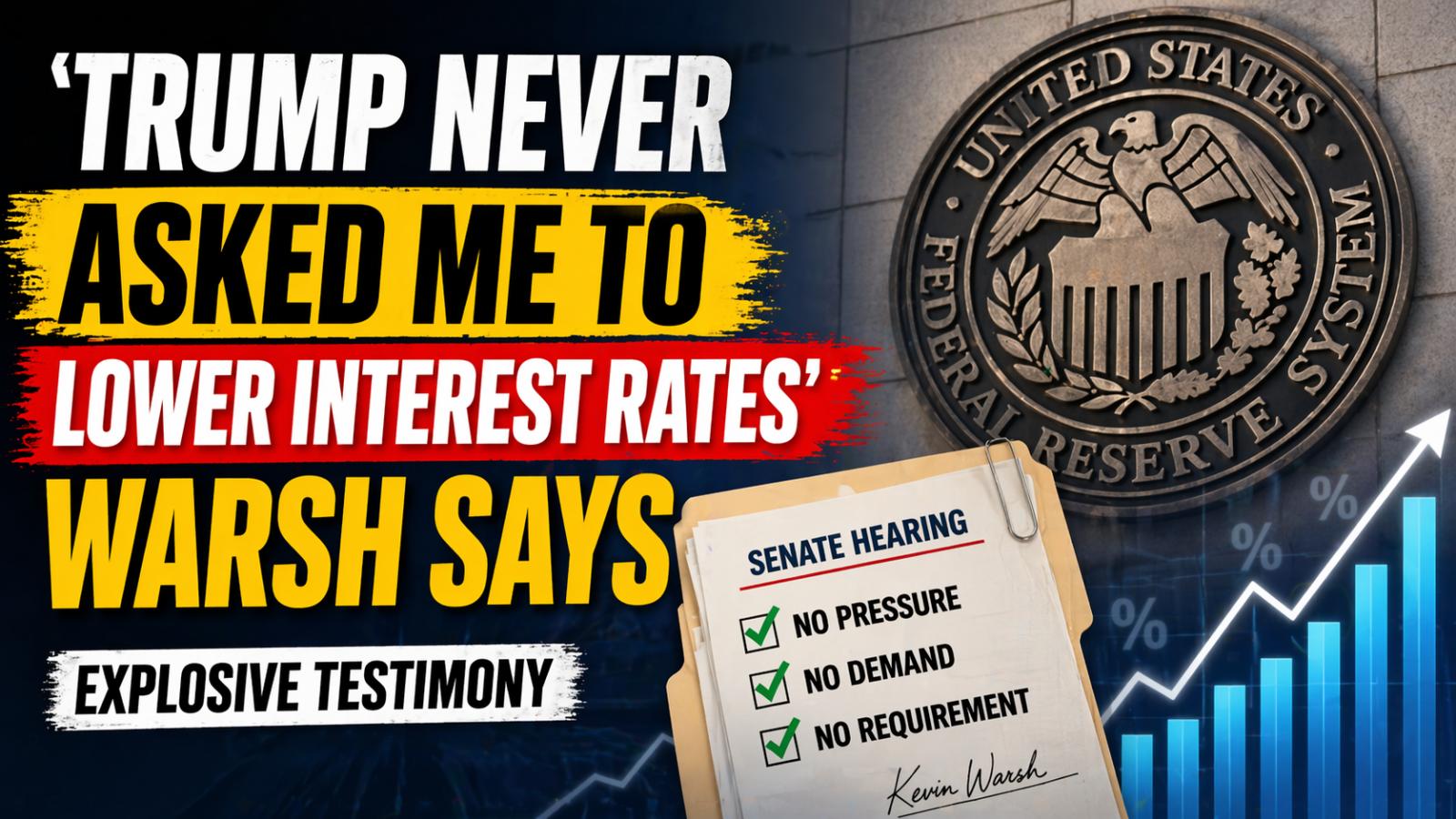
Trump interest rate controversy: Warsh denies pressure in explosive testimony
The Trump interest rate controversy has taken a new turn after Kevin Warsh firmly denied being pressured by US President Donald Trump regarding monetary policy. His testimony has sparked fresh debate over the independence of the Federal Reserve and political influence on economic decisions. What happened and why it matters On April 22, 2026, Kevin Warsh s
Trump interest rate controversy: Warsh denies pressure in explosive testimony
The Trump interest rate controversy has taken a new turn after Kevin Warsh firmly denied being pressured by US President Donald Trump regarding monetary policy. His testimony has sparked fresh debate over the independence of the Federal Reserve and political influence on economic decisions. What happened and why it matters On April 22, 2026, Kevin Warsh s

Kerala Loan Fraud Exposed: How Fake Apps Are Targeting Students and Homemakers
A major loan app scam in Kerala has come to light, with students and homemakers emerging as the worst affected groups. The fraudulent operation involves illegal digital lending apps that lure users with quick and easy loans, often requiring minimal documentation. Once individuals sign up, they are trapped in a cycle of harassment, high interest rates, and threats. Authorities have revealed that these apps operate without proper registration and violate financial regulations. Victims
Kerala Loan Fraud Exposed: How Fake Apps Are Targeting Students and Homemakers
A major loan app scam in Kerala has come to light, with students and homemakers emerging as the worst affected groups. The fraudulent operation involves illegal digital lending apps that lure users with quick and easy loans, often requiring minimal documentation. Once individuals sign up, they are trapped in a cycle of harassment, high interest rates, and threats. Authorities have revealed that these apps operate without proper registration and violate financial regulations. Victims
RBI Keeps Repo Rate Steady at 5.25% in First FY27 Monetary Policy
The Reserve Bank of India has kept the policy repo rate unchanged at 5.25% in its first monetary policy announcement for the financial year 2026–27. The decision was announced by RBI Governor Sanjay Malhotra following a detaile
RBI Keeps Repo Rate Steady at 5.25% in First FY27 Monetary Policy
The Reserve Bank of India has kept the policy repo rate unchanged at 5.25% in its first monetary policy announcement for the financial year 2026–27. The decision was announced by RBI Governor Sanjay Malhotra following a detaile

Oracle Appoints Hilary Maxson as New CFO, Effective April 6, 2026, Amid Tech Expansion
Oracle Corporation has announced the appointment of Hilary Maxson as its new Chief Financial Officer (CFO), effective April 6, 2026. Maxson will take charge of Oracle’s global finance organization, reporting directly to co‑CEO Clay Magouyrk. This appointment marks a pivotal leadership change for the company as it continues to strengthen its position in the cloud computing and artificial intelligence (AI) markets. Maxson, who brings extensive experience in corporate finance and technology leadership, joins Oracle from Schneider Electric, where she served as the Executive Vice President and Group CFO. Her appointment is seen as a strategic move to bolster Oracle’s financial operations amid its ongoing expansion in AI and cloud services. As the company focuses heavily on AI-driven solutions and cloud infrastructure, Maxson’s expertise will be key in navigating the complexities of the evolving tech landscape. With demand for cloud services and AI technologies surging, Oracle is focused on scaling its operations to meet the growing market needs. Maxson’s leadership will guide Oracle through this critical phase, ensuring financial stability while supporting the company’s ambitious growth objectives. Oracle’s investment in AI and cloud technologies has positioned it as a major player in these sectors, and Maxson’s financial oversight will be essential as the company continues to innovate and expand its global footprint. The timing of this leadership change is significant, as Oracle is also undergoing a restructuring process. Recently, the company has faced workforce layoffs, a strategic move to streamline its operations and focus on the most promising areas for future growth. With Maxson at the helm of the finance team, Oracle is poised to make smart financial decisions that will fuel its continued success in the competitive tech sector. Maxson’s appointment underscores Oracle’s commitment to adapting to industry trends and ensuring its leadership is well-equipped to manage the challenges and opportunities in the rapidly changing tech landscape. As she steps into her new role, Maxson’s focus will be on aligning Oracle’s financial strategies with its long-term goals, driving profitability, and supporting the company’s continued leadership in cloud computing and AI.
Oracle Appoints Hilary Maxson as New CFO, Effective April 6, 2026, Amid Tech Expansion
Oracle Corporation has announced the appointment of Hilary Maxson as its new Chief Financial Officer (CFO), effective April 6, 2026. Maxson will take charge of Oracle’s global finance organization, reporting directly to co‑CEO Clay Magouyrk. This appointment marks a pivotal leadership change for the company as it continues to strengthen its position in the cloud computing and artificial intelligence (AI) markets. Maxson, who brings extensive experience in corporate finance and technology leadership, joins Oracle from Schneider Electric, where she served as the Executive Vice President and Group CFO. Her appointment is seen as a strategic move to bolster Oracle’s financial operations amid its ongoing expansion in AI and cloud services. As the company focuses heavily on AI-driven solutions and cloud infrastructure, Maxson’s expertise will be key in navigating the complexities of the evolving tech landscape. With demand for cloud services and AI technologies surging, Oracle is focused on scaling its operations to meet the growing market needs. Maxson’s leadership will guide Oracle through this critical phase, ensuring financial stability while supporting the company’s ambitious growth objectives. Oracle’s investment in AI and cloud technologies has positioned it as a major player in these sectors, and Maxson’s financial oversight will be essential as the company continues to innovate and expand its global footprint. The timing of this leadership change is significant, as Oracle is also undergoing a restructuring process. Recently, the company has faced workforce layoffs, a strategic move to streamline its operations and focus on the most promising areas for future growth. With Maxson at the helm of the finance team, Oracle is poised to make smart financial decisions that will fuel its continued success in the competitive tech sector. Maxson’s appointment underscores Oracle’s commitment to adapting to industry trends and ensuring its leadership is well-equipped to manage the challenges and opportunities in the rapidly changing tech landscape. As she steps into her new role, Maxson’s focus will be on aligning Oracle’s financial strategies with its long-term goals, driving profitability, and supporting the company’s continued leadership in cloud computing and AI.

FBI warns of sharp rise in ATM jackpotting attacks across US
The Federal Bureau of Investigation has issued a nationwide alert to banks and financial institutions, warning of a significant rise in ATM jackpotting attacks, a form of cyber-enabled theft that forces machines to dispense cash without legitimate transactions. Authorities say the trend is accelerating, with financial losses mounting as criminal groups refine their techniques and expand operations across the United States. According to federal officials, nearly 1,900 ATM jackpotting incidents have been reported nationwide since 2020. More than 700 of those cases occurred in 2025 alone, resulting in losses exceeding $20 million. The sharp increase has prompted urgent calls for banks to strengthen ATM security controls, monitor suspicious activity more closely, and share threat intelligence with law enforcement. At the center of the surge is malware from the Ploutus family, a tool specifically designed to hijack ATM systems. Rather than targeting individual customer accounts, the malware attacks the machine’s internal software layer. It exploits the Extensions for Financial Services, or XFS, which normally manages how ATMs physically dispense cash. By injecting unauthorized commands into this layer, attackers can override standard authorization checks and trigger withdrawals without bank approval, card use, or customer credentials. Security analysts warn that once installed, the malware can give criminals direct control of the machine. Because many ATMs operate on widely used operating systems, the attack can often be adapted across different manufacturers with minimal modification. In many cases, cash-out operations can be completed within minutes, allowing perpetrators to leave before alerts are triggered or the machine runs empty. Investigators emphasize that physical access remains the most common entry point for these attacks. Criminals frequently use generic keys to open ATM cabinets and then deploy malware using one of two primary methods. In some incidents, the machine’s hard drive is removed, infected on a separate computer, and reinstalled. In others, the original drive is replaced entirely with a compromised device preloaded with malicious software. Because the malware operates independently of standard banking communications, it can dispense cash without interacting with customer accounts or triggering traditional fraud detection systems. Officials have outlined several warning signs that may indicate a compromised ATM, including unexpected door alerts outside maintenance windows, sudden low-cash notifications, unauthorized devices connected to the machine, missing or tampered hard drives, and machines abruptly marked out of service. Financial institutions are being urged to review physical security protocols, enhance monitoring of service patterns, and report suspicious activity promptly as part of a broader effort to contain the growing ATM cyberattack threat.
FBI warns of sharp rise in ATM jackpotting attacks across US
The Federal Bureau of Investigation has issued a nationwide alert to banks and financial institutions, warning of a significant rise in ATM jackpotting attacks, a form of cyber-enabled theft that forces machines to dispense cash without legitimate transactions. Authorities say the trend is accelerating, with financial losses mounting as criminal groups refine their techniques and expand operations across the United States. According to federal officials, nearly 1,900 ATM jackpotting incidents have been reported nationwide since 2020. More than 700 of those cases occurred in 2025 alone, resulting in losses exceeding $20 million. The sharp increase has prompted urgent calls for banks to strengthen ATM security controls, monitor suspicious activity more closely, and share threat intelligence with law enforcement. At the center of the surge is malware from the Ploutus family, a tool specifically designed to hijack ATM systems. Rather than targeting individual customer accounts, the malware attacks the machine’s internal software layer. It exploits the Extensions for Financial Services, or XFS, which normally manages how ATMs physically dispense cash. By injecting unauthorized commands into this layer, attackers can override standard authorization checks and trigger withdrawals without bank approval, card use, or customer credentials. Security analysts warn that once installed, the malware can give criminals direct control of the machine. Because many ATMs operate on widely used operating systems, the attack can often be adapted across different manufacturers with minimal modification. In many cases, cash-out operations can be completed within minutes, allowing perpetrators to leave before alerts are triggered or the machine runs empty. Investigators emphasize that physical access remains the most common entry point for these attacks. Criminals frequently use generic keys to open ATM cabinets and then deploy malware using one of two primary methods. In some incidents, the machine’s hard drive is removed, infected on a separate computer, and reinstalled. In others, the original drive is replaced entirely with a compromised device preloaded with malicious software. Because the malware operates independently of standard banking communications, it can dispense cash without interacting with customer accounts or triggering traditional fraud detection systems. Officials have outlined several warning signs that may indicate a compromised ATM, including unexpected door alerts outside maintenance windows, sudden low-cash notifications, unauthorized devices connected to the machine, missing or tampered hard drives, and machines abruptly marked out of service. Financial institutions are being urged to review physical security protocols, enhance monitoring of service patterns, and report suspicious activity promptly as part of a broader effort to contain the growing ATM cyberattack threat.
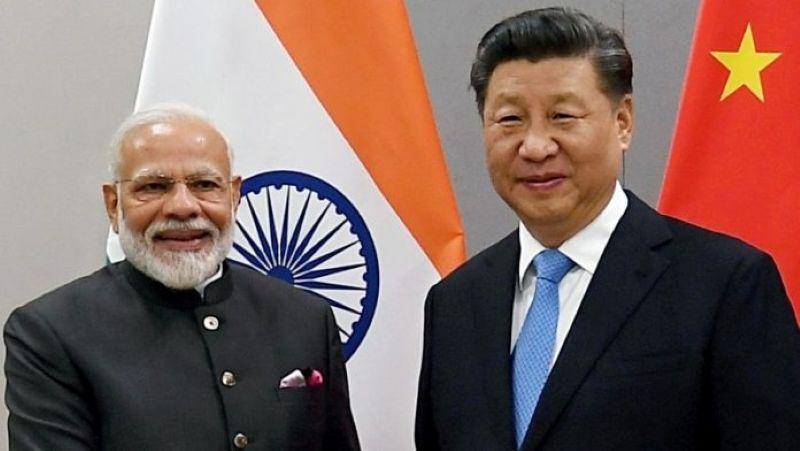
China seeks stronger yuan as Xi Jinping outlines push for global reserve currency
Amid continuing global economic uncertainty and renewed debate over the stability of major reserve currencies, Chinese President Xi Jinping has reiterated China’s ambition to build a “strong currency” and gradually elevate the yuan’s status in the global financial system. Xi said China aims to expand the use of the yuan in international trade, investment, and foreign exchange markets, underscoring a long-standing policy goal to strengthen the country’s financial influence worldwide. Xi’s remarks were outlined in a speech delivered in 2024 to senior provincial and ministerial officials and later published on Saturday in Qiushi, the Communist Party’s leading theoretical journal. The publication of excerpts from the address comes at a time of heightened volatility in global markets and growing scrutiny of the dominance of the US dollar, adding significance to Beijing’s renewed emphasis on currency strength and financial resilience. In the speech, Xi set out what he described as the essential characteristics of a global financial powerhouse. These included a solid economic foundation, world-leading technological and industrial capabilities, and a widely accepted and credible currency. He argued that currency strength was inseparable from broader national competitiveness and institutional capacity, noting that financial influence must be supported by real economic and technological power rather than short-term market movements. Xi also stressed the importance of a capable and independent central bank able to implement effective monetary policy and macroprudential management. He said globally competitive financial institutions, along with influential international financial centres, were necessary to attract global capital and exert pricing power in international markets. According to Xi, these elements must be matched with strong regulation, a reliable legal framework, and a deep pool of skilled financial professionals to ensure long-term stability and credibility. While acknowledging China’s scale in global finance, Xi noted that the country still faced structural limitations. He said China ranked among the world’s largest economies in terms of banking assets, foreign exchange reserves, and capital market size, but remained “big but not strong” overall. Transforming China into a true global financial powerhouse, he added, would be a gradual and long-term undertaking rather than an immediate achievement. Beijing has promoted the internationalisation of the yuan for more than a decade, with measurable progress in its use for cross-border trade settlement. The currency’s role in global markets, however, remains limited when compared with established reserve currencies. China’s Cross-Border Interbank Payment System currently clears an average of about 700 billion yuan, or roughly 100 billion US dollars, in transactions each day. This figure remains well below the nearly 2 trillion US dollars cleared daily through the dollar-based Clearing House Interbank Payments System. Yuan-denominated debt issuance in international markets also accounts for a small share of global activity, representing less than one percent of total issuance. These figures highlight the gap between China’s ambitions and the yuan’s current global footprint, despite steady domestic financial expansion. In recent months, the yuan has generally held firm against the US dollar, even amid trade tensions and uneven global growth. This stability contrasts with the sharper depreciation seen during former US President Donald Trump’s first term, when market observers speculated that Chinese authorities tolerated a weaker currency to offset the impact of tariffs. International investment banks continue to argue that the yuan remains below its long-term fair value, reflecting both policy controls and cautious foreign investor sentiment. The republication of Xi’s speech signals continuity in China’s financial strategy rather than a sudden shift. As global markets navigate uncertainty and reassess existing monetary structures, Beijing appears intent on steadily advancing its vision of a stronger yuan and a more influential role in the international financial system over the long term.
China seeks stronger yuan as Xi Jinping outlines push for global reserve currency
Amid continuing global economic uncertainty and renewed debate over the stability of major reserve currencies, Chinese President Xi Jinping has reiterated China’s ambition to build a “strong currency” and gradually elevate the yuan’s status in the global financial system. Xi said China aims to expand the use of the yuan in international trade, investment, and foreign exchange markets, underscoring a long-standing policy goal to strengthen the country’s financial influence worldwide. Xi’s remarks were outlined in a speech delivered in 2024 to senior provincial and ministerial officials and later published on Saturday in Qiushi, the Communist Party’s leading theoretical journal. The publication of excerpts from the address comes at a time of heightened volatility in global markets and growing scrutiny of the dominance of the US dollar, adding significance to Beijing’s renewed emphasis on currency strength and financial resilience. In the speech, Xi set out what he described as the essential characteristics of a global financial powerhouse. These included a solid economic foundation, world-leading technological and industrial capabilities, and a widely accepted and credible currency. He argued that currency strength was inseparable from broader national competitiveness and institutional capacity, noting that financial influence must be supported by real economic and technological power rather than short-term market movements. Xi also stressed the importance of a capable and independent central bank able to implement effective monetary policy and macroprudential management. He said globally competitive financial institutions, along with influential international financial centres, were necessary to attract global capital and exert pricing power in international markets. According to Xi, these elements must be matched with strong regulation, a reliable legal framework, and a deep pool of skilled financial professionals to ensure long-term stability and credibility. While acknowledging China’s scale in global finance, Xi noted that the country still faced structural limitations. He said China ranked among the world’s largest economies in terms of banking assets, foreign exchange reserves, and capital market size, but remained “big but not strong” overall. Transforming China into a true global financial powerhouse, he added, would be a gradual and long-term undertaking rather than an immediate achievement. Beijing has promoted the internationalisation of the yuan for more than a decade, with measurable progress in its use for cross-border trade settlement. The currency’s role in global markets, however, remains limited when compared with established reserve currencies. China’s Cross-Border Interbank Payment System currently clears an average of about 700 billion yuan, or roughly 100 billion US dollars, in transactions each day. This figure remains well below the nearly 2 trillion US dollars cleared daily through the dollar-based Clearing House Interbank Payments System. Yuan-denominated debt issuance in international markets also accounts for a small share of global activity, representing less than one percent of total issuance. These figures highlight the gap between China’s ambitions and the yuan’s current global footprint, despite steady domestic financial expansion. In recent months, the yuan has generally held firm against the US dollar, even amid trade tensions and uneven global growth. This stability contrasts with the sharper depreciation seen during former US President Donald Trump’s first term, when market observers speculated that Chinese authorities tolerated a weaker currency to offset the impact of tariffs. International investment banks continue to argue that the yuan remains below its long-term fair value, reflecting both policy controls and cautious foreign investor sentiment. The republication of Xi’s speech signals continuity in China’s financial strategy rather than a sudden shift. As global markets navigate uncertainty and reassess existing monetary structures, Beijing appears intent on steadily advancing its vision of a stronger yuan and a more influential role in the international financial system over the long term.
Record Chinese exports drive private capital into global stocks and bonds
China’s record-breaking trade surplus is increasingly reshaping global financial markets as export earnings that once accumulated primarily in state reserves are now being redirected into private investments overseas. The shift marks a notable departure from Beijing’s traditionally centralized management of foreign exchange inflows and introduces new dynamics into global capital movements at a time of heightened sensitivity over trade imbalances and financial stability. Last yea
Record Chinese exports drive private capital into global stocks and bonds
China’s record-breaking trade surplus is increasingly reshaping global financial markets as export earnings that once accumulated primarily in state reserves are now being redirected into private investments overseas. The shift marks a notable departure from Beijing’s traditionally centralized management of foreign exchange inflows and introduces new dynamics into global capital movements at a time of heightened sensitivity over trade imbalances and financial stability. Last yea

Lalit Modi Apologises After Viral Biggest Fugitives Video With Vijay Mallya
Former Indian Premier League chairman Lalit Modi has issued a public apology after facing widespread criticism over a viral video showing him celebrating with fugitive businessman Vijay Mallya in London. The video, which quickly spread across social media platforms, showed the two men referring to themselv
Lalit Modi Apologises After Viral Biggest Fugitives Video With Vijay Mallya
Former Indian Premier League chairman Lalit Modi has issued a public apology after facing widespread criticism over a viral video showing him celebrating with fugitive businessman Vijay Mallya in London. The video, which quickly spread across social media platforms, showed the two men referring to themselv










