





Bengaluru Gets Rail Boost with New Mumbai Services, Vande Bharat Route
Big Rail Boost: Bengaluru to Get Vande Bharat to Mangaluru, 2 New Mumbai Trains Soon In a major step to strengthen railway connectivity across Karnataka and neighbouring states, Union Railway Minister Ashwini Vaishnaw has announced the launch of three new train services from
Bengaluru Gets Rail Boost with New Mumbai Services, Vande Bharat Route
Big Rail Boost: Bengaluru to Get Vande Bharat to Mangaluru, 2 New Mumbai Trains Soon In a major step to strengthen railway connectivity across Karnataka and neighbouring states, Union Railway Minister Ashwini Vaishnaw has announced the launch of three new train services from
Raghu Rai’s Lens Preserved Bengal’s Cultural Icons, Kolkata Pays Tribute
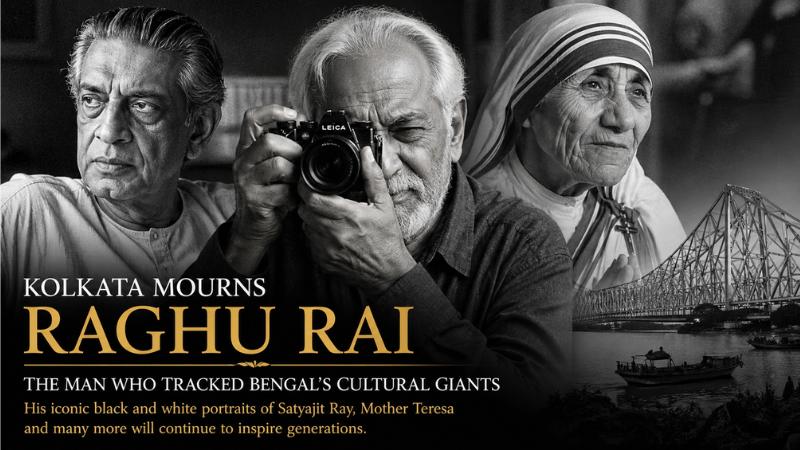
Raghu Rai’s photography stands as a timeless tribute to Bengal’s rich cultural and intellectual heritage, capturing a remarkable spectrum of personalities and moments that shaped the region’s identity. Widely regarded as one of India’s most influential photographers, Raghu Rai used his lens to document not just events, but the deeper emotions and stories behind them. His iconic black and white portraits of legends such as Satyajit Ray and Mother Teresa remain some of the most powerful visual records of their lives and work. Through subtle expressions, light, and composition, Rai was able to reveal the humanity, depth, and quiet strength of his subjects, turning simple photographs into lasting narratives. Kolkata, often considered the cultural capital of India, played a central role in Rai’s photographic journey. The city’s streets, intellectual circles, and artistic traditions frequently appeared in his work, giving audiences a glimpse into its vibrant soul. His images went beyond famous figures to include everyday life, traditions, and social realities, creating a layered and authentic portrayal of Bengal. Over the years, his work has not only preserved history but also inspired generations of photographers and art lovers. As tributes continue to pour in, his legacy endures through images that still speak with emotional clarity and cultural significance, ensuring that the spirit of Bengal’s icons and people lives on through his extraordinary vision.
Raghu Rai’s Lens Preserved Bengal’s Cultural Icons, Kolkata Pays Tribute
Raghu Rai’s photography stands as a timeless tribute to Bengal’s rich cultural and intellectual heritage, capturing a remarkable spectrum of personalities and moments that shaped the region’s identity. Widely regarded as one of India’s most influential photographers, Raghu Rai used his lens to document not just events, but the deeper emotions and stories behind them. His iconic black and white portraits of legends such as Satyajit Ray and Mother Teresa remain some of the most powerful visual records of their lives and work. Through subtle expressions, light, and composition, Rai was able to reveal the humanity, depth, and quiet strength of his subjects, turning simple photographs into lasting narratives. Kolkata, often considered the cultural capital of India, played a central role in Rai’s photographic journey. The city’s streets, intellectual circles, and artistic traditions frequently appeared in his work, giving audiences a glimpse into its vibrant soul. His images went beyond famous figures to include everyday life, traditions, and social realities, creating a layered and authentic portrayal of Bengal. Over the years, his work has not only preserved history but also inspired generations of photographers and art lovers. As tributes continue to pour in, his legacy endures through images that still speak with emotional clarity and cultural significance, ensuring that the spirit of Bengal’s icons and people lives on through his extraordinary vision.

What led to the Louisiana store shooting? Husband arrested after accidental discharge injures wife
A meeting inside a convenience store in Bossier City, Louisiana, turned into a life-threatening emergency on Friday, April 4, 2026, when a firearm discharged at close range, leaving a 30-year-old woman critically injured and prompting the arrest of her husband weeks later. Gun discharge during store meeting under investigation Authorities said the incident occurred inside Mezo Grocery and Deli, where Jigisha, also known as Soniya Gajera, and her husband
What led to the Louisiana store shooting? Husband arrested after accidental discharge injures wife
A meeting inside a convenience store in Bossier City, Louisiana, turned into a life-threatening emergency on Friday, April 4, 2026, when a firearm discharged at close range, leaving a 30-year-old woman critically injured and prompting the arrest of her husband weeks later. Gun discharge during store meeting under investigation Authorities said the incident occurred inside Mezo Grocery and Deli, where Jigisha, also known as Soniya Gajera, and her husband
Did Raghav Chadha’s switch expose ideology as strategy in politics? Yes, it raises serious questions
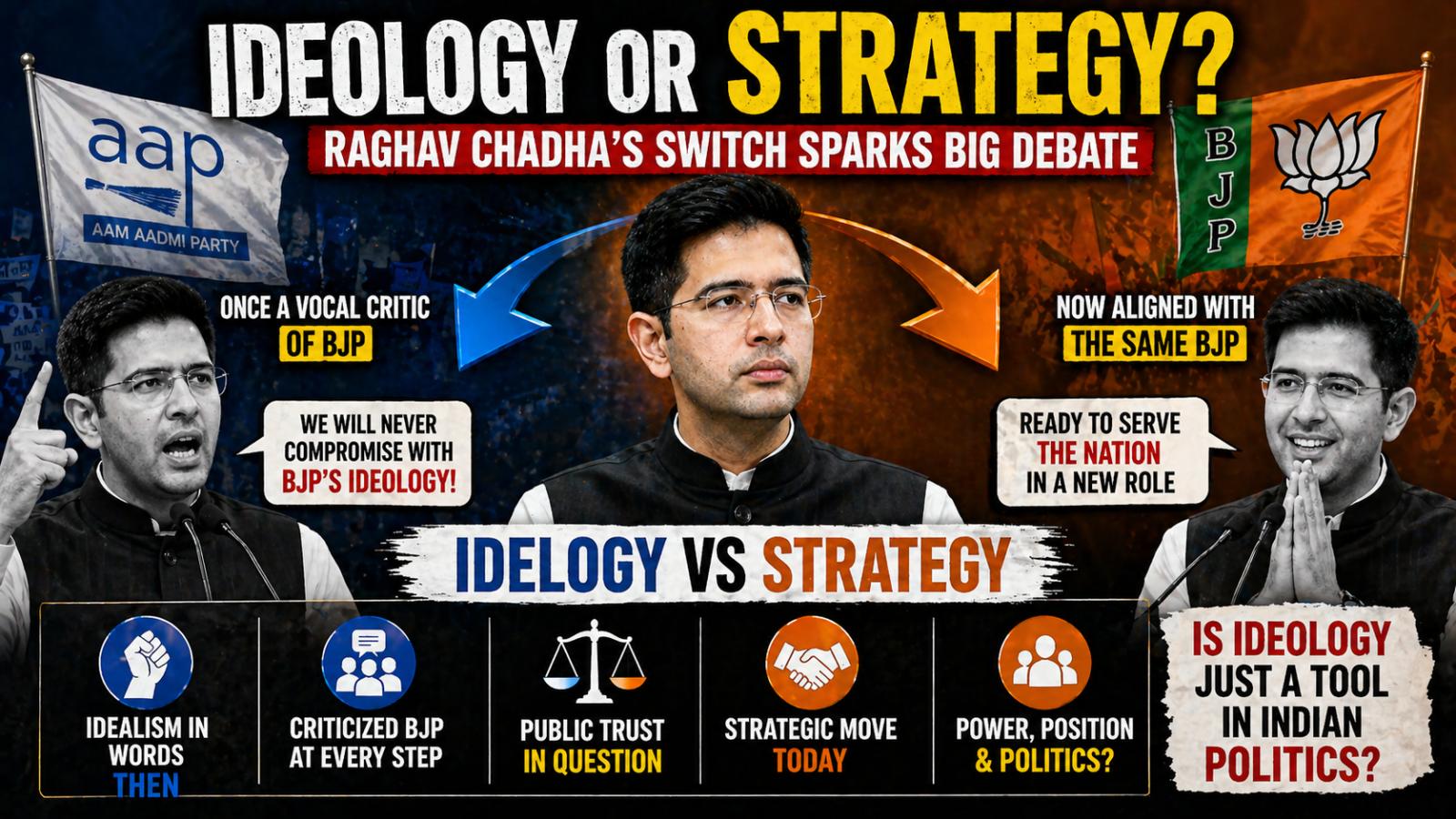
Did Raghav Chadha’s switch expose ideology as strategy in Indian politics? Yes, it raises serious questions as the recent political move by Raghav Chadha has triggered a wider debate about whether ideology in Indian politics is truly stable or simply a matter of strategy. The development, reported on Thursday, April 24, 2026, in India Standard Time, comes as Chadha, once a vocal critic of the Bharatiya Janata Party (BJP), aligned himself with the same political force he had publicly opposed. From vocal opposition to alignment with former rivals For years, Chadha built his political identity within the Aam Aadmi Party (AAP) by criticizing the BJP’s governance style, raising concerns about institutional independence and democratic functioning. His speeches positioned AAP as a clear alternative, emphasizing transparency and accountability. This consistent messaging helped shape public perception and earned him credibility among urban and educated voters. The sudden shift, however, has led to questions about whether those earlier positions were rooted in firm ideological belief or were part of a broader political strategy that evolved over time. BJP’s acceptance raises questions about ideological consistency The BJP, which has maintained political dominance at the national level for over a decade, has consistently emphasized strong ideological foundations and governance continuity. Its decision to accept a leader who had openly challenged its policies now brings attention to the balance between ideological commitment and political expansion. In parliamentary systems, numbers often determine legislative outcomes. Strategic decisions to strengthen representation can override past disagreements, reflecting a pragmatic approach to governance and policy-making. A recurring pattern across political systems This development is not isolated. Political realignments, shifting alliances, and evolving narratives are common across democratic systems worldwide. Leaders frequently transition between parties, and parties themselves adapt to changing political landscapes. Such shifts suggest that while ideology is presented as a guiding principle, strategy often plays a decisive role in shaping political actions. Public trust, consistency, and the shifting foundation of politics For the public, these developments can create uncertainty. Strong statements made in one phase of a political career may not align with actions taken later. This gap between words and actions raises broader concerns about consistency, accountability, and long-term trust in political institutions. What emerges from this pattern is not just a question about one leader or one party, but about the direction of politics itself. When positions can shift so sharply and be accepted just as quickly, it becomes harder to separate belief from convenience. The debate is no longer limited to whether one individual changed sides, but whether such changes are now an accepted norm across the political spectrum. In that context, the latest move involving Raghav Chadha reinforces a broader concern: political systems that emphasize ideology in public messaging may increasingly rely on strategy in practice. In that reality, one conclusion is becoming difficult to ignore. Adapting strategy to suit the moment is no longer just a political tool; it is increasingly becoming the most consistent ideology across political parties.
Did Raghav Chadha’s switch expose ideology as strategy in politics? Yes, it raises serious questions
Did Raghav Chadha’s switch expose ideology as strategy in Indian politics? Yes, it raises serious questions as the recent political move by Raghav Chadha has triggered a wider debate about whether ideology in Indian politics is truly stable or simply a matter of strategy. The development, reported on Thursday, April 24, 2026, in India Standard Time, comes as Chadha, once a vocal critic of the Bharatiya Janata Party (BJP), aligned himself with the same political force he had publicly opposed. From vocal opposition to alignment with former rivals For years, Chadha built his political identity within the Aam Aadmi Party (AAP) by criticizing the BJP’s governance style, raising concerns about institutional independence and democratic functioning. His speeches positioned AAP as a clear alternative, emphasizing transparency and accountability. This consistent messaging helped shape public perception and earned him credibility among urban and educated voters. The sudden shift, however, has led to questions about whether those earlier positions were rooted in firm ideological belief or were part of a broader political strategy that evolved over time. BJP’s acceptance raises questions about ideological consistency The BJP, which has maintained political dominance at the national level for over a decade, has consistently emphasized strong ideological foundations and governance continuity. Its decision to accept a leader who had openly challenged its policies now brings attention to the balance between ideological commitment and political expansion. In parliamentary systems, numbers often determine legislative outcomes. Strategic decisions to strengthen representation can override past disagreements, reflecting a pragmatic approach to governance and policy-making. A recurring pattern across political systems This development is not isolated. Political realignments, shifting alliances, and evolving narratives are common across democratic systems worldwide. Leaders frequently transition between parties, and parties themselves adapt to changing political landscapes. Such shifts suggest that while ideology is presented as a guiding principle, strategy often plays a decisive role in shaping political actions. Public trust, consistency, and the shifting foundation of politics For the public, these developments can create uncertainty. Strong statements made in one phase of a political career may not align with actions taken later. This gap between words and actions raises broader concerns about consistency, accountability, and long-term trust in political institutions. What emerges from this pattern is not just a question about one leader or one party, but about the direction of politics itself. When positions can shift so sharply and be accepted just as quickly, it becomes harder to separate belief from convenience. The debate is no longer limited to whether one individual changed sides, but whether such changes are now an accepted norm across the political spectrum. In that context, the latest move involving Raghav Chadha reinforces a broader concern: political systems that emphasize ideology in public messaging may increasingly rely on strategy in practice. In that reality, one conclusion is becoming difficult to ignore. Adapting strategy to suit the moment is no longer just a political tool; it is increasingly becoming the most consistent ideology across political parties.
Ranveer Singh apologises for Kantara mimicry remarks, court to close case
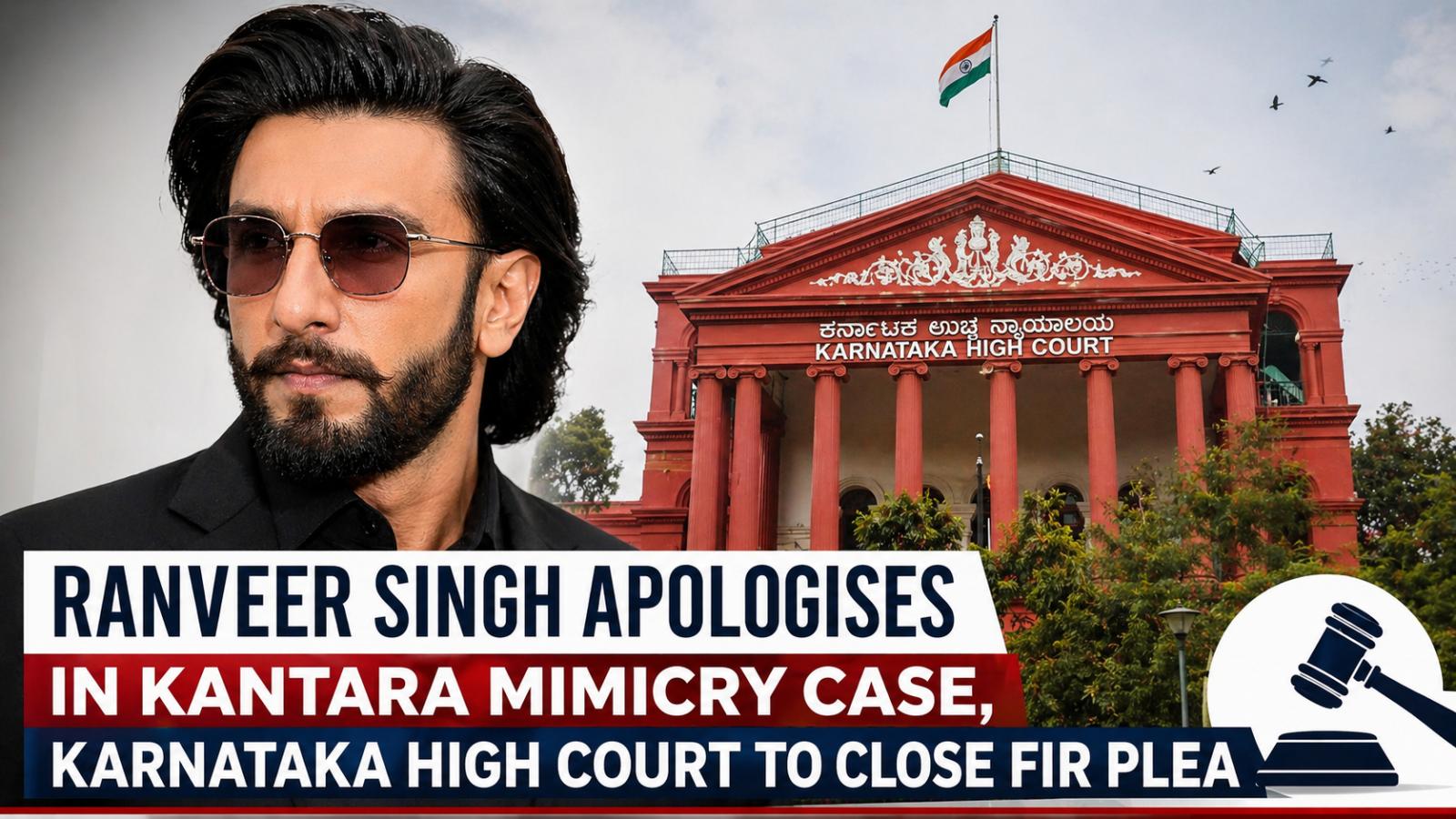
Ranveer Singh submitted a revised affidavit before the Karnataka High Court on Saturday (April 25) during a hearing, expressing his unconditional apology over his mimicry of a character from Kantara: Chapter 1 at a public event last year. The court, after taking note of the affidavit, indicated that it is likely to dispose of the matter by recording the actor’s undertaking and closing the proceedings. The hearing pertained to Singh’s plea seeking to quash an FIR registered against him following remarks made during the International Film Festival of India in Goa. At the event, the actor had mimicked a role portrayed by Rishab Shetty and allegedly made references that hurt religious sentiments associated with a temple deity. The FIR invoked provisions under the Bharatiya Nyaya Sanhita, 2023, relating to promoting enmity and outraging religious beliefs. During the proceedings, counsel representing Singh informed the court that the affidavit had been revised to include an unconditional apology and an acknowledgment of the sentiments involved. The bench noted that the actor had also undertaken to visit the concerned temple within a specified period, and this assurance would be recorded while disposing of the case. The complainant, however, argued before the court that the matter involved a larger issue of faith and should not be treated as a routine legal dispute. The court responded by stating that it would issue an admonition, emphasizing that public figures must remain mindful of their words and actions, especially in matters linked to religious sensitivities. Earlier, the court had declined to stay the FIR, observing that celebrity status does not grant immunity from accountability. With the submission of the revised affidavit during the hearing and the acknowledgment of concerns raised, the court signaled that it would formally conclude the matter without engaging in a detailed legal examination.
Ranveer Singh apologises for Kantara mimicry remarks, court to close case
Ranveer Singh submitted a revised affidavit before the Karnataka High Court on Saturday (April 25) during a hearing, expressing his unconditional apology over his mimicry of a character from Kantara: Chapter 1 at a public event last year. The court, after taking note of the affidavit, indicated that it is likely to dispose of the matter by recording the actor’s undertaking and closing the proceedings. The hearing pertained to Singh’s plea seeking to quash an FIR registered against him following remarks made during the International Film Festival of India in Goa. At the event, the actor had mimicked a role portrayed by Rishab Shetty and allegedly made references that hurt religious sentiments associated with a temple deity. The FIR invoked provisions under the Bharatiya Nyaya Sanhita, 2023, relating to promoting enmity and outraging religious beliefs. During the proceedings, counsel representing Singh informed the court that the affidavit had been revised to include an unconditional apology and an acknowledgment of the sentiments involved. The bench noted that the actor had also undertaken to visit the concerned temple within a specified period, and this assurance would be recorded while disposing of the case. The complainant, however, argued before the court that the matter involved a larger issue of faith and should not be treated as a routine legal dispute. The court responded by stating that it would issue an admonition, emphasizing that public figures must remain mindful of their words and actions, especially in matters linked to religious sensitivities. Earlier, the court had declined to stay the FIR, observing that celebrity status does not grant immunity from accountability. With the submission of the revised affidavit during the hearing and the acknowledgment of concerns raised, the court signaled that it would formally conclude the matter without engaging in a detailed legal examination.
How did Dr. Rajkumar influence Kannada cinema and earn top honors?
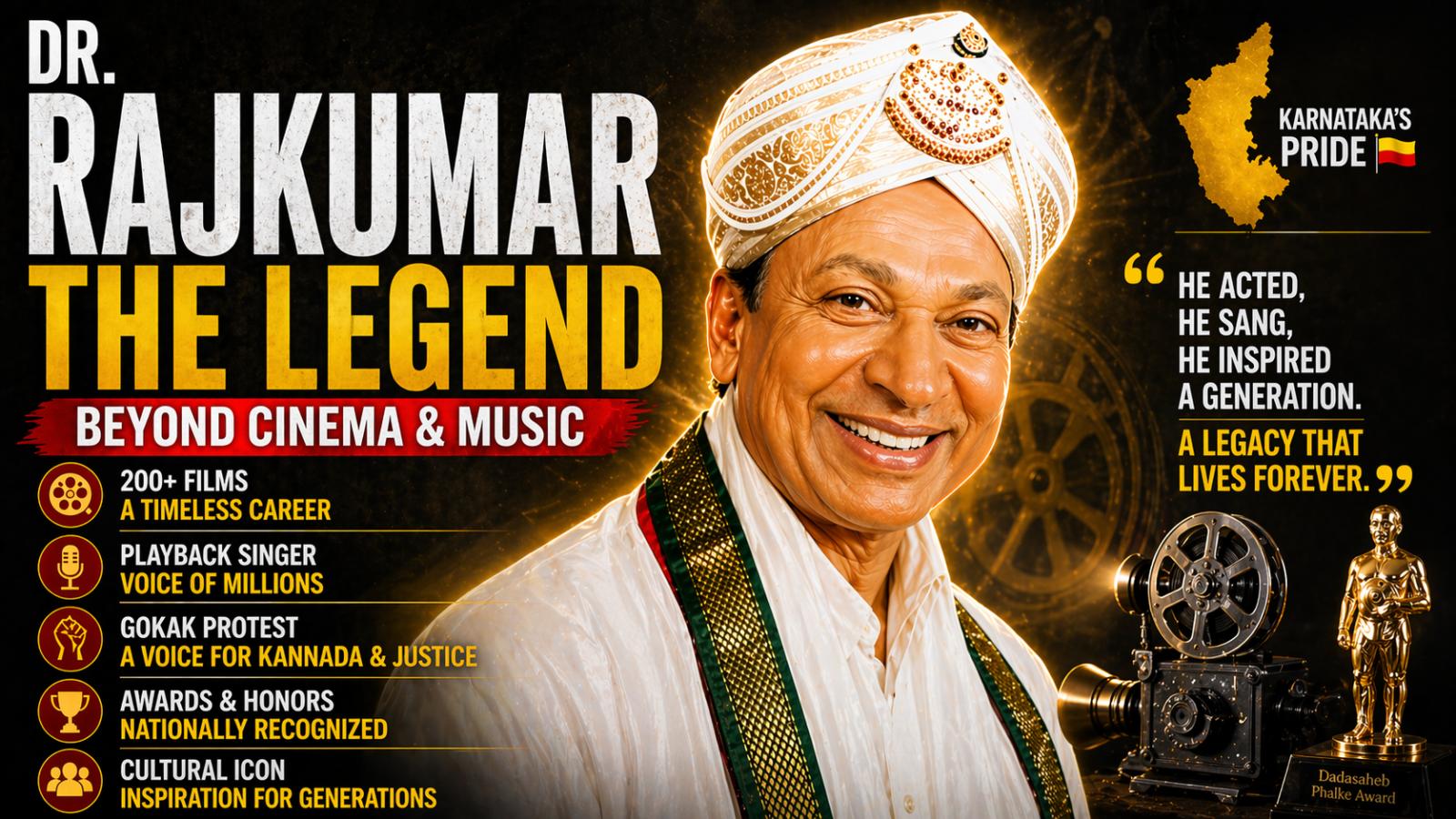
How did Dr. Rajkumar influence Kannada cinema and earn top honors? remains a defining question in understanding Indian cinema, particularly in southern India. Dr. Rajkumar, born on April 24, 1929, in Karnataka, India, rose from a theater background to become one of the most respected actors in Kannada cinema. Raised in a family of stage performers, his early exposure to acting shaped a disciplined and values-driven career that spanned decades. Early life and rise in Kannada cinema Rajkumar’s upbringing in rural Karnataka and his work in traveling theater troupes laid the foundation for his entry into films. He made his cinematic debut in the 1950s with Bedara Kannappa, a mythological film where he portrayed a devoted follower of Lord Shiva. The film marked a turning point in Kannada cinema and established him as a leading actor. Over time, he went on to act in more than 200 films, earning widespread recognition Film career success and lasting impact Over the course of his career, Rajkumar became synonymous with Kannada cinema, often referred to as “Annavru.” His films consistently performed well at the box office and carried strong social messages. One of his most influential works, Bangarada Manushya, portrayed a man returning to agriculture, inspiring many toward rural development and farming. Decades later, Jeevana Chaitra highlighted his enduring appeal, where he played an elderly villager reflecting on changing societal values. Contributions as a playback singer In addition to acting, Rajkumar was an accomplished playback singer. His songs, often rooted in classical traditions, gained widespread popularity. His performance in “Nadamaya” from Jeevana Chaitra earned him national recognition, further establishing his versatility in Indian cinema. Awards, honors, and public recognition Rajkumar received numerous prestigious honors for his contributions to cinema and culture. He was awarded the Dadasaheb Phalke Award in 1995, India’s highest recognition in film. He also received the Padma Bhushan in 1983, one of the country’s top civilian honors. In 1992, he was conferred the Karnataka Ratna, recognizing his profound influence on the state’s cultural identity. Role in Gokak protest and personal principles During the Gokak agitation in the 1980s, Rajkumar played an active role in advocating for the primacy of the Kannada language in education. His involvement brought widespread attention to the movement and reinforced his position as a cultural leader. Strict on-screen rule against smoking and alcohol portrayal One of his most defining personal principles was his conscious decision to never smoke or consume alcohol in his on-screen roles. Given his immense popularity and influence, he believed audiences—especially younger fans—might imitate his behavior. This deliberate choice reflected his sense of responsibility as a public figure and strengthened his reputation as a disciplined and value-driven icon. Rajkumar’s legacy continues to influence Indian cinema and cultural identity, making his life and career a lasting point of reference for artists and audiences alike.
How did Dr. Rajkumar influence Kannada cinema and earn top honors?
How did Dr. Rajkumar influence Kannada cinema and earn top honors? remains a defining question in understanding Indian cinema, particularly in southern India. Dr. Rajkumar, born on April 24, 1929, in Karnataka, India, rose from a theater background to become one of the most respected actors in Kannada cinema. Raised in a family of stage performers, his early exposure to acting shaped a disciplined and values-driven career that spanned decades. Early life and rise in Kannada cinema Rajkumar’s upbringing in rural Karnataka and his work in traveling theater troupes laid the foundation for his entry into films. He made his cinematic debut in the 1950s with Bedara Kannappa, a mythological film where he portrayed a devoted follower of Lord Shiva. The film marked a turning point in Kannada cinema and established him as a leading actor. Over time, he went on to act in more than 200 films, earning widespread recognition Film career success and lasting impact Over the course of his career, Rajkumar became synonymous with Kannada cinema, often referred to as “Annavru.” His films consistently performed well at the box office and carried strong social messages. One of his most influential works, Bangarada Manushya, portrayed a man returning to agriculture, inspiring many toward rural development and farming. Decades later, Jeevana Chaitra highlighted his enduring appeal, where he played an elderly villager reflecting on changing societal values. Contributions as a playback singer In addition to acting, Rajkumar was an accomplished playback singer. His songs, often rooted in classical traditions, gained widespread popularity. His performance in “Nadamaya” from Jeevana Chaitra earned him national recognition, further establishing his versatility in Indian cinema. Awards, honors, and public recognition Rajkumar received numerous prestigious honors for his contributions to cinema and culture. He was awarded the Dadasaheb Phalke Award in 1995, India’s highest recognition in film. He also received the Padma Bhushan in 1983, one of the country’s top civilian honors. In 1992, he was conferred the Karnataka Ratna, recognizing his profound influence on the state’s cultural identity. Role in Gokak protest and personal principles During the Gokak agitation in the 1980s, Rajkumar played an active role in advocating for the primacy of the Kannada language in education. His involvement brought widespread attention to the movement and reinforced his position as a cultural leader. Strict on-screen rule against smoking and alcohol portrayal One of his most defining personal principles was his conscious decision to never smoke or consume alcohol in his on-screen roles. Given his immense popularity and influence, he believed audiences—especially younger fans—might imitate his behavior. This deliberate choice reflected his sense of responsibility as a public figure and strengthened his reputation as a disciplined and value-driven icon. Rajkumar’s legacy continues to influence Indian cinema and cultural identity, making his life and career a lasting point of reference for artists and audiences alike.
Amit Shah Predicts BJP Sweep In Bengal, Claims 110 Of 152 Phase 1 Seats
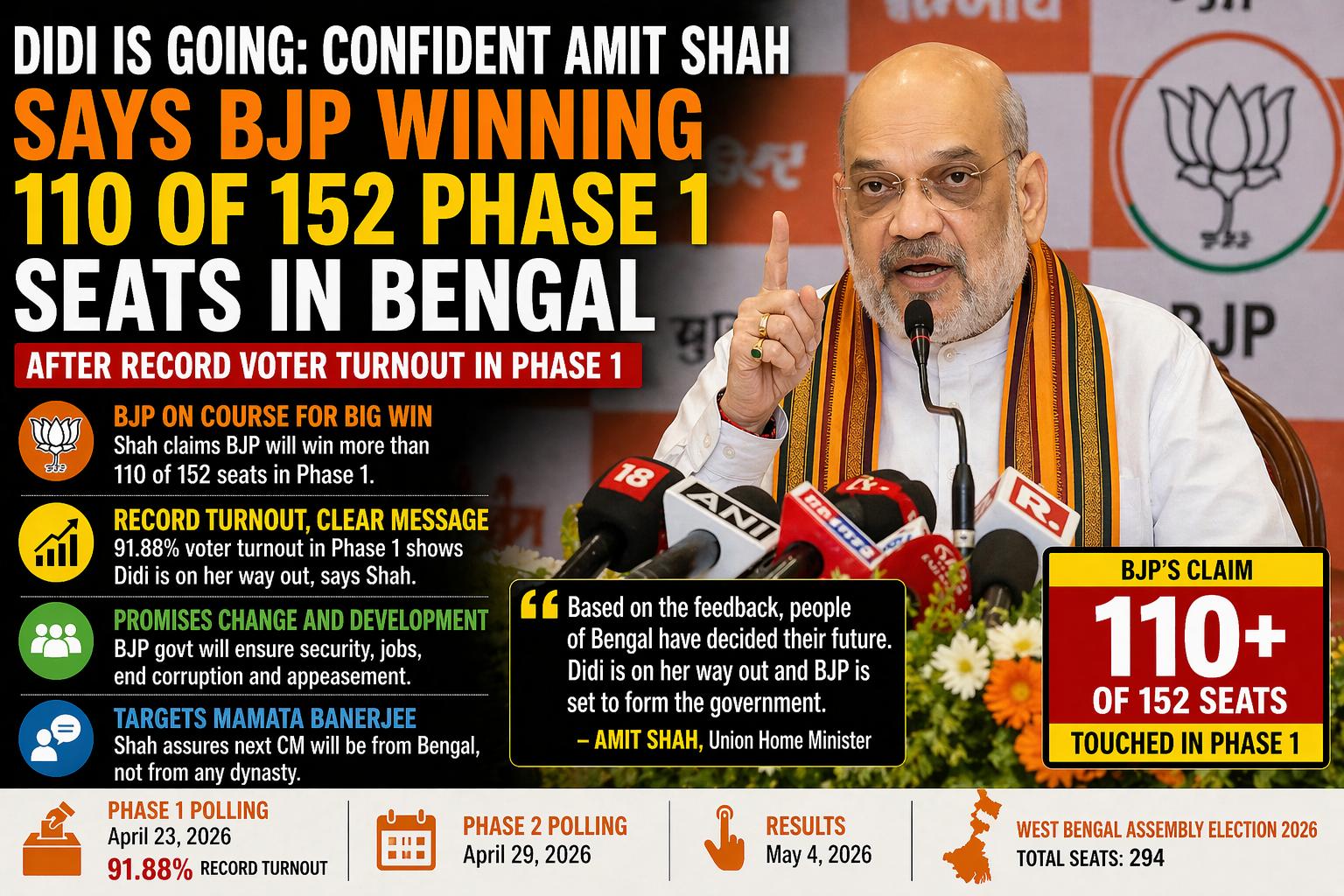
Union Home Minister Amit Shah on April 24, 2026, expressed strong confidence in the Bharatiya Janata Party’s prospects in the West Bengal Assembly elections, asserting that the surge in voter turnout signals a decisive shift in favour of the party. Addressing a press conference in Kolkata a day after Phase 1 polling, Shah claimed that the BJP is on track to win more than 110 of the 152 seats that
Amit Shah Predicts BJP Sweep In Bengal, Claims 110 Of 152 Phase 1 Seats
Union Home Minister Amit Shah on April 24, 2026, expressed strong confidence in the Bharatiya Janata Party’s prospects in the West Bengal Assembly elections, asserting that the surge in voter turnout signals a decisive shift in favour of the party. Addressing a press conference in Kolkata a day after Phase 1 polling, Shah claimed that the BJP is on track to win more than 110 of the 152 seats that
Tamil Nadu Records 84.6% Polling, Highest Ever Turnout In Assembly Elections
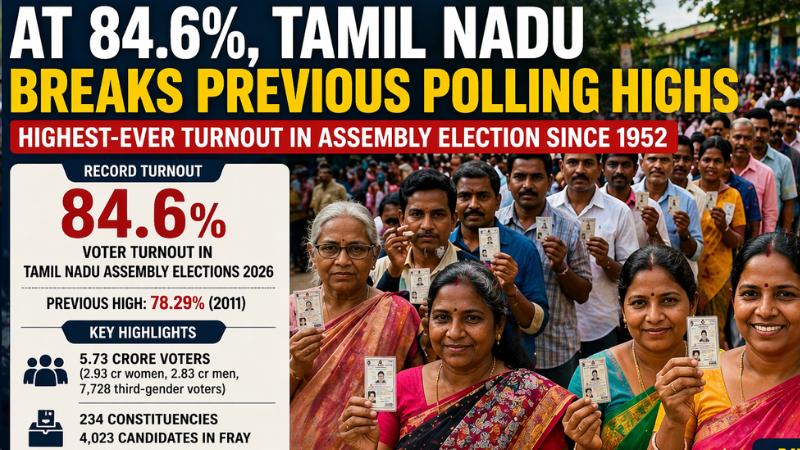
Tamil Nadu witnessed a historic voter turnout of 84.6% in the Assembly elections held on April 24, 2026, marking the highest polling percentage in the state since 1952. The Election Commission reported that the turnout surpassed the previous high of 78.29% recorded in 2011, reflecting strong electoral participation across all 234 constituencies. From early morning, polling booths across the state saw long queues of voters, including elderly citizens, first-time voters, and families, highlight
Tamil Nadu Records 84.6% Polling, Highest Ever Turnout In Assembly Elections
Tamil Nadu witnessed a historic voter turnout of 84.6% in the Assembly elections held on April 24, 2026, marking the highest polling percentage in the state since 1952. The Election Commission reported that the turnout surpassed the previous high of 78.29% recorded in 2011, reflecting strong electoral participation across all 234 constituencies. From early morning, polling booths across the state saw long queues of voters, including elderly citizens, first-time voters, and families, highlight
Wrongful Handcuffing Case: Bombay HC Directs State To Pay ₹50K Each
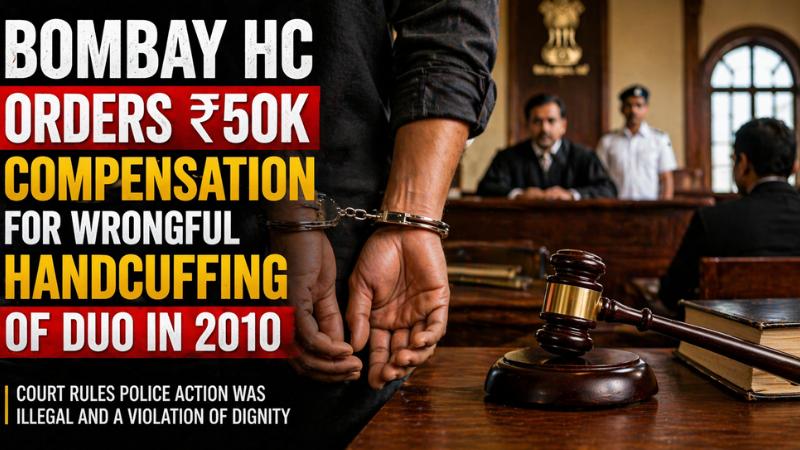
The Bombay High Court has directed the Maharashtra government to pay ₹50,000 each as compensation to advocate Yogeshwar Kawade and former serviceman Avinash Date for wrongful handcuffing by police in a 2010 case. A division bench comprising Justices Urmila Joshi-Phalke and Nivedita Mehta observed that the act amounted to “unwarranted humiliation and in
Wrongful Handcuffing Case: Bombay HC Directs State To Pay ₹50K Each
The Bombay High Court has directed the Maharashtra government to pay ₹50,000 each as compensation to advocate Yogeshwar Kawade and former serviceman Avinash Date for wrongful handcuffing by police in a 2010 case. A division bench comprising Justices Urmila Joshi-Phalke and Nivedita Mehta observed that the act amounted to “unwarranted humiliation and in
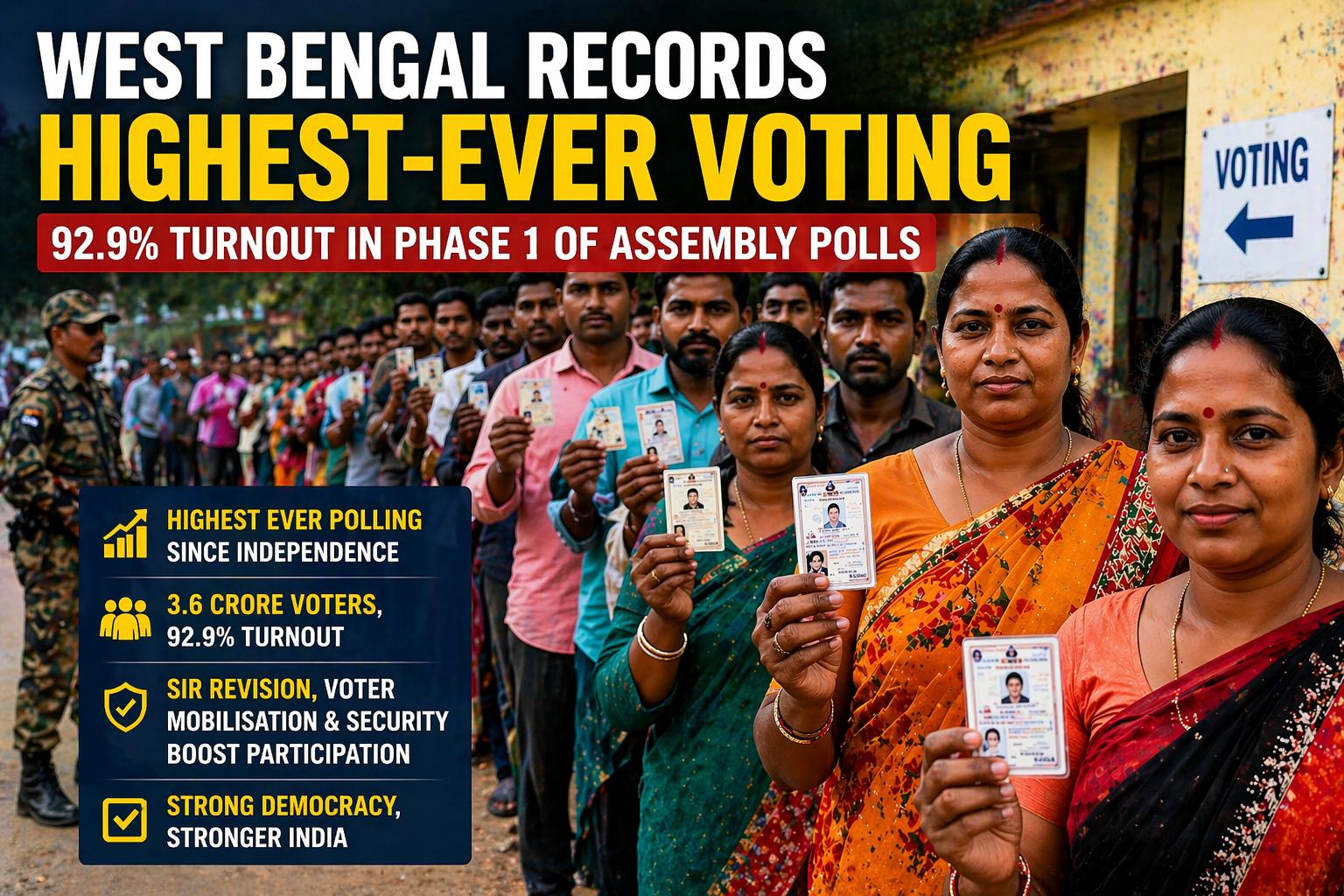
West Bengal Records 92.9% Voting: What Historic Turnout Reveals In 2026 Polls
West Bengal recorded an unprecedented 92.9% voter turnout in Phase 1 of the Assembly elections held on Thursday, April 24, 2026, making it the highest polling percentage in the state since Independence. According to Chief Election Commissioner Gyanesh Kumar, this marks a historic milestone, reflecting extraordinary voter participation across constituencies. Out of approximately 3.6 crore registered
West Bengal Records 92.9% Voting: What Historic Turnout Reveals In 2026 Polls
West Bengal recorded an unprecedented 92.9% voter turnout in Phase 1 of the Assembly elections held on Thursday, April 24, 2026, making it the highest polling percentage in the state since Independence. According to Chief Election Commissioner Gyanesh Kumar, this marks a historic milestone, reflecting extraordinary voter participation across constituencies. Out of approximately 3.6 crore registered
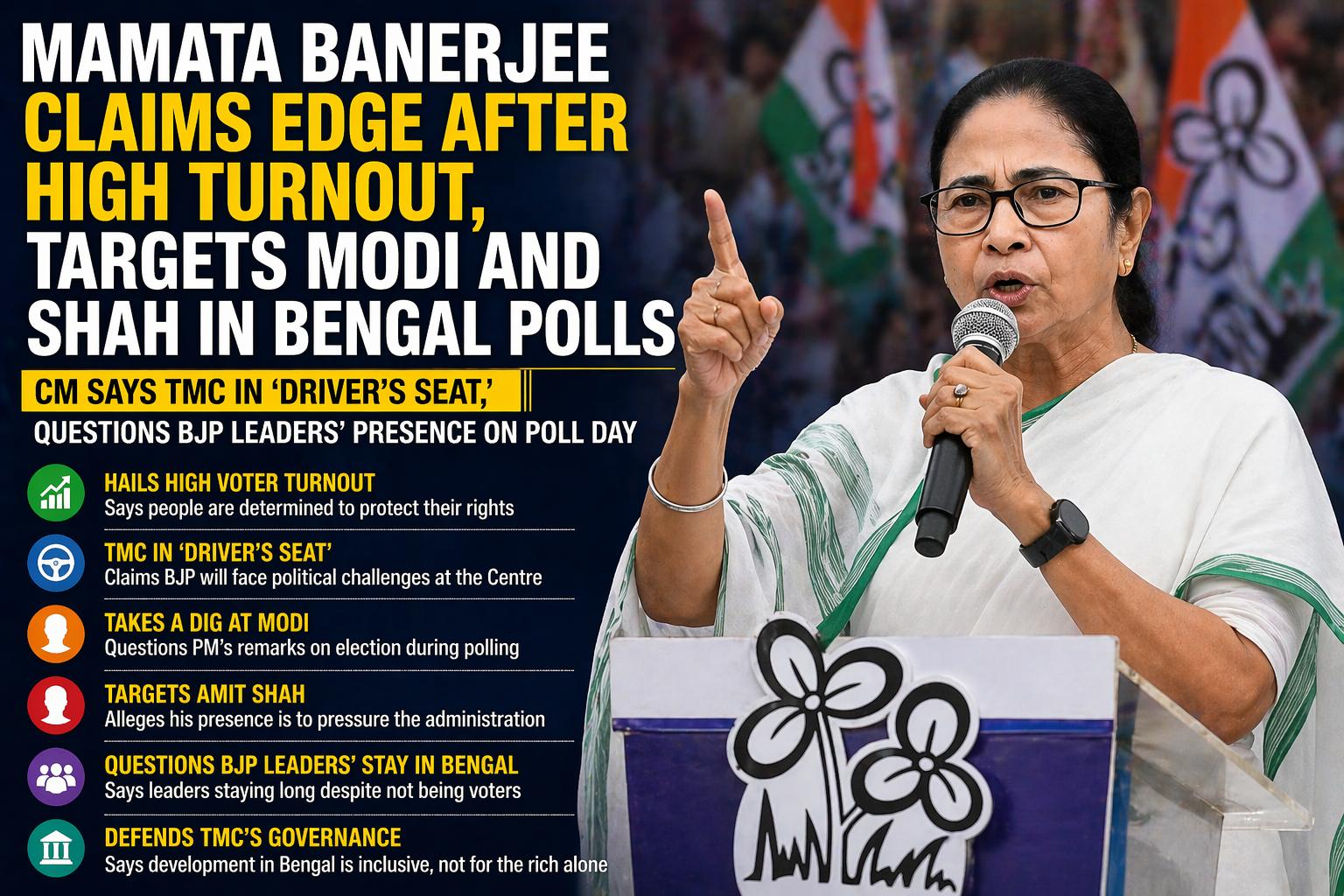
Mamata Banerjee Claims Edge After High Turnout, Targets Modi And Shah In Bengal Polls
West Bengal Chief Minister Mamata Banerjee on April 23, 2026, expressed strong confidence in her party’s performance following a high voter turnout in the first phase of the Assembly elections. Addressing a rally in Chowringhee, central Kolkata, the Trinamool Congress (TMC) chief said the enthusiastic participation of voters indicated public support for her government and its policies. She stated
Mamata Banerjee Claims Edge After High Turnout, Targets Modi And Shah In Bengal Polls
West Bengal Chief Minister Mamata Banerjee on April 23, 2026, expressed strong confidence in her party’s performance following a high voter turnout in the first phase of the Assembly elections. Addressing a rally in Chowringhee, central Kolkata, the Trinamool Congress (TMC) chief said the enthusiastic participation of voters indicated public support for her government and its policies. She stated

Why did the US intercept oil tankers? Enforcement targets Iran-linked shipping network
Seizure of Majestic X in Indian Ocean amid rising tensions The U.S. Department of Defense announced on Thursday, April 23, 2026, that it seized the oil tanker Majestic X in the Indian Ocean while it was en route to Zhoushan, China. Officials said the operation is part of ongoing maritime enforcement aimed at disrupting networks linked to Iranian oil exports in violation of U.S. sanctions. The Pentagon released video footage showing U.S. troops boarding a
Why did the US intercept oil tankers? Enforcement targets Iran-linked shipping network
Seizure of Majestic X in Indian Ocean amid rising tensions The U.S. Department of Defense announced on Thursday, April 23, 2026, that it seized the oil tanker Majestic X in the Indian Ocean while it was en route to Zhoushan, China. Officials said the operation is part of ongoing maritime enforcement aimed at disrupting networks linked to Iranian oil exports in violation of U.S. sanctions. The Pentagon released video footage showing U.S. troops boarding a
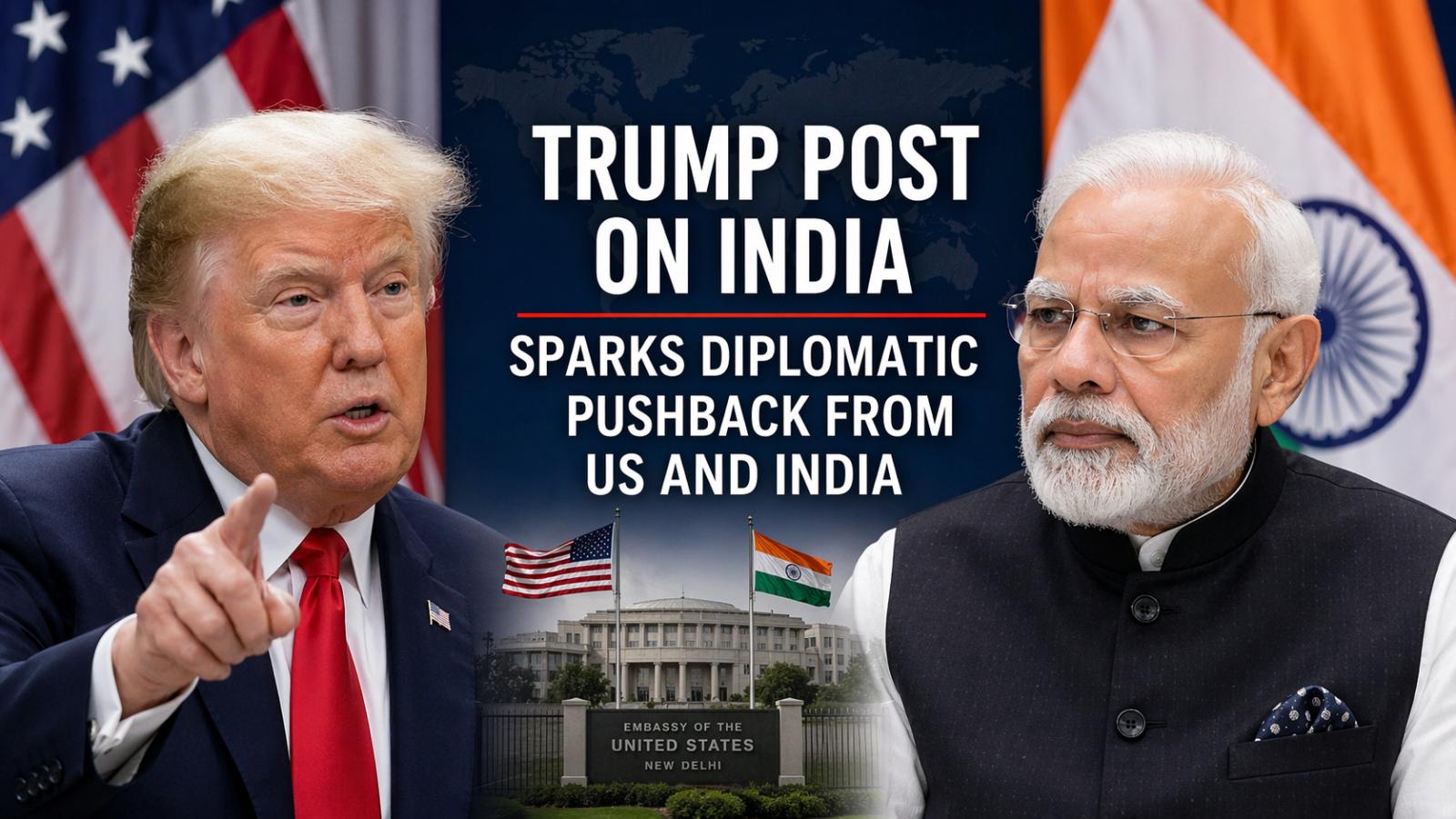
Trump post on India sparks diplomatic pushback from US and India
A controversial Trump post on India triggered diplomatic reactions from US and Indian officials, prompting efforts to reaffirm strong bilateral ties and address global political concerns. Trump post on India sparks diplomatic pushback from US and India — Hours after Donald Trump shared a social media post containing derogatory language about India, US officials moved sw
Trump post on India sparks diplomatic pushback from US and India
A controversial Trump post on India triggered diplomatic reactions from US and Indian officials, prompting efforts to reaffirm strong bilateral ties and address global political concerns. Trump post on India sparks diplomatic pushback from US and India — Hours after Donald Trump shared a social media post containing derogatory language about India, US officials moved sw

“Butter Chicken Tsunami” Comment Triggers Debate Over Immigration and Trade
Comments by New Zealand lawmaker Shane Jones have sparked criticism from the Indian community and political leaders, highlighting tensions within the ruling coalition over immigration and a proposed trade agreement with India. Jones referred to the potential deal as a “butter chicken tsunami” during a radio interview, a remark that quickly drew backlash across political and community circles. Prime Minister Christopher Luxon described the statement as unhelpful but stopped short of labeling it discriminatory. The proposed agreement between New Zealand and India is already facing political hurdles, as Jones’s party, New Zealand First, has voiced opposition. This stance could force the governing party to seek support from the opposition Labour Party to secure parliamentary approval. Jones defended his position by raising concerns about immigration, arguing that unrestricted inflows could impact wages, infrastructure, and public services. His remarks have reignited broader debates about immigration policy and economic priorities, especially as the country navigates its trade relationships. Community leaders expressed strong concern over the tone of the comments. Representatives from Indian associations emphasized the contributions of Indians, who form one of the largest ethnic groups in the country. They argued that such rhetoric risks undermining social cohesion and creating unnecessary divisions within a multicultural society. The controversy has also drawn reactions from political opponents. Labour leader Chris Hipkins criticized the remarks, calling for more responsible discourse from public officials. Business representatives echoed similar sentiments, suggesting that policymakers should focus on constructive dialogue rather than rhetoric that could damage bilateral ties. Jones later acknowledged that colleagues had advised him to moderate his language, though he maintained that his comments were intended to emphasize concerns. As debate continues, the episode underscores the challenges facing New Zealand’s leadership in balancing trade ambitions, immigration policy, and maintaining unity within a diverse population.
“Butter Chicken Tsunami” Comment Triggers Debate Over Immigration and Trade
Comments by New Zealand lawmaker Shane Jones have sparked criticism from the Indian community and political leaders, highlighting tensions within the ruling coalition over immigration and a proposed trade agreement with India. Jones referred to the potential deal as a “butter chicken tsunami” during a radio interview, a remark that quickly drew backlash across political and community circles. Prime Minister Christopher Luxon described the statement as unhelpful but stopped short of labeling it discriminatory. The proposed agreement between New Zealand and India is already facing political hurdles, as Jones’s party, New Zealand First, has voiced opposition. This stance could force the governing party to seek support from the opposition Labour Party to secure parliamentary approval. Jones defended his position by raising concerns about immigration, arguing that unrestricted inflows could impact wages, infrastructure, and public services. His remarks have reignited broader debates about immigration policy and economic priorities, especially as the country navigates its trade relationships. Community leaders expressed strong concern over the tone of the comments. Representatives from Indian associations emphasized the contributions of Indians, who form one of the largest ethnic groups in the country. They argued that such rhetoric risks undermining social cohesion and creating unnecessary divisions within a multicultural society. The controversy has also drawn reactions from political opponents. Labour leader Chris Hipkins criticized the remarks, calling for more responsible discourse from public officials. Business representatives echoed similar sentiments, suggesting that policymakers should focus on constructive dialogue rather than rhetoric that could damage bilateral ties. Jones later acknowledged that colleagues had advised him to moderate his language, though he maintained that his comments were intended to emphasize concerns. As debate continues, the episode underscores the challenges facing New Zealand’s leadership in balancing trade ambitions, immigration policy, and maintaining unity within a diverse population.
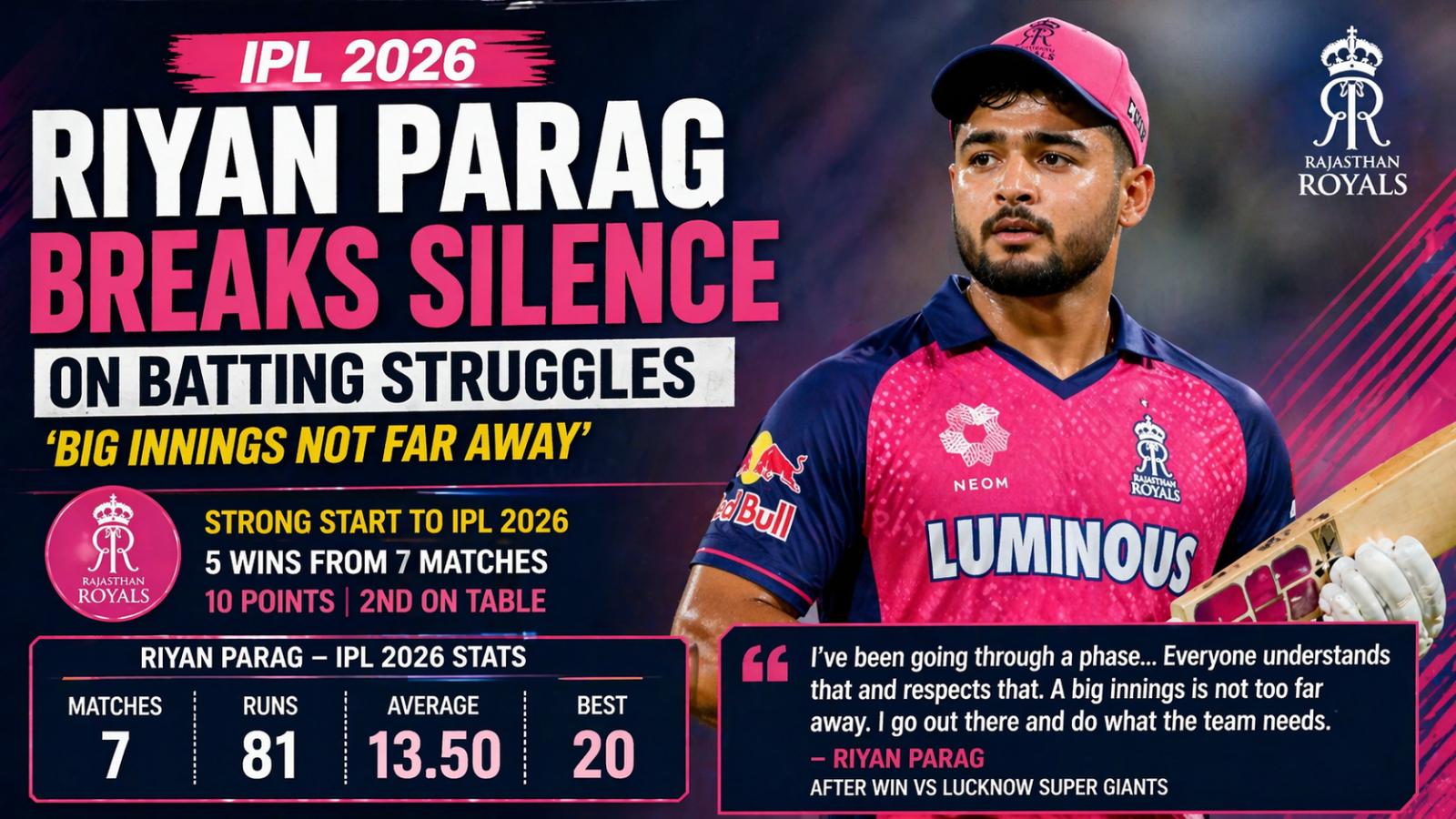
Rajasthan Royals Captain Riyan Parag Confident Big Score Is Coming Soon
Rajasthan Royals have emerged as one of the standout teams in the early phase of IPL 2026, securing five wins in their first seven matches and climbing to second place on the points table with 10 points. While the team’s overall performance has been consistent and dominant, captain Riyan Parag has faced challenges with his personal batting form. Parag has managed only 81 runs across seven innings, averaging 13.50, which is well below expectations for a top-order batter. In the rec
Rajasthan Royals Captain Riyan Parag Confident Big Score Is Coming Soon
Rajasthan Royals have emerged as one of the standout teams in the early phase of IPL 2026, securing five wins in their first seven matches and climbing to second place on the points table with 10 points. While the team’s overall performance has been consistent and dominant, captain Riyan Parag has faced challenges with his personal batting form. Parag has managed only 81 runs across seven innings, averaging 13.50, which is well below expectations for a top-order batter. In the rec
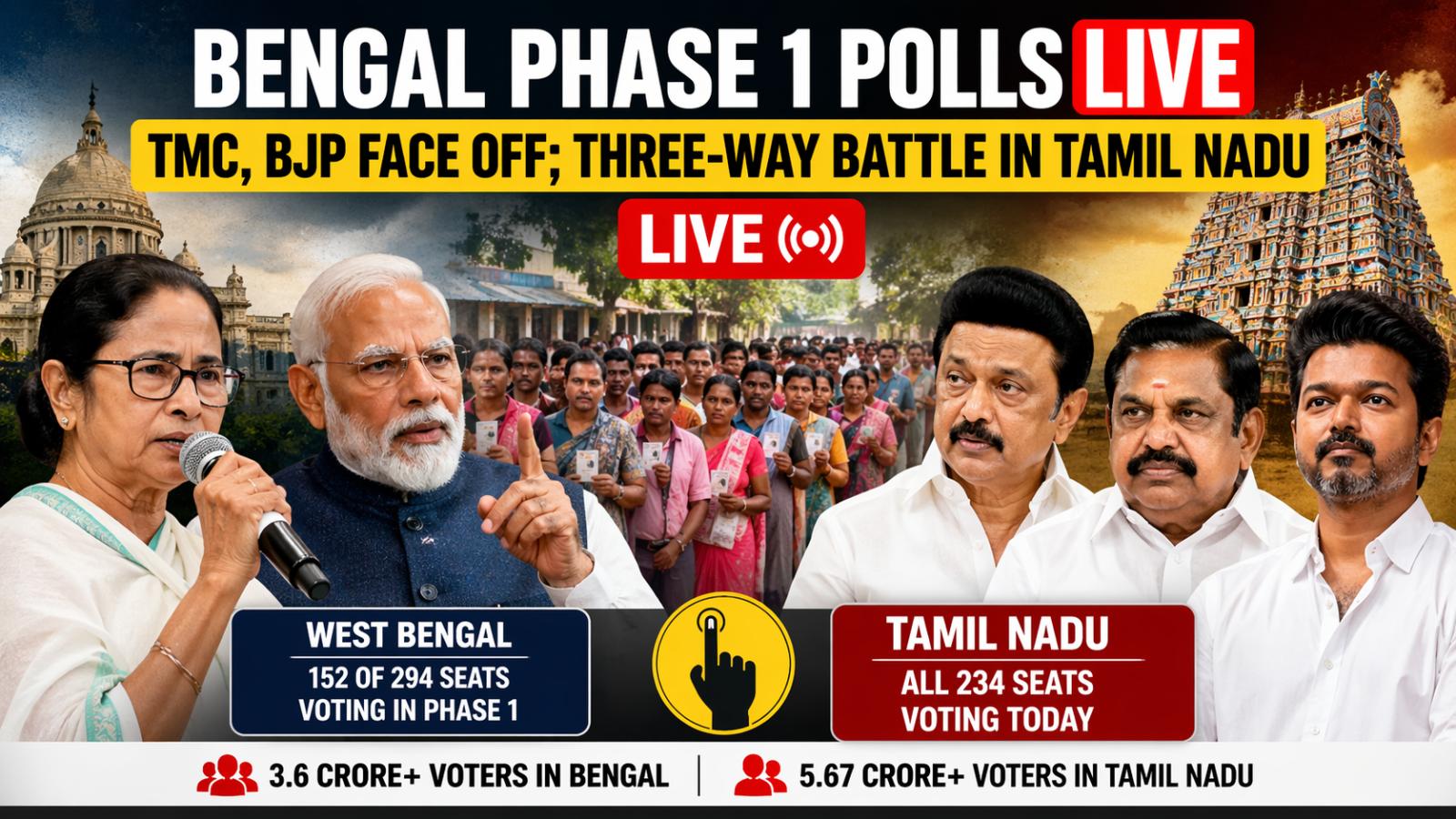
Assembly Elections Live: Bengal Voting Begins, Tamil Nadu Sees Triangular Contest
After weeks of intense campaigning, voting has begun in West Bengal and Tamil Nadu, marking a crucial phase in the 2026 Assembly elections. In West Bengal, polling started at 7 am across 152 constituencies in the first phase, covering more than half of the state’s total 294 seats. The contest in Bengal is largely seen as a direct and high-stakes face-off between the ruling Trinamool Congress led by Mamata Banerjee and the Bharatiya Janata Party. Early hours witnessed long queues at polling
Assembly Elections Live: Bengal Voting Begins, Tamil Nadu Sees Triangular Contest
After weeks of intense campaigning, voting has begun in West Bengal and Tamil Nadu, marking a crucial phase in the 2026 Assembly elections. In West Bengal, polling started at 7 am across 152 constituencies in the first phase, covering more than half of the state’s total 294 seats. The contest in Bengal is largely seen as a direct and high-stakes face-off between the ruling Trinamool Congress led by Mamata Banerjee and the Bharatiya Janata Party. Early hours witnessed long queues at polling
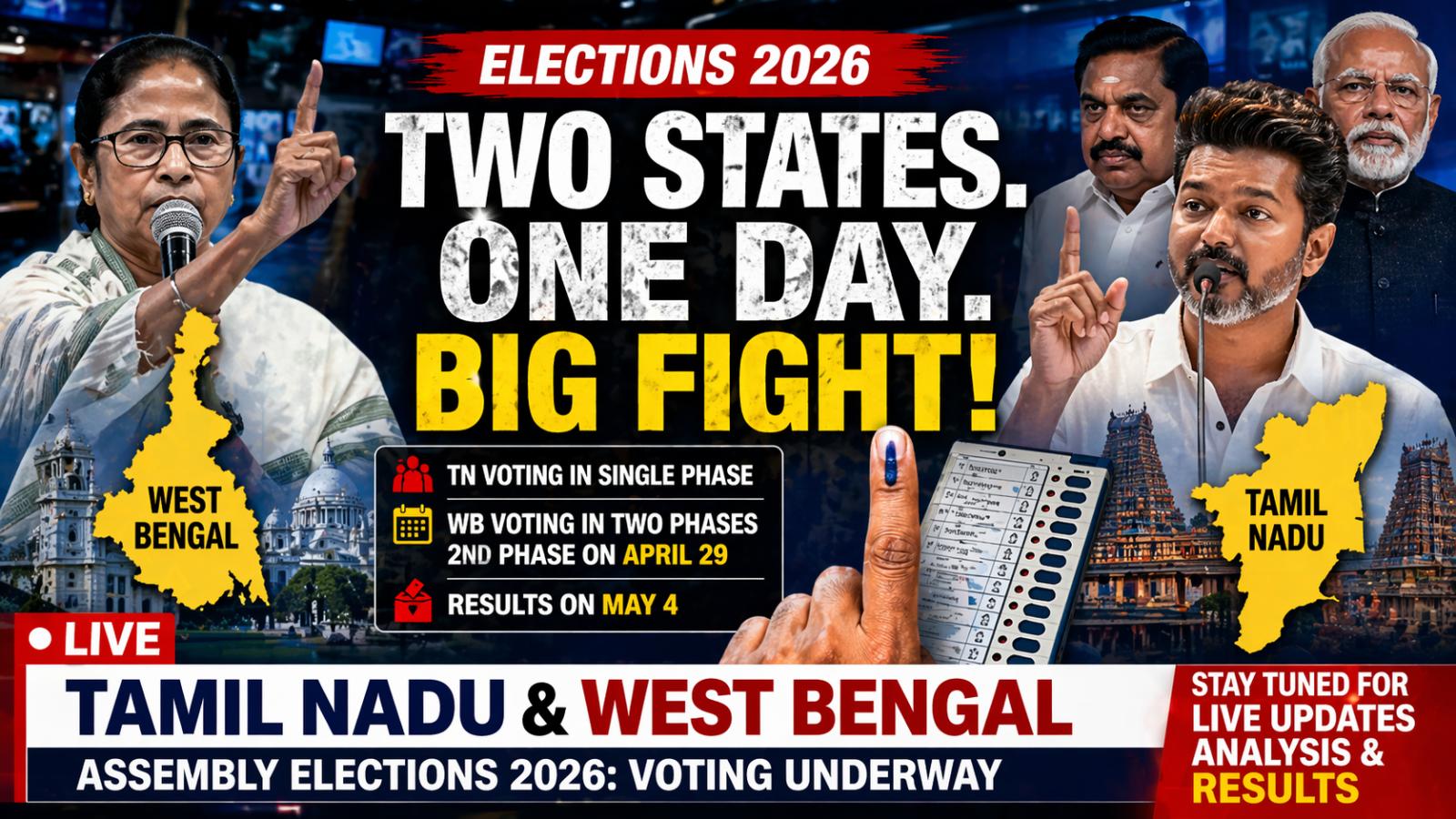
High-Stakes Voting Begins in Tamil Nadu and West Bengal
Voting is currently underway in two of India’s most politically significant states, Tamil Nadu and West Bengal, as part of the 2026 Assembly elections. Polling began today at 7:00 am and is scheduled to continue until 6:00 pm, following early mock polling exercises conducted at select locations such as Chennai and Siliguri to ensure the readiness of voting systems. Officials have reported smooth initial operations, with voter turnout expected to build steadily throughout the day. The electoral process differs between the two states. Tamil Nadu is conducting voting in a single phase, meaning voters across the state will determine the next government simultaneously. In contrast, West Bengal is following a two-phase format, with the second phase scheduled for April 29. Results for both states, along with ongoing bypolls in other regions, will be declared on May 4. In Tamil Nadu, the contest is primarily between the DMK-led Secular Progressive Alliance and the NDA bloc led by AIADMK. The DMK alliance includes Congress, DMDK, and VCK, while AIADMK is aligned with BJP and PMK. However, this election cycle introduces a notable shift with the political entry of Vijay and his party TVK. His debut adds a third dimension to what has traditionally been a two-front contest, potentially altering voting patterns and outcomes. West Bengal presents an equally intense political environment. The ruling Trinamool Congress, led by Chief Minister Mamata Banerjee, is seeking a fourth consecutive term in power. The BJP, which significantly expanded its presence in the previous election by securing 77 seats, is aiming to build on that momentum and challenge the incumbent leadership more aggressively. Beyond these two major states, bypolls are also being conducted in Gujarat’s Umreth and Maharashtra’s Baramati and Rahuri constituencies. These results will be announced alongside the main election outcomes, adding further political significance to the day’s voting activity.
High-Stakes Voting Begins in Tamil Nadu and West Bengal
Voting is currently underway in two of India’s most politically significant states, Tamil Nadu and West Bengal, as part of the 2026 Assembly elections. Polling began today at 7:00 am and is scheduled to continue until 6:00 pm, following early mock polling exercises conducted at select locations such as Chennai and Siliguri to ensure the readiness of voting systems. Officials have reported smooth initial operations, with voter turnout expected to build steadily throughout the day. The electoral process differs between the two states. Tamil Nadu is conducting voting in a single phase, meaning voters across the state will determine the next government simultaneously. In contrast, West Bengal is following a two-phase format, with the second phase scheduled for April 29. Results for both states, along with ongoing bypolls in other regions, will be declared on May 4. In Tamil Nadu, the contest is primarily between the DMK-led Secular Progressive Alliance and the NDA bloc led by AIADMK. The DMK alliance includes Congress, DMDK, and VCK, while AIADMK is aligned with BJP and PMK. However, this election cycle introduces a notable shift with the political entry of Vijay and his party TVK. His debut adds a third dimension to what has traditionally been a two-front contest, potentially altering voting patterns and outcomes. West Bengal presents an equally intense political environment. The ruling Trinamool Congress, led by Chief Minister Mamata Banerjee, is seeking a fourth consecutive term in power. The BJP, which significantly expanded its presence in the previous election by securing 77 seats, is aiming to build on that momentum and challenge the incumbent leadership more aggressively. Beyond these two major states, bypolls are also being conducted in Gujarat’s Umreth and Maharashtra’s Baramati and Rahuri constituencies. These results will be announced alongside the main election outcomes, adding further political significance to the day’s voting activity.
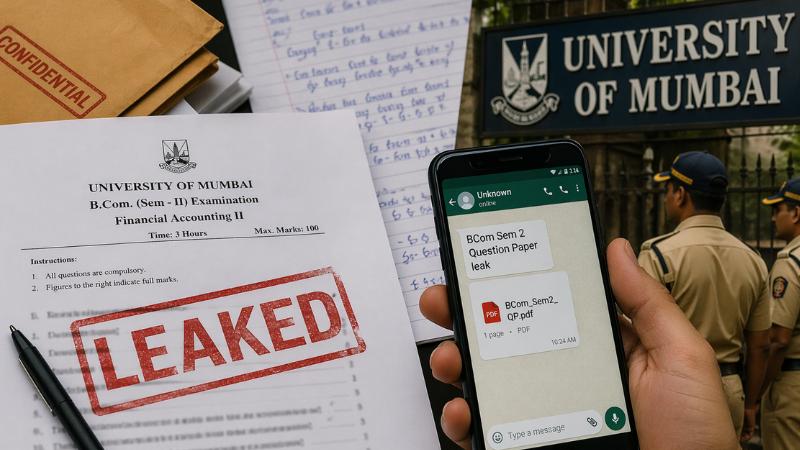
Mumbai BCom Question Paper Leak: Authorities Trace Source
The University of Mumbai has launched an inquiry into the alleged leak of three question papers from its third-year BCom examinations conducted between April 10 and 15. University officials confirmed that the investigation is ongoing and details are being kept confidential. They stated that strict action will be taken in accordance with rules if any individual is found guilty of involvement in the leak. The issue came to light after students approached the Akhil Bharatiya Vidyarthi
Mumbai BCom Question Paper Leak: Authorities Trace Source
The University of Mumbai has launched an inquiry into the alleged leak of three question papers from its third-year BCom examinations conducted between April 10 and 15. University officials confirmed that the investigation is ongoing and details are being kept confidential. They stated that strict action will be taken in accordance with rules if any individual is found guilty of involvement in the leak. The issue came to light after students approached the Akhil Bharatiya Vidyarthi
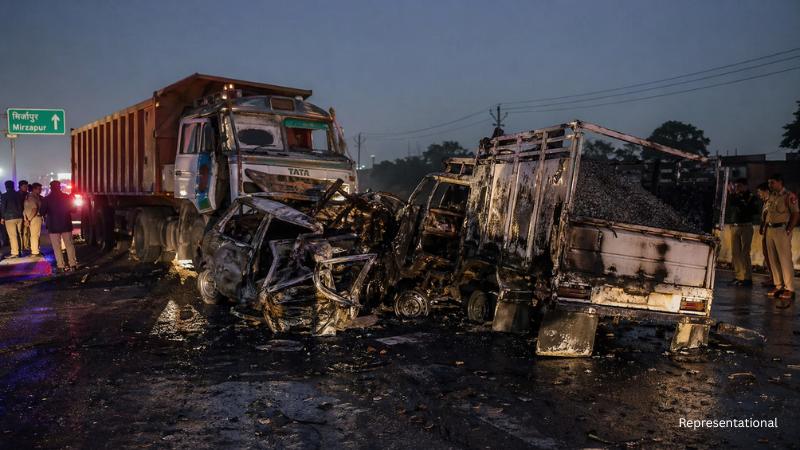
Deadly Uttar Pradesh crash leaves 11 dead after truck collision and fire
A fatal road accident in Mirzapur district of Uttar Pradesh, India, around 8:00 PM IST on Wednesday, April 22, 2026evening resulted in the deaths of 11 people after a truck collided with multiple vehicles and triggered a fire, authorities confirmed. The incident highlights ongoing concerns about road safety and traffic enforcement in the region. According to police officials, the crash occurred when a speeding truck rammed into a Swift car. The force of the impact pushed the smalle
Deadly Uttar Pradesh crash leaves 11 dead after truck collision and fire
A fatal road accident in Mirzapur district of Uttar Pradesh, India, around 8:00 PM IST on Wednesday, April 22, 2026evening resulted in the deaths of 11 people after a truck collided with multiple vehicles and triggered a fire, authorities confirmed. The incident highlights ongoing concerns about road safety and traffic enforcement in the region. According to police officials, the crash occurred when a speeding truck rammed into a Swift car. The force of the impact pushed the smalle
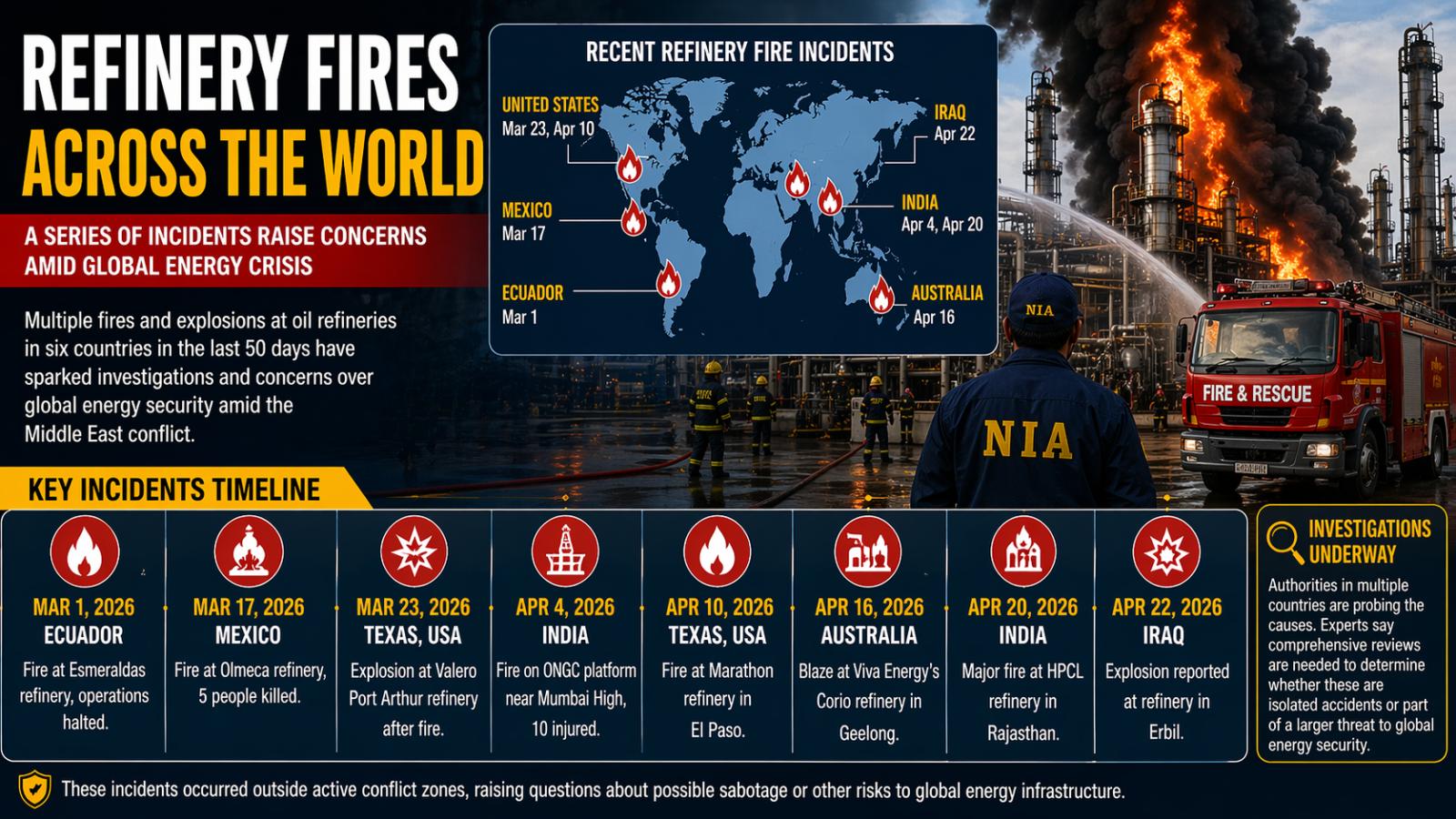
Multiple refinery fires worldwide spark investigations and security concerns
A series of fires and explosions at oil refineries across multiple countries has raised global concerns about energy security as geopolitical tensions escalate following the Middle East conflict that began on Friday, February 28, 2026. Incidents have been reported in India, Iraq, the United States, Mexico, Ecuador, and Australia over a span of approximately 50 days, prompting investigations and speculation about possible underlying causes. In India, a major fire broke out at the Hindu
Multiple refinery fires worldwide spark investigations and security concerns
A series of fires and explosions at oil refineries across multiple countries has raised global concerns about energy security as geopolitical tensions escalate following the Middle East conflict that began on Friday, February 28, 2026. Incidents have been reported in India, Iraq, the United States, Mexico, Ecuador, and Australia over a span of approximately 50 days, prompting investigations and speculation about possible underlying causes. In India, a major fire broke out at the Hindu