








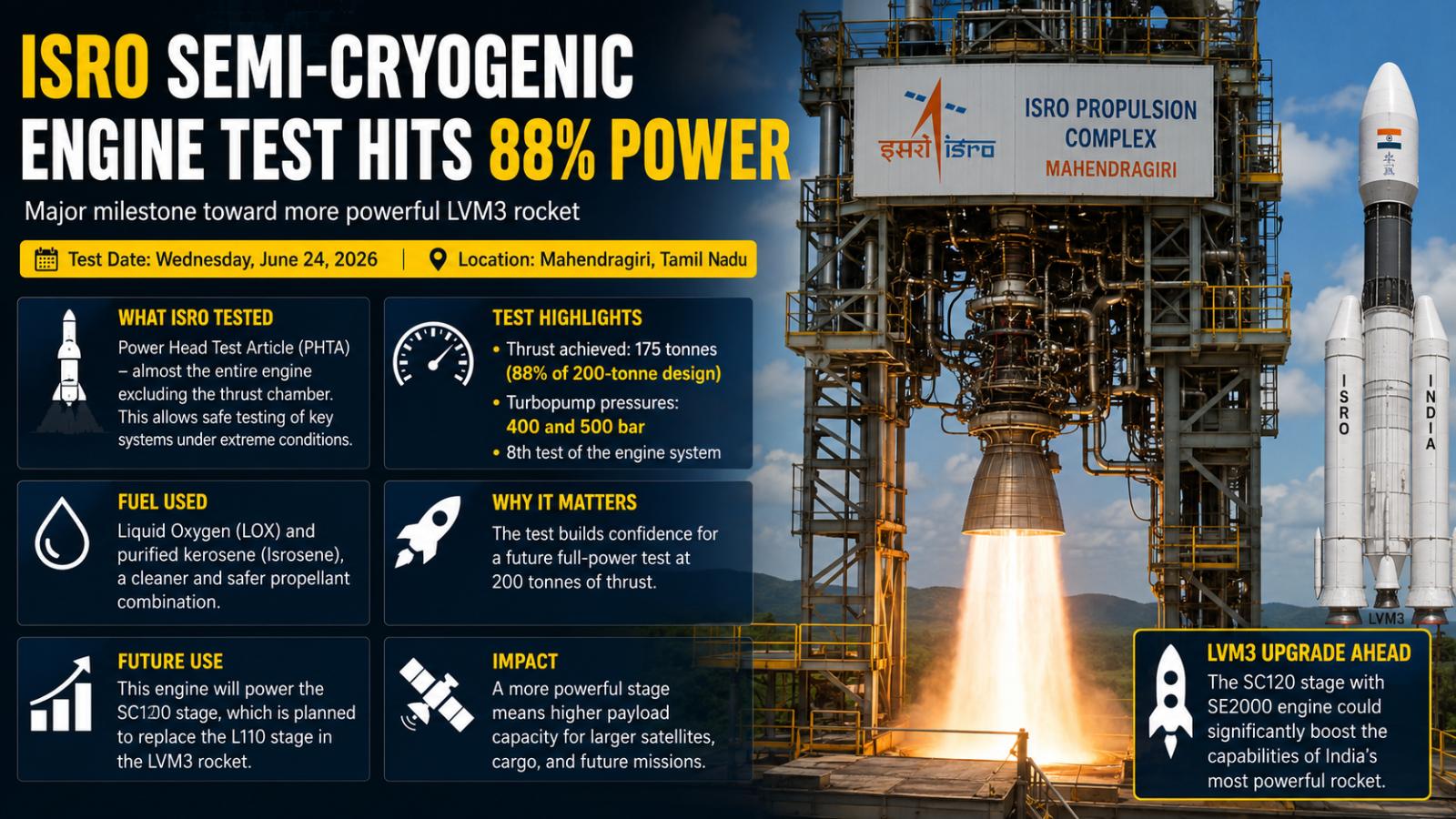











ISRO’s semi-cryogenic engine test reached 88% of its designed thrust on Wednesday, June 24, 2026, marking a major step toward upgrading India’s LVM3 rocket. The Indian Space Research Organisation tested the Power Head Test Article, or PHTA, at its propulsion facility in Mahendragiri, Tamil Nadu. The PHTA includes most major engine systems but excludes the thrust chamber, allowing engineers to evaluate fuel delivery, ignition and pressure performance before testing the complete e
India's growing space capabilities took a decisive leap forward with the successful hot test of the Lox Kerosene 200T thrust semi-cryogenic engine by the Indian Space Research Organisation (ISRO). Conducted at the ISRO Propulsion Complex (IPRC) in Mahendragiri, Tamil Nadu, the test marks a pivotal advancement in India’s space propulsion technology and highlights ISRO's steady progress in developing next-generation launch systems. The newly tested engine i