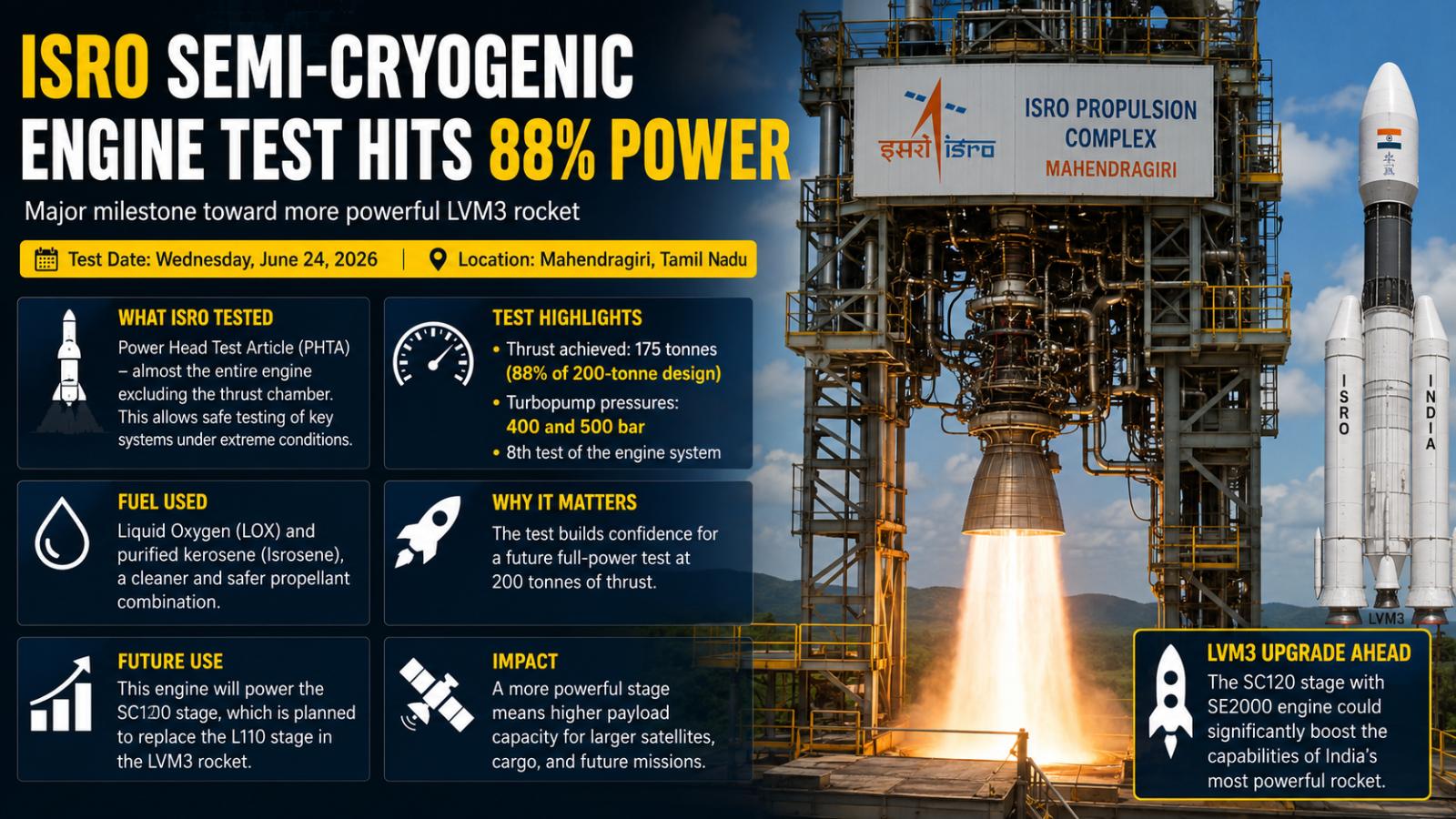
ISRO’s semi-cryogenic engine test reached 88% of its designed thrust on Wednesday, June 24, 2026, marking a major step toward upgrading India’s LVM3 rocket.
The Indian Space Research Organisation tested the Power Head Test Article, or PHTA, at its propulsion facility in Mahendragiri, Tamil Nadu. The PHTA includes most major engine systems but excludes the thrust chamber, allowing engineers to evaluate fuel delivery, ignition and pressure performance before testing the complete engine.
ISRO Semi-Cryogenic Engine Test Reaches 175 Tonnes of Thrust
During the eighth PHTA trial, ISRO increased the thrust level to 175 tonnes—88% of the engine’s planned 200-tonne capacity. Earlier tests had reached 47% and 60%.
The agency also reported that the turbopumps performed as expected, producing pressures of 400 and 500 bar. These pumps feed fuel and oxidizer into the engine under extreme pressure.
ISRO said the test parameters matched predictions, giving engineers confidence to move toward a full-power test at 200 tonnes.
How the Engine Could Upgrade the LVM3 Rocket
The semi-cryogenic system is being developed for the SE2000 engine and the planned SC120 stage. The SC120 is intended to replace the L110 stage currently used on the LVM3, India’s most powerful operational rocket.
A more powerful stage could increase the LVM3’s payload capacity, supporting larger satellites, heavier cargo and more ambitious future missions, including crewed spaceflight programs.
Why ISRO Is Using Liquid Oxygen and Isrosene
The engine uses liquid oxygen and purified kerosene, which ISRO calls “isrosene.” This combination is considered easier to handle and less toxic than some older liquid rocket propellants while offering strong performance.
The successful high-thrust test does not complete the engine’s development, but it clears an important technical milestone. Reaching full thrust and testing the complete engine will determine how soon the technology can move closer to flight use.