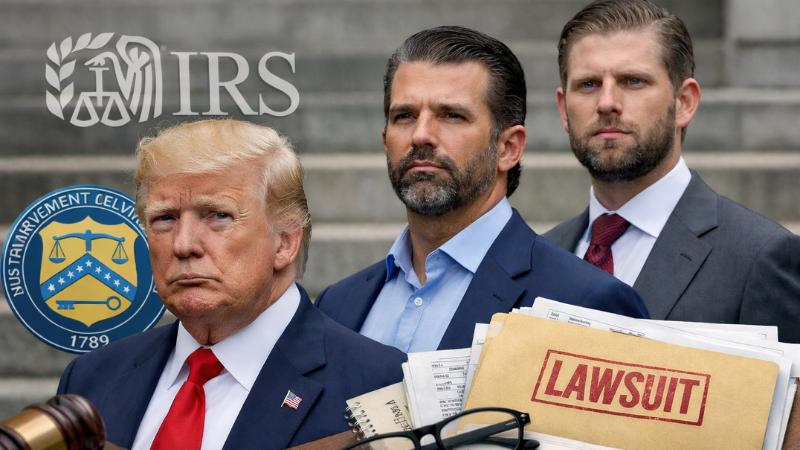
United States President Donald Trump and his two sons have filed a $10 billion civil lawsuit against the Internal Revenue Service and the US Treasury Department, alleging systemic failures that allowed the unlawful disclosure of their confidential tax information. The lawsuit was filed in federal court in Miami and accuses federal authorities of negligence in preventing internal misconduct that resulted in the release of sensitive financial records.
According to the court filing, Trump is pursuing the case in his personal capacity and not as part of his official duties as president. The complaint claims that federal agencies failed to implement and enforce adequate safeguards to protect taxpayer data, despite being legally obligated to do so. The plaintiffs argue that these failures directly enabled an internal breach that caused significant personal, professional, and financial harm.
The lawsuit states that the alleged disclosures led to reputational damage, public embarrassment, and unfair harm to the business interests and public standing of Trump and his sons. The filing further contends that the incident portrayed the plaintiffs in a false light and exposed them to sustained public scrutiny based on information that was obtained and disseminated unlawfully.
At the center of the case is Charles “Chaz” Littlejohn, a former IRS employee who admitted to illegally accessing and disclosing confidential tax records during 2019 and 2020. Littlejohn pleaded guilty to federal charges related to the unauthorized removal and distribution of taxpayer information and was sentenced in 2024 to five years in prison. Prosecutors said he abused his position within the agency to gain access to protected data that he had no lawful right to obtain or share.
Information taken by Littlejohn included tax records belonging to Trump, which became public during the 2020 election period. The disclosures included claims about Trump’s federal income tax payments in earlier years. Trump has consistently rejected the accuracy of those claims, stating that the information was illegally obtained, misrepresented, and used to create a misleading public narrative.
Court documents also show that Littlejohn admitted to stealing tax records belonging to thousands of other individuals during the same period. Those records reportedly included information related to numerous high-net-worth individuals, raising broader concerns about internal access controls and data security practices within the IRS.
Following the exposure of the breach, the IRS acknowledged the seriousness of the incident and said it had taken steps to strengthen internal safeguards. In a public statement, the agency said it had implemented enhanced security measures designed to reduce the risk of unauthorized access and to prevent similar incidents from occurring in the future.
The lawsuit filed by Trump and his sons seeks monetary damages and holds both the IRS and the Treasury Department accountable for what the plaintiffs describe as institutional failures. The complaint argues that the agencies are legally responsible for protecting taxpayer information and that their alleged lapses directly enabled the misconduct that led to the disclosures.
The case is expected to draw renewed attention to federal data protection policies and oversight mechanisms within government agencies. Legal experts say the outcome could have broader implications for how federal institutions are held accountable when confidential taxpayer information is compromised due to internal security failures.