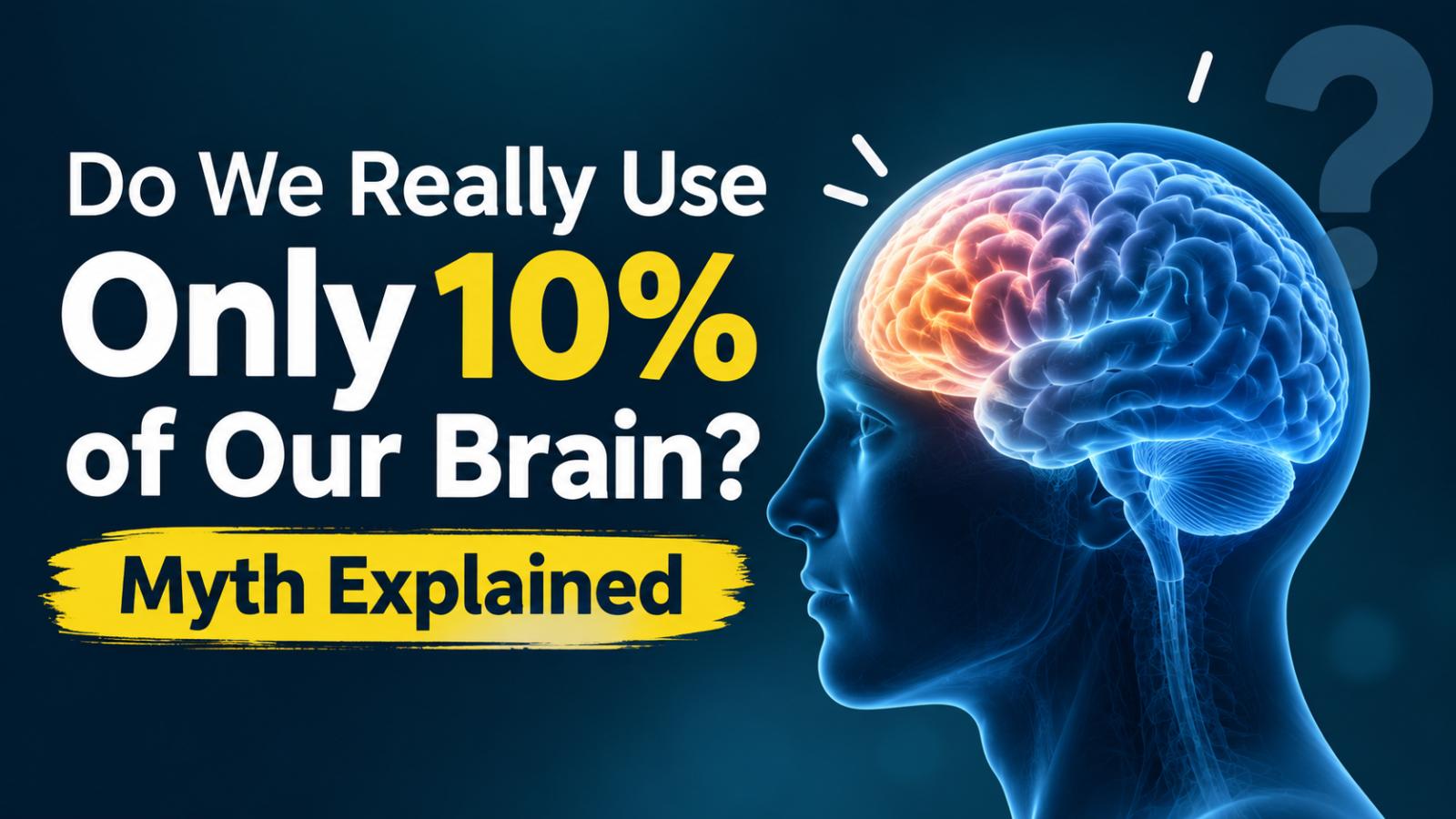
The idea that humans use only 10% of their brains has been repeated for decades in movies, motivational speeches and popular culture. It sounds exciting because it suggests that most of the brain remains unused and that people might unlock extraordinary abilities by accessing the remaining 90%.
Modern neuroscience, however, does not support this claim. Different parts of the brain perform different functions, and brain activity changes depending on what a person is doing. Across a normal day, many regions of the brain are involved in movement, memory, speech, emotions, decision-making and other essential processes.
Where Did the 10% Brain Myth Come From?
The exact origin of the 10% figure is unclear. One possible explanation is that early ideas about human potential were misunderstood over time.
Psychologist William James wrote about people using only a small part of their possible mental and physical resources. His comments referred to human potential and motivation, not to the idea that 90% of the brain is physically inactive.
Over the years, self-help books, advertisements and popular entertainment may have transformed that general idea into the more dramatic claim that people use only 10% of their brains.
There is no scientific evidence supporting that percentage.
What Brain Scans Reveal
Modern brain-imaging technologies allow researchers to observe which areas of the brain become active during different activities.
When a person reads, speaks, walks, solves a problem, remembers an event or even rests, different networks within the brain become active. Not every neuron works at full intensity at the same time, but that does not mean the remaining areas are unused.
The brain operates more like a coordinated network, with different regions becoming more active depending on the task.
This makes the claim that 90% of the brain remains permanently inactive highly misleading.
Brain Injuries Also Disprove the 10% Claim
Brain injuries provide another strong reason to question the myth.
If most of the brain had no meaningful function, damage to large areas should have little effect. In reality, even relatively small injuries in certain regions can affect speech, movement, vision, memory, behavior or other important abilities.
The effects depend on which part of the brain is injured and how severe the damage is.
This demonstrates that different brain regions have important roles and that large areas are not simply unused reserve space.
Can We Still Improve Brain Function?
Rejecting the 10% myth does not mean people cannot improve their mental abilities.
The brain can adapt and change through learning and experience, a process known as neuroplasticity. Learning a new language, practicing music, developing a skill or repeatedly performing a task can strengthen or reorganize connections between brain cells.
However, this is very different from suddenly activating a hidden 90% of the brain.
A more accurate explanation is that people use virtually all parts of the brain over time, while specific regions become more active depending on what they are doing.
Why the Myth Continues to Be Popular
The 10% claim remains popular because it offers an attractive idea: that everyone may have extraordinary abilities waiting to be unlocked.
Movies, advertisements and motivational content have helped keep the myth alive. The reality is less dramatic but equally impressive.
The human brain is a highly complex organ whose different regions constantly work together to support thinking, memory, movement, emotions, communication and basic body functions.
Instead of trying to “unlock” unused brain capacity, practical habits such as getting enough sleep, staying physically active, continuing to learn and maintaining overall health are more realistic ways to support brain function.
Note: This article is for general educational and informational purposes only. It is not intended to diagnose, treat or replace professional medical advice. Anyone experiencing sudden memory problems, confusion, speech difficulty, weakness or other neurological symptoms should seek medical attention.