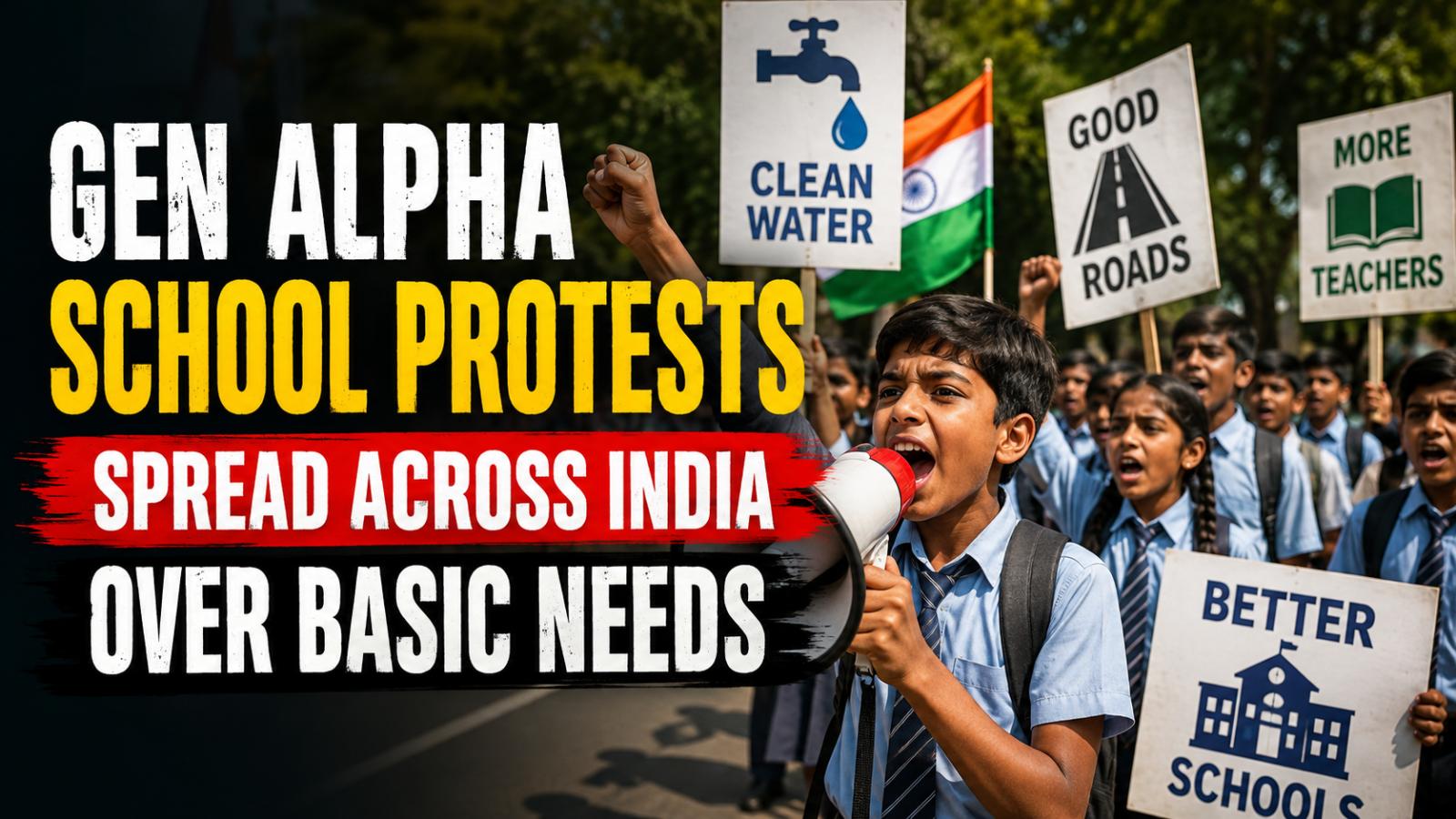
Gen Alpha school protests are drawing attention across India as children demand safer roads, enough teachers, clean drinking water, functioning toilets and reliable transport. From Uttar Pradesh to Maharashtra and Bihar, students are taking local problems directly to administrators and demanding action.
CJP rise adds momentum to student activism
The protests come after the Cockroach Janta Party, or CJP, emerged as a prominent youth-led movement over examination irregularities and education accountability. The group held a prolonged demonstration at Delhi's Jantar Mantar and demanded the resignation of then Union Education Minister Dharmendra Pradhan. Pradhan resigned on July 25, 2026, after weeks of protests.
CJP founder Abhijeet Dipke has since announced a nationwide "School Thik Karo" campaign beginning on August 15. The initiative aims to highlight poor conditions in government schools, particularly in villages. However, the recent school protests should not all be treated as CJP-organised events, as many arose independently over long-standing local grievances.
UP roads become a rallying point for students
In Hamirpur, Uttar Pradesh, schoolchildren carrying the Tricolour marched to the District Magistrate's office on August 11 to demand a proper paved road. Students said the existing route becomes muddy during the monsoon, making the daily journey to school difficult.
Students in Fatehpur have also protested over conditions inside schools. Their demands included clean drinking water, working fans, electricity, sanitation and improvements to classroom infrastructure. The demonstrations show how basic facilities, rather than broader political issues, are driving much of the current student mobilisation.
Teacher gaps trigger protests in government schools
Teacher shortages have emerged as another major concern. Students in Rajasthan have protested against vacant teaching posts, arguing that missing teachers are affecting regular lessons and examination preparation. Reports from several states indicate that children are increasingly willing to lock school gates, hold sit-ins or approach officials when repeated complaints fail to bring improvements.
The pattern highlights a larger challenge for government schools: infrastructure improvements alone cannot solve learning problems if classrooms continue to operate without adequate teaching staff.
Bihar schools face demands over basic facilities
Students in Bihar's Gaya district have taken their complaints directly to local administrators. Children from Simuara Middle School raised concerns over school management and basic facilities, including drinking water, toilets and midday meals.
Such protests are significant because students themselves are becoming visible participants in discussions about school quality. Their demands are largely practical and immediate: they want conditions that allow them to attend classes safely and study without avoidable disruption.
Maha protest highlights teachers, transport and bad roads
In Maharashtra, students have raised different but connected concerns. Schoolchildren in Dharashiv protested over vacant teacher posts, while students in rural Nagpur have sought better bus connectivity because difficult roads make travelling to school challenging.
Near Nashik, students drew wider attention by recording their own report on poor road conditions using a plastic bottle as a makeshift microphone. The approach showed how young students can use simple videos and social media to bring neglected civic problems into public discussion.
The Gen Alpha school protests do not yet represent a single coordinated national movement. What connects them is a common demand for accountability over everyday essentials. Roads, teachers, water, toilets and transport may appear basic, but for these students they directly determine whether education is accessible, safe and effective.