- galaxy
- 07 Sep 2026
- #nasa #isro #moonbase #indiausspaceties #spacenews #lunarexploration
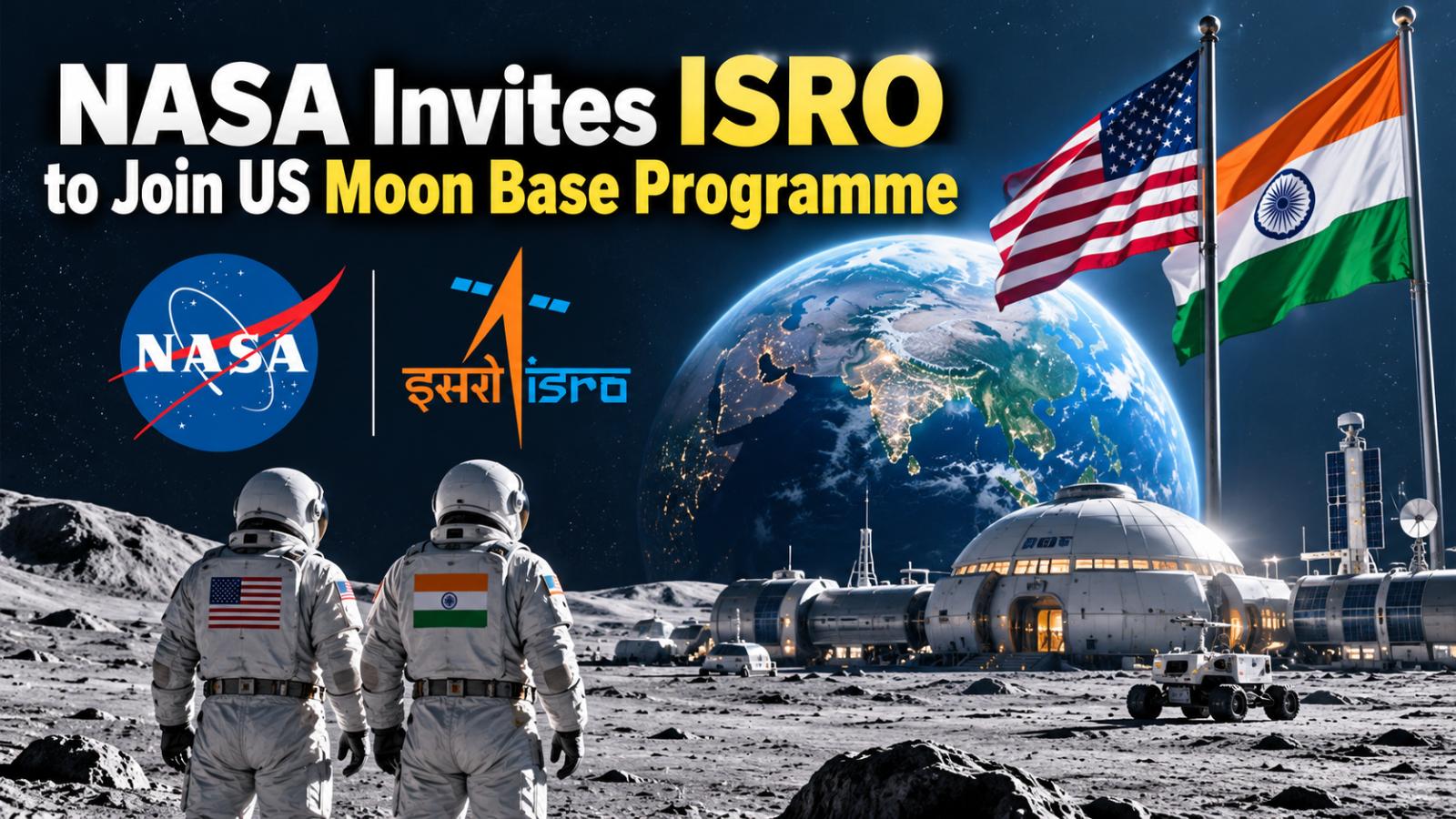
US Ambassador to India Sergio Gor has said Washington wants India to be part of the next phase of lunar exploration as the United States prepares to return astronauts to the Moon. Speaking at Bengaluru Space Expo 2026, Gor said NASA has formally invited ISRO to participate in its Moon base programme under the broader Artemis framework.
The development marks another step in expanding India-US space cooperation beyond Earth observation and satellite missions into human spaceflight, lunar exploration and long-term space infrastructure.
NASA Invites ISRO to Join Moon Base Programme
According to Gor, the United States wants India “by its side” as it prepares for future missions to the Moon. The invitation reflects growing confidence in India’s space capabilities and the expanding partnership between NASA and ISRO.
India joined the Artemis Accords in 2023, opening the door for closer cooperation on peaceful lunar exploration, scientific research and future human missions.
The latest invitation could potentially give ISRO a role in projects linked to sustained human presence on and around the Moon. However, detailed terms of India’s participation have not yet been publicly announced.
Any future involvement would also need to align with India’s own long-term space plans, including Chandrayaan missions, Gaganyaan and the proposed Bharatiya Antariksh Station.
NISAR Highlights Growing India-US Space Partnership
Gor highlighted the NASA-ISRO Synthetic Aperture Radar mission, known as NISAR, as an example of how cooperation between the two countries has expanded into major joint space projects.
NISAR is designed to observe changes across Earth’s surface and support research related to ecosystems, natural hazards, glaciers, agriculture and other environmental processes.
The partnership demonstrates how the relationship between NASA and ISRO has moved from limited technical cooperation toward jointly developed missions with global scientific applications.
Axiom-4 and Astronaut Training Boost Human Spaceflight Ties
Human spaceflight has also become an increasingly important area of cooperation.
The Axiom-4 mission and astronaut-related training were highlighted as examples of India gaining greater international experience in crewed space operations. Such cooperation could become particularly important as India prepares for its own Gaganyaan human spaceflight programme.
Training exchanges, mission experience and technical collaboration may help both countries explore additional opportunities involving human spaceflight and future lunar missions.
Indian Space Startups Could Gain New Opportunities
Gor also emphasized the rapidly growing role of India’s private space sector.
Indian startups have expanded into launch vehicles, satellite technology, Earth observation, propulsion systems, space-based communications and other areas following reforms that opened the sector to greater private participation.
Closer India-US cooperation could create opportunities for Indian companies to access international markets, investment and technology partnerships.
For American companies, India’s engineering talent and expanding commercial space ecosystem could provide opportunities for collaboration across manufacturing, launch services and satellite applications.
India and US Look at Global Space Governance
The partnership is also expanding beyond individual missions.
India and the United States are increasingly discussing issues such as responsible space operations, long-term sustainability, space traffic coordination and international rules governing peaceful activities in outer space.
As more countries and private companies launch satellites and plan lunar missions, questions surrounding resource use, safety standards and responsible behavior are becoming increasingly important.
Cooperation between India and the US in these areas could therefore influence not only future missions but also wider discussions on global space governance.
What the Moon Base Invitation Means for India
NASA’s invitation to ISRO represents a potentially important opportunity for India as lunar exploration moves toward longer-duration missions and permanent infrastructure.
India has already demonstrated major lunar capabilities through the Chandrayaan programme, while Gaganyaan is intended to establish independent human spaceflight capability.
Participation in future Moon base projects could allow India to combine its own lunar ambitions with international cooperation in science, technology and human exploration.
For now, the invitation signals a significant expansion in India-US space relations, covering Earth observation, astronaut training, human spaceflight, startups, lunar exploration and international space policy.