Goddess Durga 11-Armed Image Triggers Political Controversy
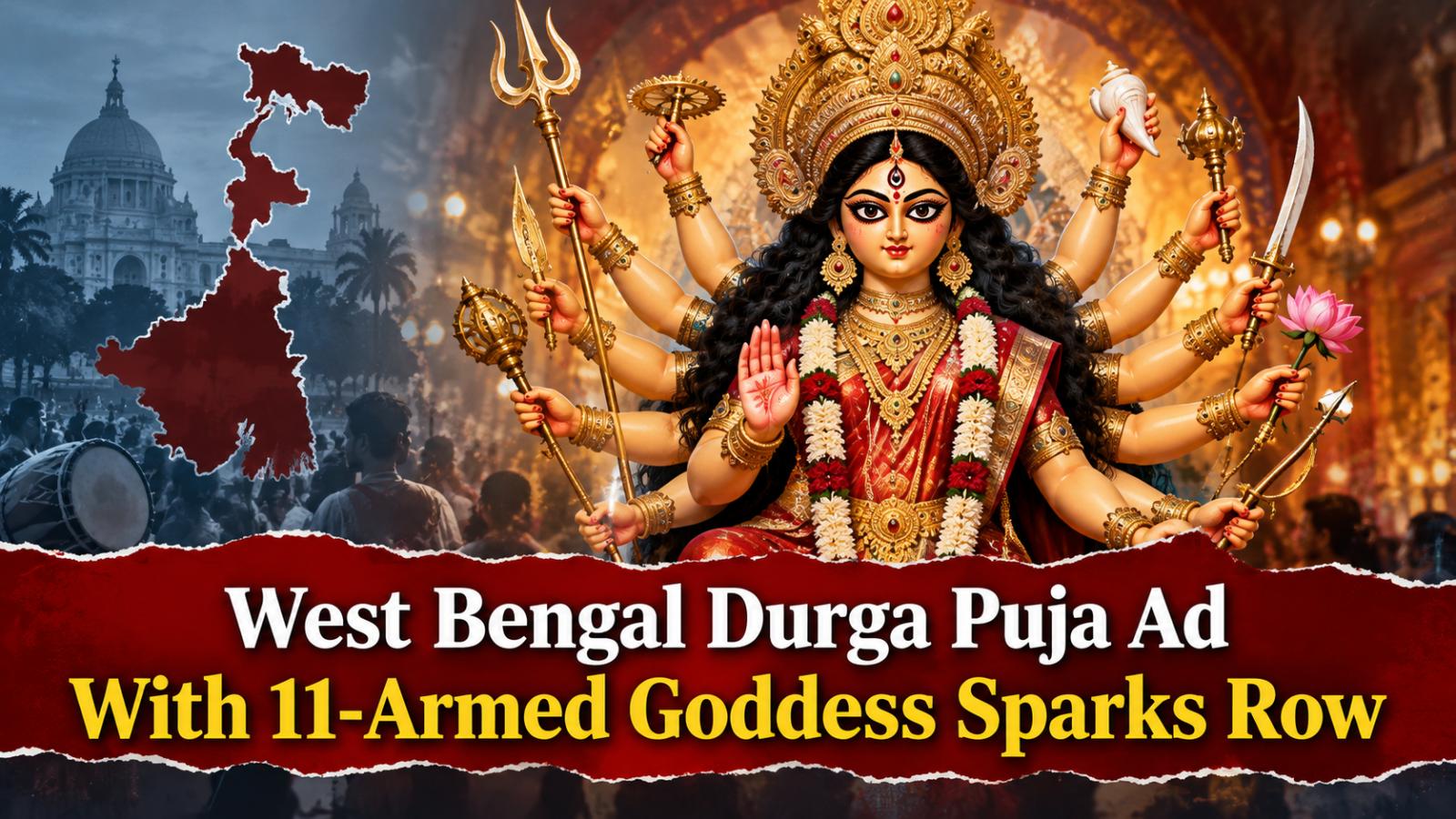
A West Bengal government advertisement linked to preparations for Durga Puja 2026 has triggered a political row after Goddess Durga was depicted with eleven arms. The image drew attention because Durga is traditionally worshipped in Bengal in her Dashabhuja form, representing the ten-armed goddess.
The advertisement was released in connection with a meeting involving Puja committees, and the image soon became the centre of criticism. Political leaders questioned how an official campaign could use a depiction that differs from the traditional form widely recognised by devotees.
Trinamool Congress leader Kunal Ghosh reacted sharply and questioned which scripture supported the eleven-armed image. His comments focused on the contrast between the traditional Dashabhuja representation and the version shown in the advertisement.
CPM leader Shatarup Ghosh also criticised the visual. He pointed out that Goddess Durga is traditionally shown with ten hands carrying weapons given by the gods to defeat Mahishasura. He questioned how an additional arm appeared in an official advertisement connected to such an important religious festival.
The Trinamool Congress also described the depiction as insulting to Bengal’s cultural and religious traditions. The party argued that Durga Puja is not simply a festival but an important part of Bengali identity and emotion.
BJP Calls Durga Puja Ad An Agency Error And Promises Correction
West Bengal BJP president Samik Bhattacharya responded by saying the issue appeared to be an error made by an agency rather than a political matter. He also said the mistake would be corrected.
His response attempted to reduce the political heat surrounding the controversy, but the debate continued as opposition leaders questioned the handling of religious imagery in an official advertisement.
The controversy has also opened a wider discussion about the responsibility of government departments and advertising agencies when using religious symbols in public campaigns. In a state where Durga Puja has deep cultural and spiritual importance, even a small visual mistake can quickly become a major public issue.
Political parties have used the incident to raise questions about cultural understanding, religious sensitivity and administrative oversight. Critics argue that official advertisements involving religious themes should be reviewed carefully before publication, especially when they relate to major festivals.
For now, attention is likely to remain on whether the controversial advertisement is formally corrected and whether any explanation is issued about how the eleven-armed image was approved. The incident has once again shown how strongly Durga Puja is connected with Bengal’s cultural identity and why visual accuracy matters when religious traditions are represented in public campaigns.