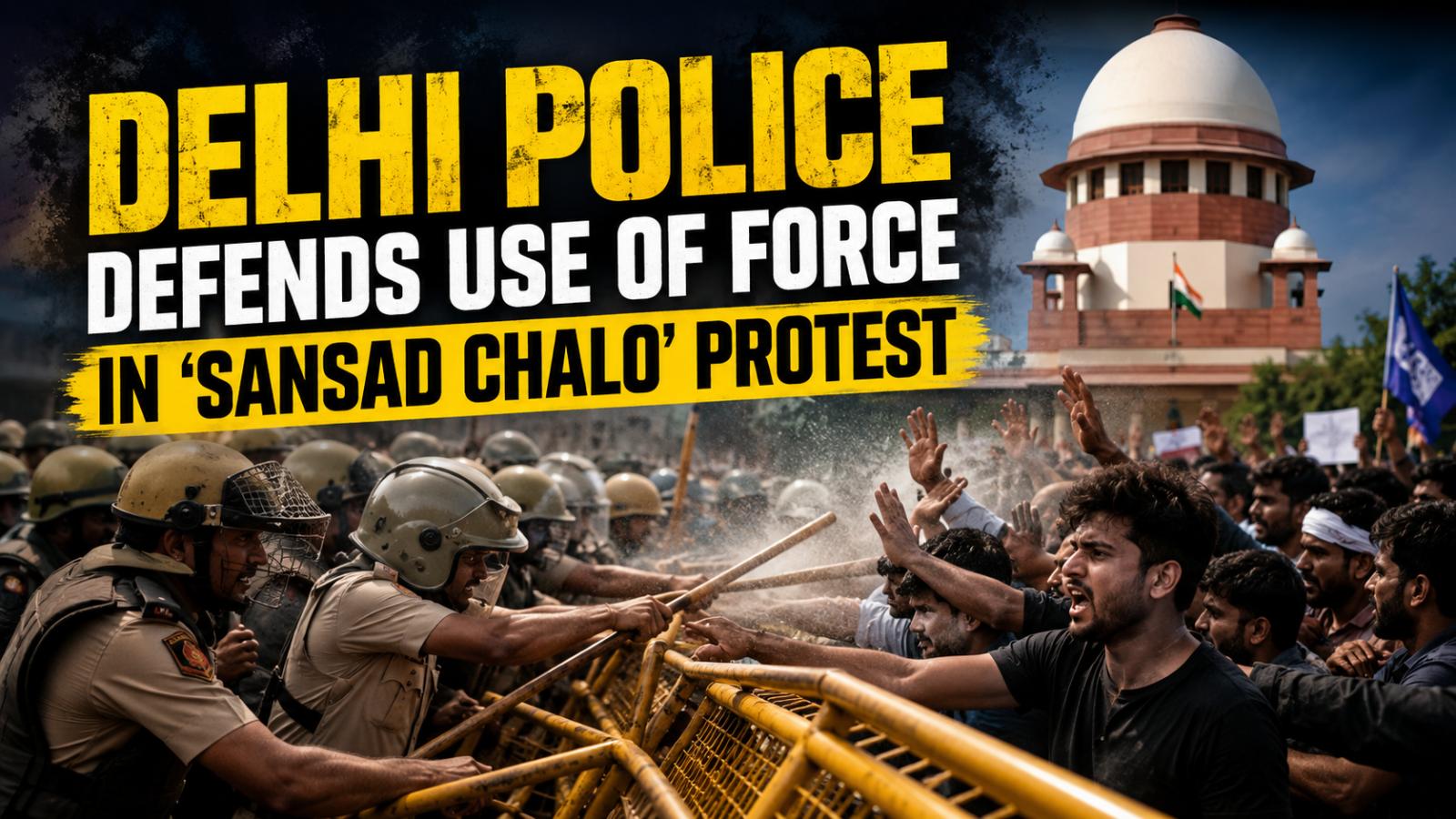
Delhi Police has defended its handling of the July 20 Sansad Chalo protest in a counter-affidavit filed before the Supreme Court on August 18, 2026. Police rejected allegations of excessive force, saying officers adopted a graded response after parts of the crowd breached barricades and attempted to move towards Parliament.
The affidavit comes amid judicial scrutiny of policing during the student-led demonstration at Jantar Mantar. Delhi Police said more than 30,000 protesters were spread across nearly three kilometres, while around 5,000 police personnel were deployed. Police also claimed that more than 240 personnel suffered injuries during the unrest.
Plainclothes
Delhi Police defended the deployment of personnel in civilian clothes, saying they acted as spotters during the protest. According to the affidavit, officers from the Special Branch, Special Cell, Crime Branch and local police units merged with the gathering to identify potential security threats as the situation developed.
Police said the deployment became necessary because of the size of the gathering and the possibility of violence. The force has maintained that these personnel were performing policing duties rather than attempting to secretly provoke or disrupt peaceful demonstrators.
Face scan
The affidavit also defended facial recognition technology at the protest site, describing its use as a proportionate policing measure rather than indiscriminate surveillance.
Police said facial recognition and other investigative methods were used to identify people in the protest area who allegedly had previous criminal records. Delhi Police has said 2,873 individuals were identified during its scrutiny, while reports on the police data indicated that 989 had serious criminal records.
The force maintained that a facial recognition match alone does not result in police action and that further verification is required before authorities proceed against an individual.
Crowd control
Delhi Police said officers used force only after protesters allegedly crossed security barricades and tried to move towards Parliament despite restrictions on the march.
The affidavit also referred to standing rules for demonstrations at Jantar Mantar. Police said prior permission is required and that marches outside the designated protest area are restricted unless authorities approve a limited symbolic march.
Deputy Commissioner of Police Sachin Sharma argued that the deployment of about 5,000 officers to manage a gathering of more than 30,000 people demonstrated the scale of the challenge faced by police.
Nail lathi
Police also responded to allegations that personnel used lathis fitted with nails. According to the affidavit, its examination of available footage found one instance involving such an object.
Delhi Police maintained that standard lathis are permitted crowd-control equipment and said they were used to contain groups that allegedly attacked personnel. The legality and proportionality of the force used remain central to the dispute before the court.
SC hearing
The Supreme Court is examining allegations of police excess arising from the protests, including concerns over crowd-control methods, plainclothes personnel and the use of technology to identify demonstrators. The court had earlier indicated that allegations of excessive force warranted independent examination and directed preservation of relevant electronic evidence.
The Delhi Police, meanwhile, has maintained that its response was proportionate to the circumstances and that officers acted to prevent further breaches of security around Parliament. The case now places both public-order concerns and the right to peaceful protest under judicial scrutiny.