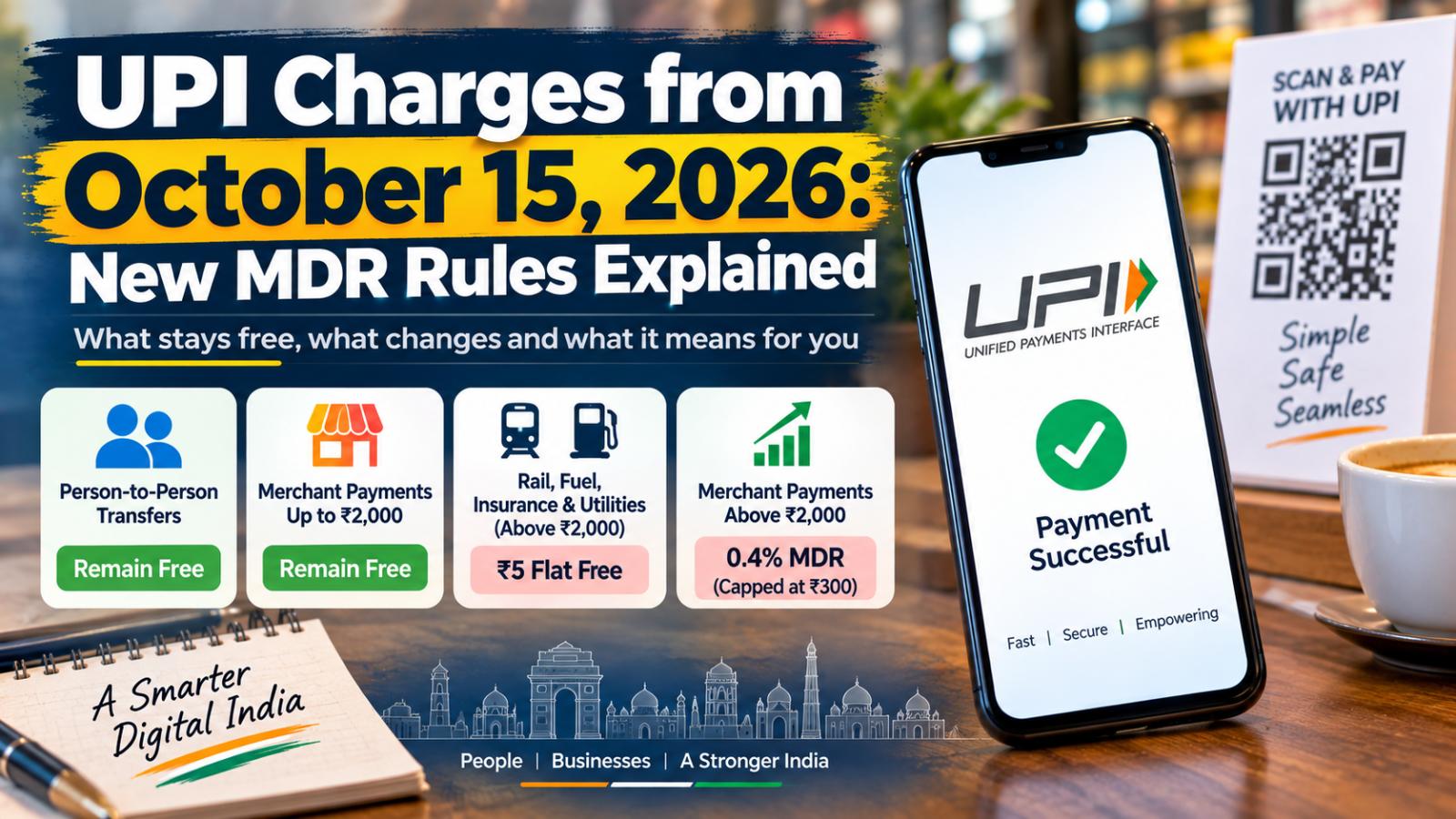
UPI charges from October 15 2026 will introduce a revised fee structure for certain merchant payments, while most everyday users will continue to make personal UPI transfers without charges.
Under the new framework, eligible merchant transactions above Rs 2,000 will attract a merchant discount rate, or MDR, of 0.4%, subject to a maximum charge of Rs 300. The MDR is meant to be paid by merchants for processing digital payments and is not intended to be directly charged to customers.
The biggest point for regular UPI users is that person-to-person transfers will remain free. Sending money to friends, family members or other individuals will continue without an MDR or transaction fee.
UPI transactions that remain free
Person-to-person UPI transactions will continue to remain free regardless of the amount transferred. This means users can send or receive money from individuals without worrying about the new merchant payment charges.
Merchant payments of up to Rs 2,000 will also continue to attract zero MDR. This is important for customers making smaller everyday payments at shops, restaurants and local businesses.
Small merchants receiving qualifying payments through UPI QR codes may also continue to benefit from zero-MDR provisions under the applicable limits.
UPI AutoPay and recurring mandates will remain outside the standard MDR structure. Users making recurring payments for services such as subscriptions or certain utility bills through UPI mandates can continue using the facility without the newly introduced merchant MDR being applied in the same way.
For most consumers, this means the basic UPI experience will remain largely unchanged. The new rules are focused more on higher-value merchant transactions than routine personal transfers.
UPI MDR charges for merchant payments
Eligible merchant UPI payments above Rs 2,000 will attract an MDR of 0.4%, capped at Rs 300 per transaction.
For example, a merchant payment of Rs 5,000 would attract MDR based on the applicable rate, while very high-value transactions would remain protected by the Rs 300 maximum cap.
Certain categories will follow special fee structures instead of the standard 0.4% rate.
Railway ticket payments, fuel purchases, insurance premiums and selected utility transactions above Rs 2,000 will attract a flat MDR of Rs 5 per transaction. Payments below Rs 2,000 in qualifying categories will continue to remain free from MDR.
Capital-market transactions made through UPI will receive a concessional MDR structure. Payments related to mutual funds, securities and eligible brokerage transactions will attract a lower MDR of 0.02%, subject to the applicable maximum cap.
The revised rules are designed to introduce merchant payment charges while keeping most personal and smaller-value UPI transactions free.
For customers, the key takeaway is simple: sending money to another person remains free, and small merchant payments will continue without MDR. The biggest impact will be on businesses accepting higher-value UPI payments.
The new UPI charges from October 15 2026 therefore represent a change mainly for merchant-side payment processing rather than a blanket fee on every UPI transaction.
Quick UPI fee summary:
Person-to-person UPI transfer: Free
Merchant payment up to Rs 2,000: Free
Eligible merchant payment above Rs 2,000: 0.4% MDR, capped at Rs 300
Rail, fuel, insurance and selected utilities above Rs 2,000: Rs 5 flat MDR
UPI AutoPay and recurring mandates: Free under the applicable framework
Capital-market UPI transactions: 0.02% concessional MDR