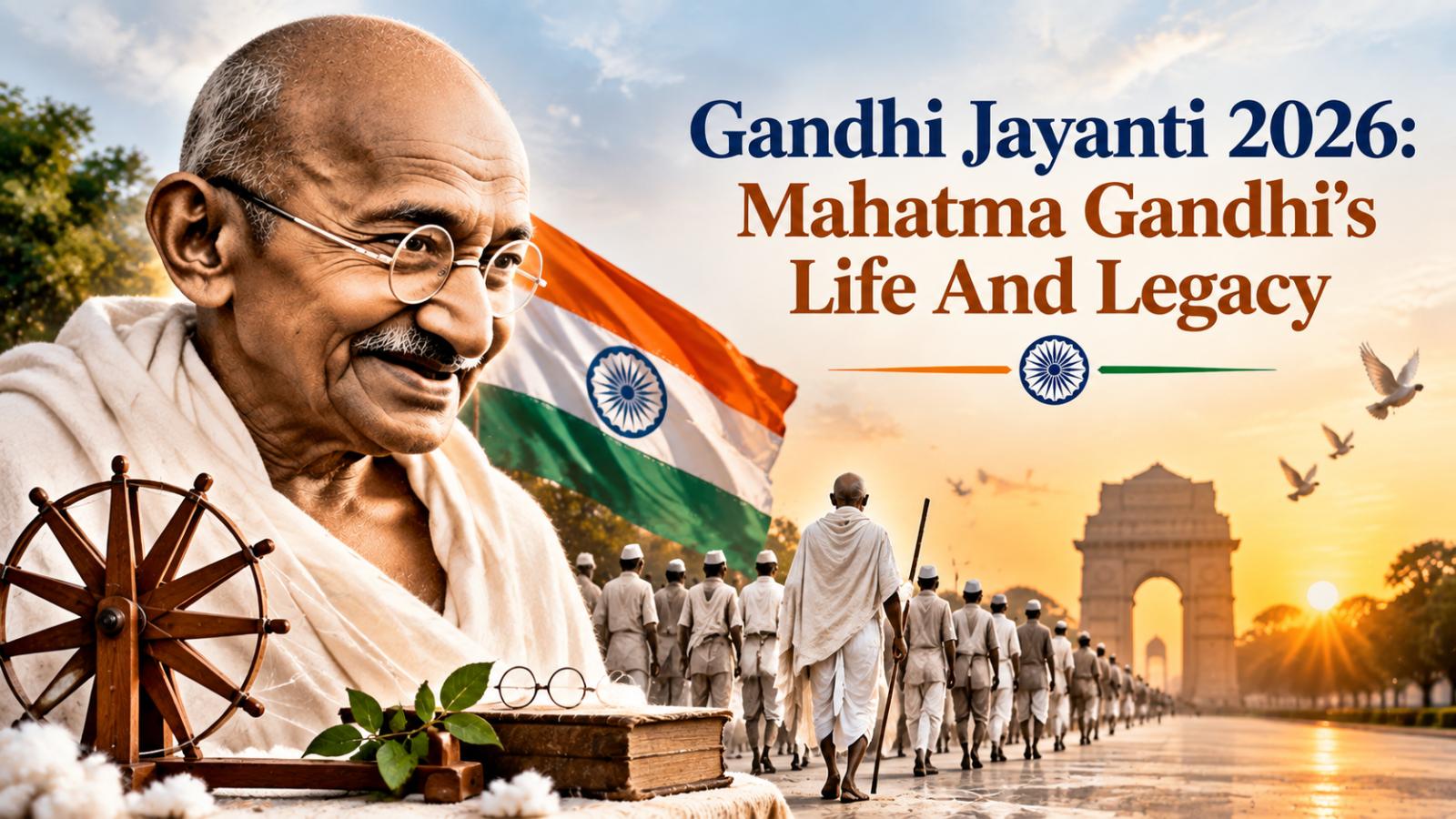
On October 2, 2026, India will observe Gandhi Jayanti to mark Mahatma Gandhi’s 157th birth anniversary. The day honours his role in shaping India’s independence struggle and encourages people to follow his principles of peace, equality, truth and non-violent action.
Observed across India and remembered worldwide, Gandhi Jayanti is an opportunity to reflect on Gandhi’s contribution to India’s independence movement and the values that continue to inspire movements for peace and justice around the world.
Mahatma Gandhi’s early life and journey towards leadership
Mahatma Gandhi, whose full name was Mohandas Karamchand Gandhi, was born on October 2, 1869, in Porbandar, Gujarat. After studying law in London, Gandhi travelled to South Africa in 1893, where his experiences with racial discrimination shaped his understanding of equality and human rights.
During his years in South Africa, Gandhi developed the concept of Satyagraha, a method of peaceful resistance based on truth and non-violence. This philosophy later became the foundation of many campaigns during India’s freedom struggle.
After returning to India in 1915, Gandhi emerged as a prominent leader who encouraged people to participate in peaceful movements against British rule. His approach focused on mass participation, self-reliance and peaceful protest.
Gandhi’s role in India’s freedom movement
Gandhi played a significant role in several major movements that shaped India’s journey towards independence.
The Non-Cooperation Movement encouraged Indians to peacefully withdraw support from British institutions. Through this campaign, Gandhi promoted unity and encouraged people to participate in the freedom struggle.
The Swadeshi movement focused on encouraging the use of locally made products, especially khadi, while reducing dependence on foreign goods. Gandhi believed self-reliance was important for economic and social empowerment.
In 1930, Gandhi led the historic Salt March from Sabarmati Ashram to Dandi to protest against the British salt tax. The movement became one of the most recognised examples of peaceful resistance.
The Quit India Movement launched in 1942 became another important chapter in the independence movement, with Gandhi calling for an end to British rule through a mass peaceful campaign.
Beyond politics, Gandhi also worked on social issues, including promoting cleanliness, equality, communal harmony and dignity for marginalised communities.
Importance and message of Gandhi Jayanti
Gandhi Jayanti is not only a remembrance of a historical figure but also a day to revisit the values he promoted throughout his life.
The principle of non-violence remains one of Gandhi’s most recognised contributions. He believed conflicts could be addressed through dialogue, understanding and peaceful action rather than violence.
His commitment to truth encouraged people to follow honesty and integrity in personal and public life. Gandhi also emphasised equality and respect for every individual, regardless of social background.
The idea of self-reliance promoted through Swadeshi continues to be discussed in the context of supporting local communities, traditional industries and sustainable development.
Gandhi’s ideas influenced several global leaders and movements, including civil rights campaigns that adopted peaceful methods to demand social change.
Gandhi Jayanti celebrations across India
Gandhi Jayanti is observed through various programmes across the country. Government institutions, schools, colleges and community organisations conduct events to remember Gandhi’s contributions.
Rajghat in New Delhi, the memorial dedicated to Gandhi, becomes a major centre for tribute ceremonies. Leaders and citizens offer floral tributes and participate in prayer meetings.
Educational institutions organise essay competitions, debates, cultural programmes and exhibitions highlighting Gandhi’s life and philosophy. Many communities also conduct cleanliness drives and social service activities inspired by Gandhi’s emphasis on sanitation and public responsibility.
Prayer gatherings often include devotional songs and discussions about Gandhi’s teachings, helping younger generations understand his role in Indian history.
International Day of Non-Violence
October 2 is also observed globally as the International Day of Non-Violence. The United Nations declared this observance in 2007 to promote the message of peace, tolerance and understanding.
The day connects Gandhi’s philosophy of peaceful resistance with global efforts to resolve conflicts through non-violent approaches. It encourages education, awareness and respect among different communities.
Key facts about Gandhi Jayanti 2026
- Date: October 2, 2026
- Day: Friday
- Occasion: 157th birth anniversary of Mahatma Gandhi
- Full name: Mohandas Karamchand Gandhi
- Born: October 2, 1869
- Birthplace: Porbandar, Gujarat
- Main principles: Truth, Ahimsa (non-violence) and Satyagraha
- International observance: International Day of Non-Violence
- Memorial: Rajghat, New Delhi
Gandhi Jayanti continues to serve as a reminder of the importance of peace, compassion and responsibility in society. As generations learn about Gandhi’s life and contributions, the day provides an opportunity to reflect on how these values can be applied in modern times.