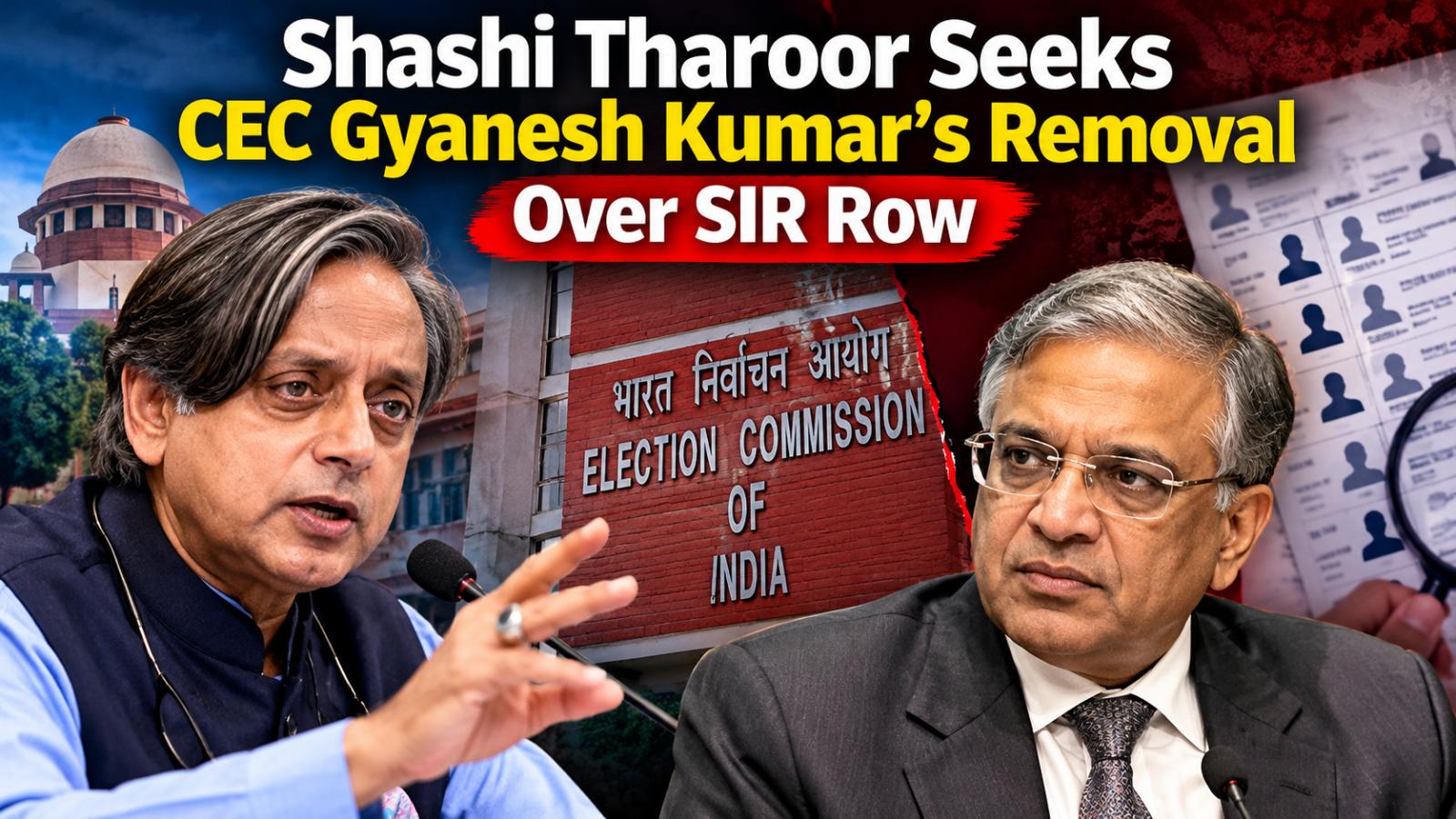
Congress MP Shashi Tharoor has called for Chief Election Commissioner (CEC) Gyanesh Kumar to resign over alleged irregularities in the Special Intensive Revision (SIR) of electoral rolls.
Tharoor said Opposition parties are working on a parliamentary move to seek Kumar's removal. He also questioned the legal protection available to Election Commissioners under a law passed in 2023, arguing that such protection should not prevent accountability.
The Congress MP said the Opposition's concerns centre on alleged voter deletions, the methods used during the SIR exercise and difficulties faced by people trying to restore their names to electoral rolls.
Tharoor maintained that the Opposition's objective is to protect the credibility of elections and ensure that every eligible voter has a fair opportunity to participate.
Gyanesh Kumar Removal and Election Commission Legal Immunity
Tharoor questioned Section 16 of the Chief Election Commissioner and Other Election Commissioners (Appointment, Conditions of Service and Term of Office) Act, 2023.
The provision protects serving and former Election Commissioners from civil or criminal proceedings for actions connected with their official duties. However, it does not remove the constitutional mechanism for removing a Chief Election Commissioner.
Under Article 324(5) of the Constitution, the CEC can be removed in the same manner and on the same grounds as a Supreme Court judge.
Tharoor argued that legal protection should not prevent Parliament from holding constitutional authorities accountable. He also urged Kumar to step down, saying Opposition parties had lost confidence in his leadership of the Election Commission.
The legal immunity provision is also facing judicial scrutiny. According to the source report, the Supreme Court issued notice to the Centre and Election Commission in January 2026 but declined to stay the provision.
Any attempt by the Opposition to remove Kumar would still have to follow the constitutional and parliamentary process.
SIR Voter Deletions Raise Opposition Concerns
The Special Intensive Revision of electoral rolls is at the centre of the political dispute.
Tharoor said the Opposition does not object to removing deceased, relocated or otherwise ineligible voters from electoral rolls. Instead, he questioned how deletions were being carried out and how difficult it could be for eligible voters to restore their names.
He alleged that some Electoral Registration Officers were unable to reverse deletions because of restrictions in the software used for the revision process.
The Opposition has demanded that the SIR exercise be suspended, allegedly wrongful deletions be corrected, the software be reviewed and changes involving Forms 6 and 7 be reconsidered. Form 6 is used to seek inclusion in electoral rolls, while Form 7 can be used to object to an entry or request deletion.
Tharoor also cited cases involving discrepancies in voter records, including the example of Nobel laureate Amartya Sen, while arguing that historical differences in family records should not automatically put a person's voting eligibility at risk.
He further claimed that 130 million names had been removed from electoral rolls. This is Tharoor's claim and should not be interpreted as an independently verified number of wrongful deletions.
Tharoor also criticised the decision to remove Jantar Mantar's status as a designated protest site, arguing that moving demonstrations farther from central Delhi could reduce their visibility to authorities.
Despite his criticism, Tharoor said the Opposition would accept the electorate's verdict, including a BJP victory, if elections were conducted through a free and fair process.
The dispute has now developed into a broader debate over voter rights, Election Commission accountability and electoral transparency. The Opposition is expected to continue pressing for reforms while pursuing constitutional options regarding the CEC.