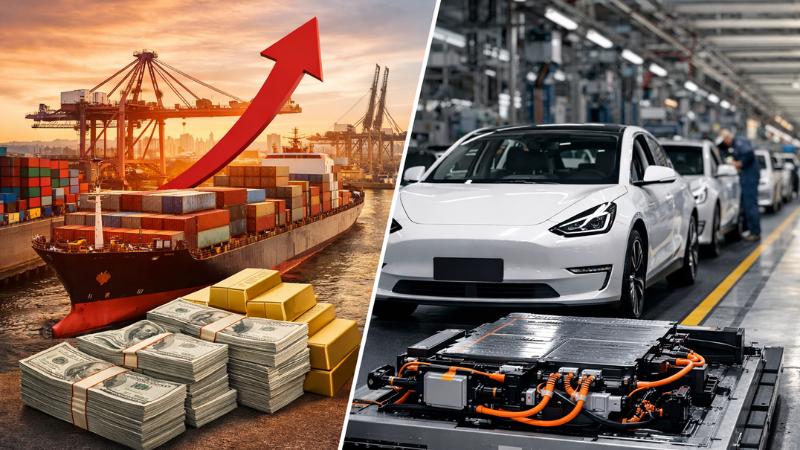
Amid ongoing geopolitical tensions, trade disputes, and armed conflicts across multiple regions, China quietly achieved two major economic milestones in 2025, underscoring its continued influence over global manufacturing and trade. Official data released this month shows that the country recorded the largest annual trade surplus in its history while further consolidating its position as the world’s leading automobile producer and seller. These achievements came despite persistent pressures from tariff policies, slowing global demand in some markets, and strategic rivalries with Western powers.
China’s total trade volume in 2025 reached between $6.48 trillion and $6.51 trillion, reflecting the scale and resilience of its export-oriented economy. Manufacturing strength, combined with a deliberate effort to diversify export destinations, played a central role in sustaining growth. While geopolitical tensions over Taiwan and the South China Sea continued to shape international relations, economic data indicates that China maintained momentum by adapting to changing market conditions rather than retreating from global engagement.
According to figures released by the General Administration of Customs on January 14, China posted a trade surplus of approximately $1.189 trillion for the full year, marking the first time the surplus surpassed the $1 trillion threshold. This represented an increase of roughly 20 percent compared to the previous record of about $992 billion to $993 billion set in 2024. Exports climbed to around $3.77 trillion, reflecting a year-on-year growth of 5.5 percent, while imports remained relatively stable at approximately $2.58 trillion.
The surplus had already exceeded $1 trillion by November and expanded further in December, when the monthly surplus alone reached $114.14 billion. December exports rose 6.6 percent compared to the same period a year earlier, while imports also increased by 5.7 percent. Over the course of the year, China recorded monthly trade surpluses exceeding $100 billion on at least seven occasions, a significant rise from just one such month in 2024.
Trade pressures from the United States, including tariffs implemented during earlier trade disputes, prompted Chinese exporters to accelerate their shift toward alternative markets. Increased shipments to the European Union, Southeast Asia, Africa, and Latin America helped offset weaker demand from the US market. This diversification strategy proved critical in sustaining export growth and stabilizing overall trade performance.
At the same time, China reinforced its dominance in the global automotive sector, marking its 17th consecutive year as the world’s largest vehicle producer and seller. Data from the China Association of Automobile Manufacturers shows that vehicle production reached 34.53 million units in 2025, representing a year-on-year increase of 10.4 percent. Vehicle sales totaled 34.4 million units, up 9.4 percent, setting new records for the industry.
Much of this growth was driven by new energy vehicles, including battery electric vehicles and plug-in hybrids. More than 16 million new energy vehicles were produced and sold during the year, accounting for over half of the domestic auto market. Competitive pricing, rapid technological development, and aggressive overseas marketing allowed Chinese manufacturers to expand their global footprint.
Chinese electric vehicle makers continued to gain ground internationally, with strong sales in emerging and developed markets alike. In 2025, one leading Chinese manufacturer surpassed its American rival to become the world’s largest seller of battery electric vehicles, delivering more than 2.25 million units globally, compared with about 1.64 million units sold by its closest competitor.
Together, the record trade surplus and expanding automotive output highlight China’s ability to navigate economic uncertainty while reinforcing its role as a central player in global production and trade. Despite mounting external challenges, the data suggests that China’s manufacturing base and export adaptability remain key pillars of its economic strategy.