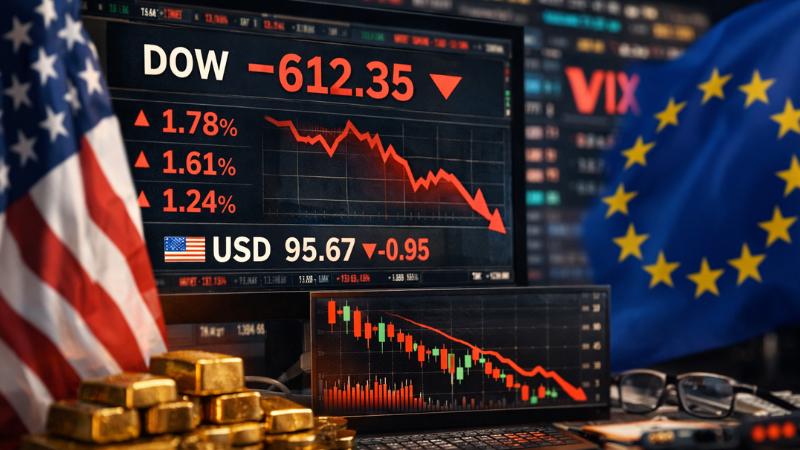
Global financial markets moved sharply lower Tuesday as renewed political tensions between the United States and Europe triggered a broad sell America trade, prompting investors to reduce exposure to U.S. assets. The shift came after President Donald Trump escalated rhetoric surrounding Greenland and proposed new tariffs targeting several European countries, reviving fears of a widening trade conflict and long-term economic fallout.
U.S. bond prices fell steeply, pushing Treasury yields higher as investors demanded greater compensation for holding American debt. At the same time, the U.S. Dollar Index dropped nearly 1 percent, marking its sharpest decline in months and signaling growing skepticism toward U.S. economic stability. The euro strengthened by about 0.8 percent against the dollar, reflecting capital flows away from the United States and into European currencies.
Precious metals rallied as market participants sought safety amid rising uncertainty. Gold and silver both climbed to fresh highs, with gold on track for its strongest single-day gain since October. The move reinforced gold’s traditional role as a safe-haven asset during periods of geopolitical stress and market volatility.
U.S. equities also faced heavy selling pressure. The Dow Jones Industrial Average fell more than 600 points, while the S&P 500 and Nasdaq Composite each declined by over 1 percent. The Cboe Volatility Index surged to levels last seen in November, underscoring growing anxiety among investors as risk appetite deteriorated.
The latest selloff followed Trump’s announcement that the United States could impose 10 percent tariffs on eight European nations beginning Feb. 1, with rates potentially increasing to 25 percent by June. European Union representatives convened an emergency meeting in response, weighing possible countermeasures that could include retaliatory tariffs and other economic penalties.
Greenland has firmly rejected U.S. proposals to purchase the territory, with its leadership emphasizing respect for international law and diplomatic dialogue. The dispute has heightened concerns in financial markets that trade relations between the United States and Europe may further deteriorate, undermining confidence in the U.S. as a reliable trading partner.
The sell America trade reflects fears that global investors may demand higher risk premiums on U.S. assets or reduce holdings altogether. Some market participants worry that European governments or institutions could scale back investments in U.S. securities as a form of economic leverage, potentially amplifying downward pressure on the dollar and equity markets.
International markets extended losses after retreating earlier in the week. European and Asian equities both traded lower, with investors reacting to the prospect of escalating tariffs on goods such as French wine and other imports. The pullback followed a U.S. market holiday, which delayed domestic reactions until Tuesday’s session.
Analysts note that the recent moves may also reflect broader diversification trends. With U.S. stock indexes hovering near record highs and American equities accounting for a significant share of global market capitalization, investors appear increasingly willing to hedge risk and shift capital elsewhere. The magnitude and duration of the current market dynamics remain uncertain, but the episode highlights how quickly geopolitical developments can reshape global investor sentiment.