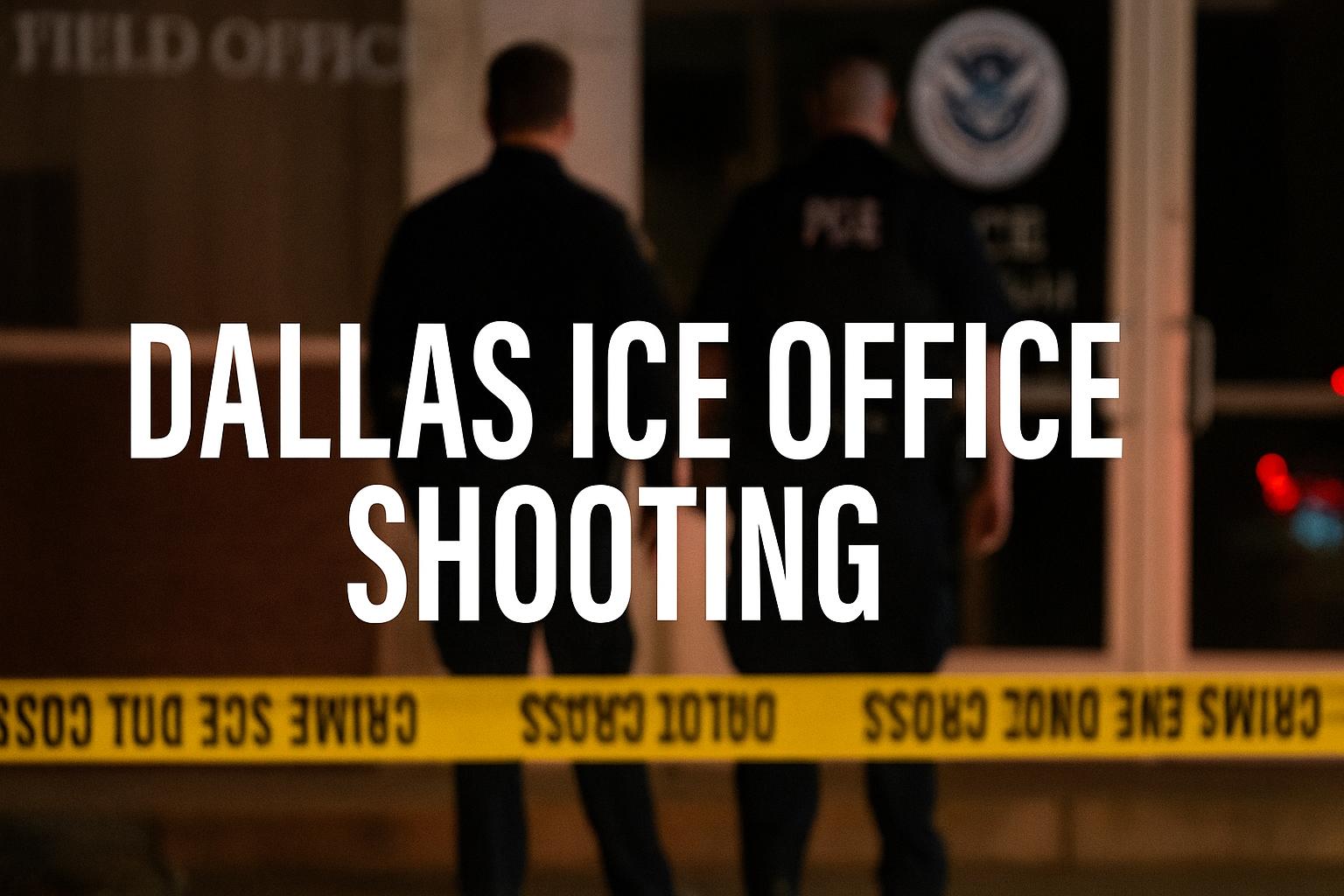
A tragic shooting at a US Immigration and Customs Enforcement (ICE) field office in Dallas on Wednesday left one detainee dead and two others injured before the gunman took his own life. Authorities identified the shooter as Joshua Jahn, who died from a self-inflicted gunshot wound shortly after the attack.
According to the Dallas Police Department, one victim died at the scene, while two others were rushed to hospital with gunshot wounds. Officials confirmed that the injured remain under treatment as investigators continue to piece together what led to the violence inside the federal immigration office.
FBI Director Kash Patel said preliminary evidence points toward an ideological motive. During the initial investigation, officers recovered a shell casing engraved with the phrase "Anti ICE," suggesting that the attack was deliberately targeted at the federal agency. Patel emphasized that while the review is still ongoing, the findings so far indicate a strong ideological component behind the act.
At a Dallas press briefing, Joseph Rothrock, special agent-in-charge of the FBI’s local field office, described the event as “an act of targeted violence.” He noted that while more evidence is being examined, the recovered casings are central to understanding the attacker’s intent.
Department of Homeland Security Secretary Kristi Noem confirmed the fatalities and injuries in a statement, saying that the suspect had died by suicide. The shooter’s body was later discovered on the roof of a nearby building, according to local reports.
National leaders quickly responded to the news. Vice President JD Vance condemned the attack and called for an end to what he described as “the obsessive attack on law enforcement, particularly ICE.” He expressed his condolences to the families of those affected and extended prayers to the injured victims.
The ICE field office serves as a central hub where individuals are processed, and decisions are made on whether detainees should be released or held. Given its role in immigration enforcement, it has often been at the center of heated political and public debates, sometimes making it a target of threats or hostile acts.
This week’s shooting was not the first security incident at the Dallas ICE facility. In August, the same office was placed on high alert after a man entered the building claiming to have a bomb. Authorities identified the suspect as Bratton Dean Wilkinson, a 36-year-old US citizen, who displayed a device on his wrist that he referred to as a “detonator.” Security staff responded immediately, and he was arrested without further harm.
The back-to-back incidents have heightened concerns about the safety of immigration facilities and their personnel. Officials are reviewing security protocols to prevent further violence, as the attacks underscore the growing risks faced by staff and detainees alike.
Law enforcement agencies continue to investigate Jahn’s background to determine if he acted alone or if others were aware of his plans. Officials stressed the importance of not drawing premature conclusions, but acknowledged the ideological markings on the ammunition as a key lead in the case.
The attack has reignited discussions about the safety of federal employees working in immigration enforcement and the need for additional protective measures at ICE facilities across the country. For detainees, the incident has raised serious concerns about safety inside detention and processing centers.
While authorities search for answers, the families of the victims are left mourning a devastating loss, and the community is grappling with the shock of another violent act against law enforcement. The Dallas shooting has once again highlighted the ongoing challenges faced by agencies tasked with immigration enforcement in an increasingly polarized environment.