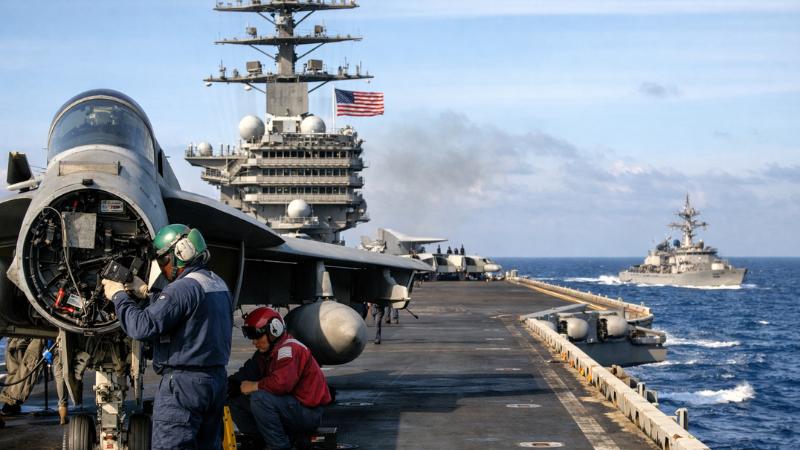
The United States has deployed the aircraft carrier USS Abraham Lincoln and its accompanying warships to the Middle East, a move aimed at reinforcing American military capabilities in a region marked by escalating political and security tensions. The announcement was made on Monday, January 26, by US Central Command, which said the carrier strike group’s presence is intended to support regional security and stability while enhancing both offensive and defensive readiness.
According to CENTCOM, the USS Abraham Lincoln Carrier Strike Group is currently operating in the Indian Ocean as part of its broader Middle East deployment. The command shared images on social media showing sailors aboard the carrier conducting what it described as routine maintenance activities. Officials emphasized that such operations are standard and reflect the vessel’s continued readiness while deployed forward in support of US strategic objectives.
The deployment comes against the backdrop of heightened US-Iran tensions and ongoing unrest inside Iran. US President Donald Trump said on Thursday, January 22, that Washington had assembled a significant naval force moving in the direction of Iran as a precautionary measure. He stressed at the time that the buildup did not necessarily mean the forces would be used, but noted that the United States must be prepared for a range of scenarios as conditions evolve.
Trump has repeatedly warned Iran’s leadership over its response to nationwide protests that began in late December, describing the demonstrations as the most serious challenge the ruling establishment has faced in years. He has strongly criticized reports of violent crackdowns on protesters and has condemned allegations of mass executions of individuals detained during the unrest, framing the issue as both a human rights concern and a matter of regional stability.
Iranian officials have responded with sharp rhetoric of their own. Over the weekend, Nournews, a media outlet aligned with Iran’s Supreme National Security Council, reported that General Mohammad Pakpour issued a warning to Washington and Israel, urging them to avoid what he described as strategic miscalculations. According to the report, Pakpour said the Islamic Revolutionary Guard Corps was on heightened alert and fully prepared to execute directives from Iran’s top leadership.
Further escalating the war of words, Iran’s Defense Ministry spokesperson, General Reza Talaei-Nik, said on Monday that any military strike by the United States or Israel would trigger a response more forceful and decisive than previous confrontations. His remarks underscored Tehran’s position that it would not hesitate to retaliate if its territory or interests were attacked.
US officials have not indicated that an imminent strike is planned, but the presence of the Abraham Lincoln strike group provides the White House with additional military options. Defense analysts note that aircraft carriers offer significant flexibility, enabling rapid power projection, air operations, and deterrence without requiring a permanent footprint on land.
CENTCOM reiterated that the deployment is part of routine force management and long-standing US commitments in the region. However, the timing reflects growing concern in Washington over Iran’s internal unrest, its regional activities, and the potential for miscalculation on all sides. As diplomatic tensions and military signaling continue, the arrival of the USS Abraham Lincoln highlights the fragile security environment in the Middle East and the United States’ intent to remain prepared for developments that could quickly alter the regional balance.