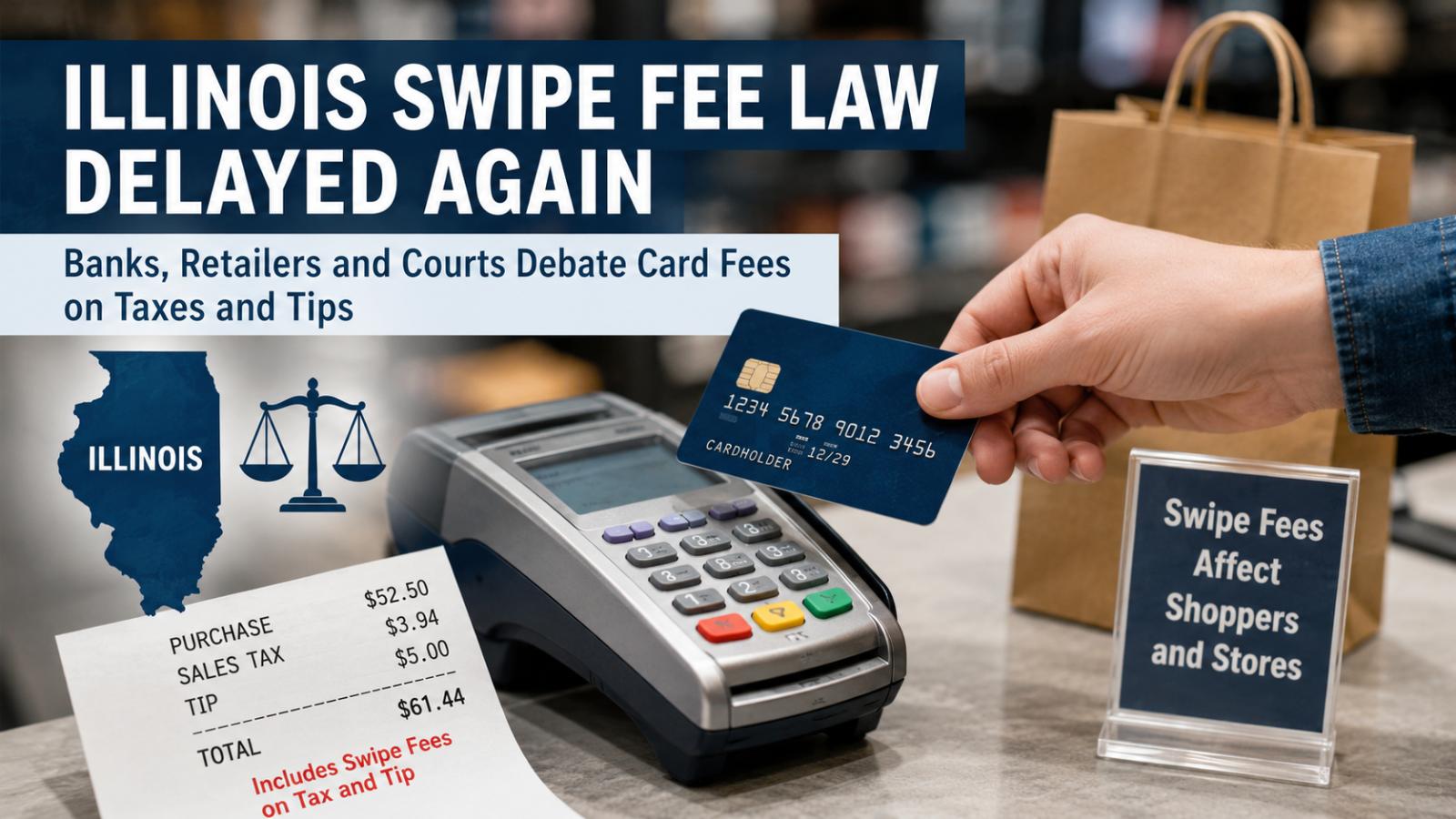
Illinois lawmakers voted to delay the state’s swipe fee law for another year, keeping the fight over card fees on sales taxes and tips in court and before federal regulators.
The delay affects the Interchange Fee Prohibition Act, or IFPA, a first-of-its-kind Illinois law that would restrict banks, credit unions and card companies from collecting interchange fees on the tax and tip portions of debit and credit card transactions.
Illinois Swipe Fee Law Delay Extends IFPA Timeline
The law was originally scheduled to take effect on July 1, 2025, before lawmakers delayed it by one year. The latest legislative action would push implementation to 2027, as the case continues through legal and regulatory challenges.
The measure still allows card fees on the actual sale price of goods and services. Its disputed provision focuses on whether payment companies can collect fees on money that merchants collect as taxes for the state or pass along as gratuities to workers.
Why Banks and Retailers Are Fighting Over the IFPA
Financial institutions argue the Illinois card fee law would be difficult to implement and could create compliance risks across debit and credit card systems. Banking groups have said the law could disrupt payment processing and create uncertainty for consumers, merchants and local banks.
Retailers and restaurant groups support the IFPA, saying businesses should not have to pay swipe fees on sales tax or tips. They argue that card fees on those portions of a transaction increase costs for restaurants, bars and neighborhood stores.
For broader context on how swipe fees affect everyday purchases, small businesses and consumers, read our explainer: Credit Card Swipe Fees Raise Costs for U.S. Shoppers and Stores.
OCC Preemption Fight Adds More Uncertainty
The Office of the Comptroller of the Currency has also moved against the Illinois law, saying federal law preempts the IFPA for national banks and federal savings associations. That federal position adds another layer to the court fight and makes the law’s future uncertain.
The issue matters beyond Illinois because other states are watching whether restrictions on swipe fees can survive legal challenges. For consumers and small businesses, the outcome could shape how card-processing costs are handled on taxes, tips and everyday purchases.