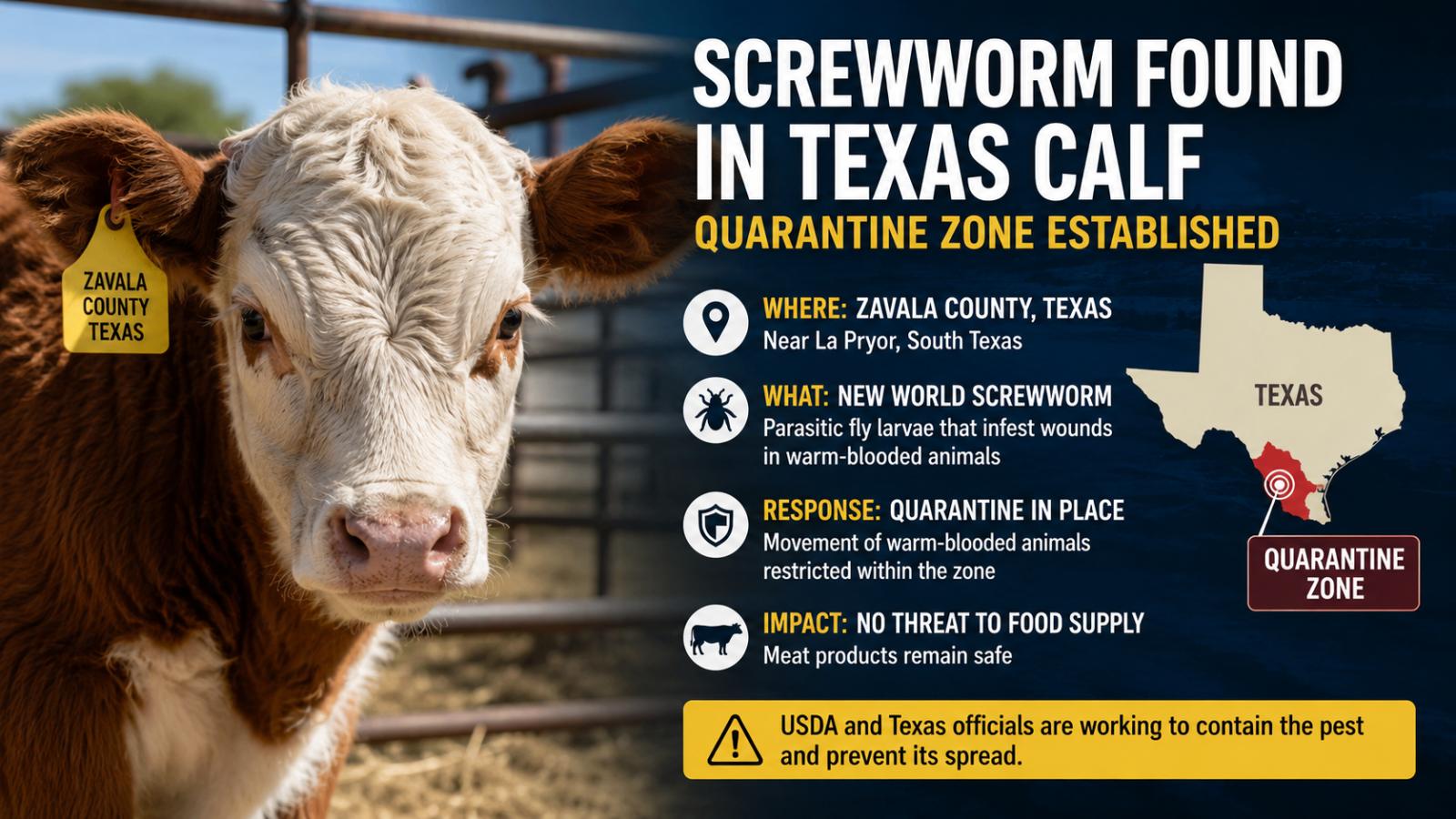
A South Texas screwworm calf case has prompted federal and state officials to establish a livestock quarantine zone in Zavala County after the New World screwworm was confirmed in a young calf near La Pryor.
The U.S. Department of Agriculture’s Animal and Plant Health Inspection Service confirmed the detection on Wednesday, June 3, 2026, in a 3-week-old calf in Zavala County, Texas. Officials said the larvae were found in the calf’s umbilical area and that no additional U.S. detections had been reported.
Zavala County screwworm quarantine restricts animal movement
Texas animal health officials established an infested zone covering parts of the Zavala and Uvalde County areas. Under the quarantine, warm-blooded animals may not be moved out of the zone without prior authorization from the Texas Animal Health Commission.
The restrictions apply to livestock and other warm-blooded animals, including pets, unless inspection, treatment or movement permits are completed as required by state officials.
What is New World screwworm?
New World screwworm is a parasitic fly whose larvae feed on living tissue. It can affect cattle, other livestock, wildlife, pets and, less commonly, people. In animals, untreated infestations can cause severe wounds and economic losses for ranchers.
Officials said the infected calf is being treated and is expected to recover. They also emphasized that the detection does not mean a wider outbreak has been found.
USDA says containment steps are underway
Federal and Texas officials said response teams are carrying out surveillance, trapping, animal inspections and sterile fly releases to prevent the pest from becoming established in the United States.
The sterile insect technique has been used before to disrupt the screwworm’s breeding cycle. The pest was eradicated from the United States decades ago, but officials have been monitoring its movement north through Mexico and Central America.
Agriculture officials said the case does not affect the safety of meat products in the marketplace. Still, the detection is significant for Texas ranchers because the parasite can spread quickly if animal wounds are not inspected and treated.
For South Texas livestock owners, the immediate focus is reporting suspicious wounds, following quarantine rules and helping officials contain the parasite before it spreads beyond the affected zone.