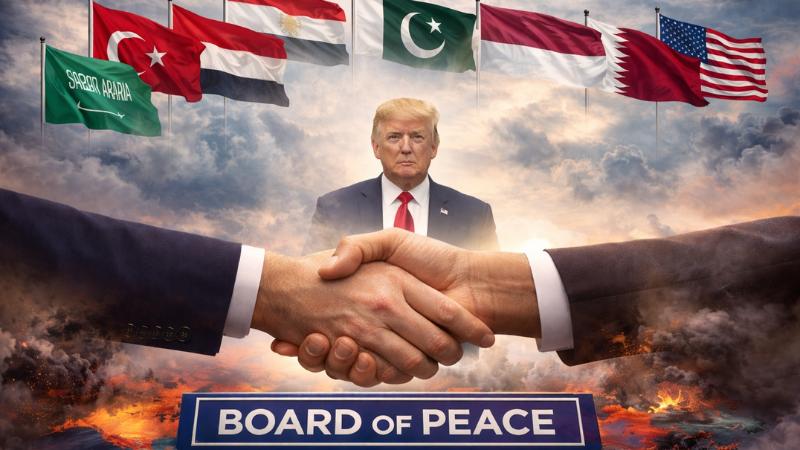
Saudi Arabia, Turkey, Egypt, Jordan, Indonesia, Pakistan and Qatar have agreed to participate in a new international initiative proposed by U.S. President Donald Trump, known as the Board of Peace, according to a joint statement issued by regional foreign ministries. The decision reflects coordinated support among several Middle Eastern and Asian governments for the initiative, which Trump has presented as a mechanism to address the ongoing Gaza conflict and broader global disputes.
Saudi Arabia’s foreign ministry said the move was the result of a shared decision by the foreign ministers of Saudi Arabia, Qatar, Turkey, Egypt, Jordan, Indonesia, Pakistan and the United Arab Emirates. The statement said the participating countries support Trump’s stated peace efforts, particularly those focused on ending hostilities in Gaza. The UAE was included in the announcement, though earlier invitations had been reported as extended to dozens of countries worldwide.
Trump first unveiled the idea of the Board of Peace in September, framing it as part of a wider plan to bring an end to the war in Gaza. Subsequent remarks from the U.S. president indicated that the board’s mandate would extend beyond the current conflict to include other international crises. The initiative is intended to promote peace-building efforts and facilitate the resolution of disputes across different regions.
According to a draft charter of the board, the U.S. president will serve as its inaugural chairman. The document outlines a structure in which the board would be responsible for advancing peace initiatives in line with international law, while seeking to mediate or resolve conflicts around the world. Member states would typically serve three-year terms, although the charter allows for permanent membership for countries that contribute $1 billion toward funding the board’s activities.
The White House has announced several figures who will sit on the initiative’s founding Executive Board. These include U.S. Secretary of State Marco Rubio, Trump’s special envoy Steve Witkoff, former British prime minister Tony Blair and Trump’s son-in-law Jared Kushner. The roles and responsibilities of these members have not been fully detailed, and it remains unclear how decisions will be implemented in practice.
Diplomats and analysts have raised questions about the legal authority of the Board of Peace, as well as its enforcement mechanisms. There is also uncertainty over how the initiative will interact with existing international bodies, including the United Nations, which currently plays a central role in global peacekeeping and conflict resolution. Some diplomats have expressed concern that the new body could complicate or undermine established multilateral frameworks.
The charter grants the chairman significant executive powers, including the authority to veto decisions and remove members, subject to certain limitations. This concentration of authority has drawn scrutiny from observers who are seeking clarity on governance, accountability and oversight within the proposed structure.
In addition to the Board of Peace, the White House has announced the creation of a Gaza Executive Board, intended to support a transitional Palestinian administration in the territory. Several individuals are expected to serve on both boards, though officials have not explained how the two bodies will coordinate their work or operate alongside one another.
As countries formally signal their willingness to participate, attention is now turning to how the Board of Peace will function and whether it can translate political backing into tangible outcomes. With conflicts continuing in Gaza and elsewhere, the initiative’s credibility and effectiveness are likely to be closely watched by governments and international observers alike.