Santa Clara data centers are facing renewed scrutiny over water use as AI and cloud-computing demand expands across Silicon Valley.
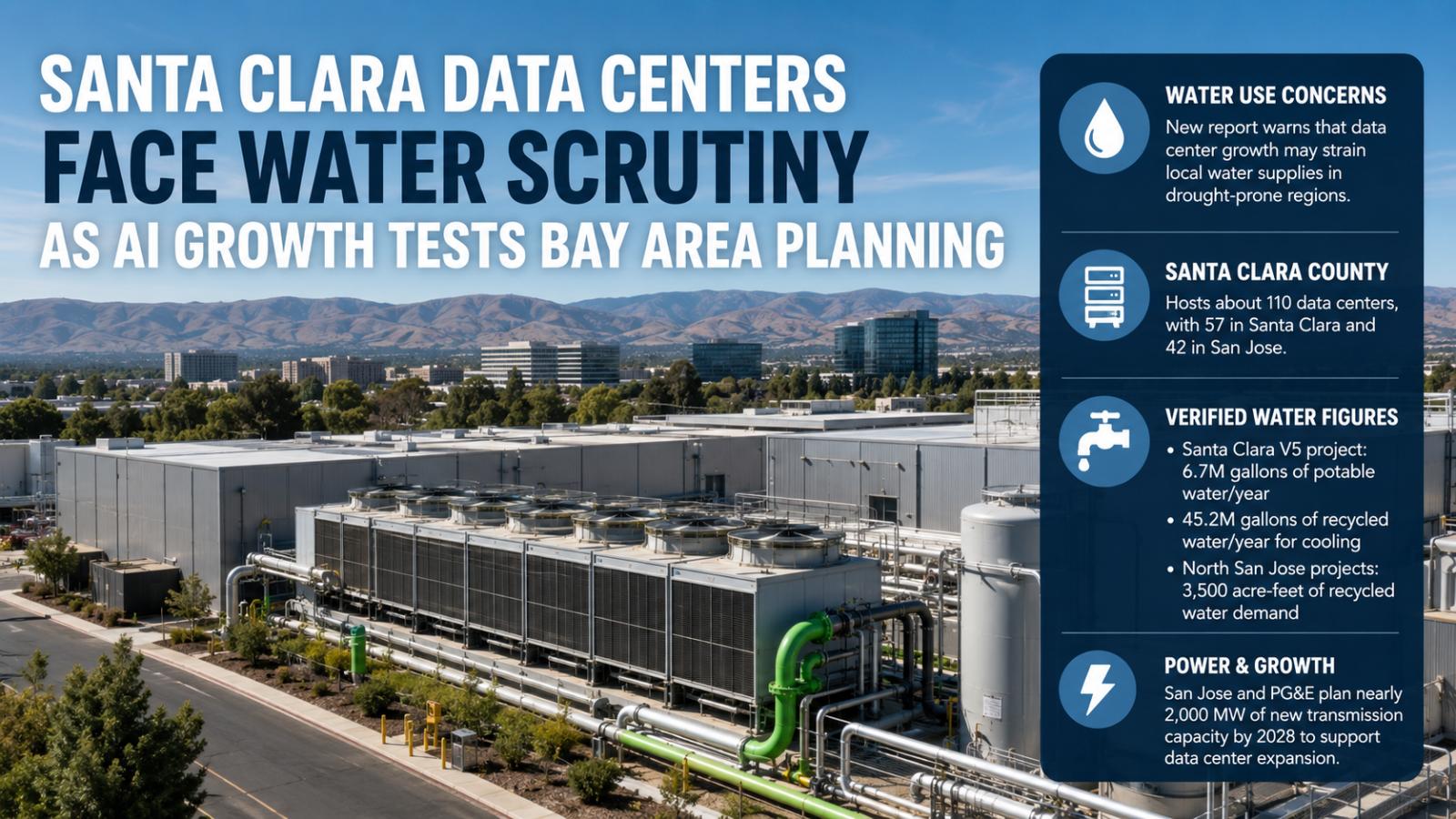
A Next 10 report released on Thursday, May 14, 2026, titled “The Intersection of Data Center Development, Water Availability, and Environmental Justice In California,” warned that California’s data center boom is moving into regions already facing water scarcity and environmental justice concerns. The report was led by researchers at Santa Clara University.
Report Warns of Water-Use Transparency Gaps
Researchers said public information on data center water use, cooling systems and water type remains limited. The report found that many facilities do not provide accessible environmental planning documents or clear details on whether they use potable water, recycled water or low-water cooling systems.
“Right now, there is a fundamental lack of transparency around how much water data centers use and what type of water they are using,” said Stephanie Leonard, director of research at Next 10.
Lead author Iris Stewart-Frey, a hydrologist and professor of environmental science at Santa Clara University, said California’s water system is already under stress, especially in groundwater-dependent regions. She warned that large water-intensive facilities can add cumulative pressure on regional supplies and reduce drought resilience.
Santa Clara County Remains a Major Data Center Hub
Santa Clara County hosts about 110 data centers, according to a May 23, 2025 Valley Water presentation. The largest concentrations are in Santa Clara with 57 facilities and San Jose with 42, followed by Sunnyvale, Mountain View, Gilroy, Milpitas and Palo Alto.
The Next 10 report’s case-study locations included Santa Clara, Gilroy, Sacramento, Los Angeles and Imperial County. It found actual water-use information was unavailable for all five case studies, even when projected water-use information existed.
Verified Water Figures Show the Planning Challenge
Public documents show how large the demand can be. For Santa Clara’s Building V5 data center project, city records estimated 6.7 million gallons of potable water per year, or 20.6 acre-feet annually, for indoor uses. The same project estimated 45.2 million gallons of recycled water per year, or 138.9 acre-feet annually, for cooling towers.
In North San Jose, three proposed data centers are expected to create about 3,500 acre-feet per year of recycled water demand once operational, according to Valley Water. The agency also said 10 new data centers were proposed within the county and were expected to have low potable water demand because of recycled water use and newer cooling technology.
San Jose Power Growth Adds Pressure
San Jose and PG&E are working to bring nearly 2,000 megawatts of additional transmission capacity to serve planned and proposed data center facilities by 2028. San Jose Clean Energy said the upgrades include two new high-voltage transmission lines.
One San Jose data center proposal at 1657 Alviso-Milpitas Road calls for a 396,914-square-foot facility with two single-story data center buildings. City documents list an estimated electrical load of 77 megawatts and a maximum load of 99 megawatts.
The issue matters because AI infrastructure is expanding faster than public reporting systems. Researchers and water officials say better disclosure of actual water use, cooling systems and recycled-water commitments is needed before local governments can fully assess cumulative impacts on Bay Area water supplies.