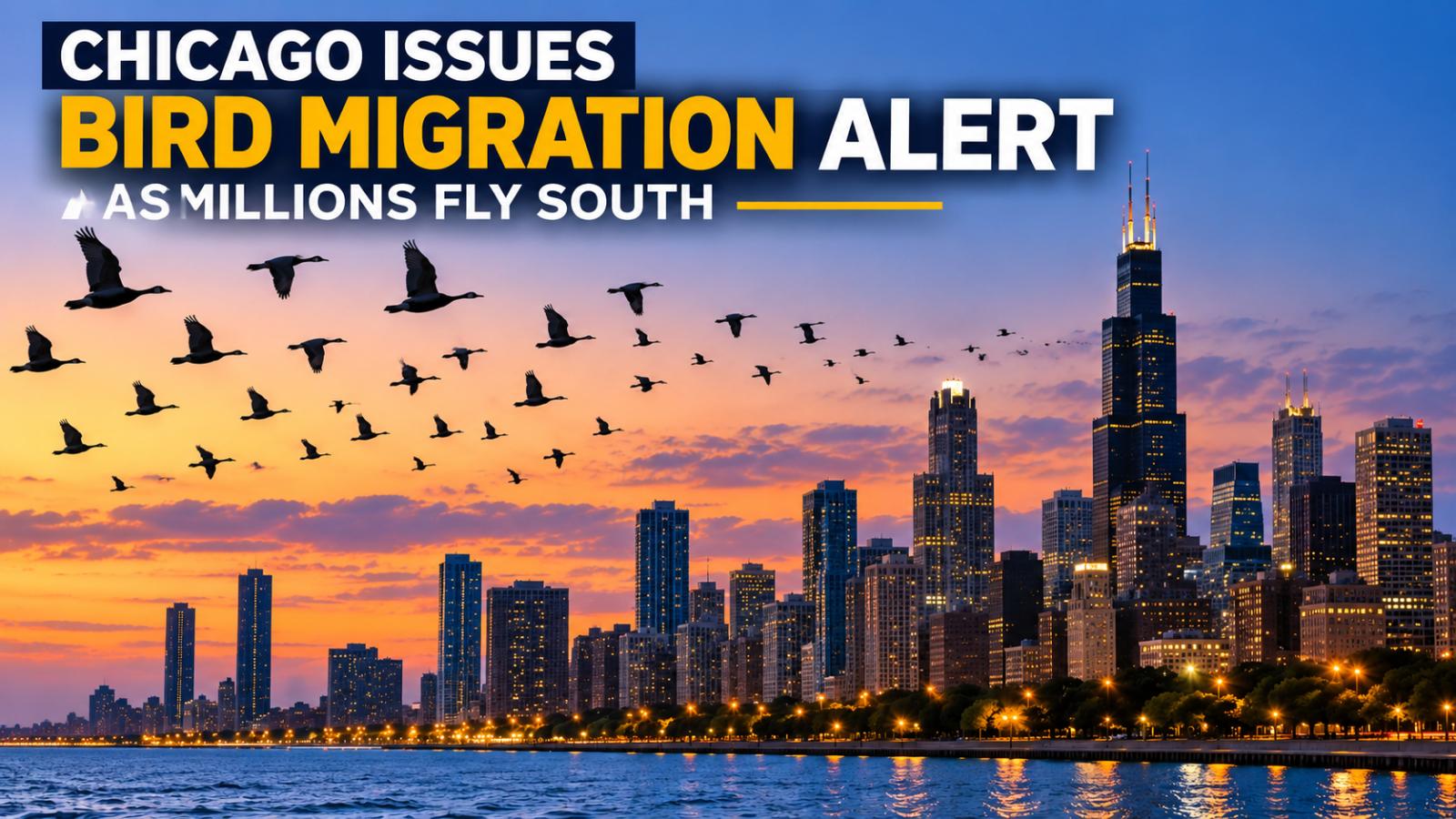
Chicago’s bird migration alert asks residents and building managers to reduce nighttime lighting as large numbers of birds move south through Illinois. The guidance is intended to limit disorientation and building collisions during peak fall migration.
Chicago officials are urging residents and building managers to reduce unnecessary nighttime lighting as a major wave of migratory birds moves south through Illinois and the Great Lakes region.
Chicago Animal Care and Control said nearly 300 million birds were expected to fly across the United States on Wednesday night, September 9, 2026, with more than 825 million projected to move nationwide over the coming days. The agency said many could pass through the Chicago region.
Fall bird migration intensifies over Illinois
Chicago sits within an important North American migration corridor used by birds traveling between northern breeding areas and wintering grounds farther south.
BirdCast, a migration-monitoring project supported by the Cornell Lab of Ornithology and research partners, uses weather-radar data to estimate nocturnal bird movement.
BirdCast’s Illinois dashboard recorded an estimated 212,200 birds crossing the state from Tuesday night, September 8, into Wednesday morning, September 9. Peak migration traffic reached an estimated 994,300 birds in flight early Wednesday morning.
Lights Out Chicago guidance returns
Residents and building managers are encouraged to switch off or dim nonessential exterior lighting from 11 p.m. until daylight during migration season. People in high-rise buildings are also encouraged to close blinds or curtains so less artificial light is visible outside.
Chicago’s long-running Lights Out program recommends reducing decorative lighting during fall migration from August 15 through November 15.
Artificial light can increase collision risk
Bright nighttime lighting can attract and disorient migrating birds, drawing them toward illuminated buildings and increasing the danger of collisions.
Research highlighted by BirdCast found that nighttime bird collisions at Chicago’s McCormick Place were substantially lower when fewer windows were illuminated, reinforcing the effectiveness of reducing artificial light during heavy migration.
Property owners can further reduce risks by limiting unnecessary lighting around rooftops, lobbies and other glass-heavy areas.
With fall migration building across the Great Lakes region, Chicago bird-protection groups continue to encourage voluntary light reduction as a practical way for residents and businesses to lower avoidable collision risks.