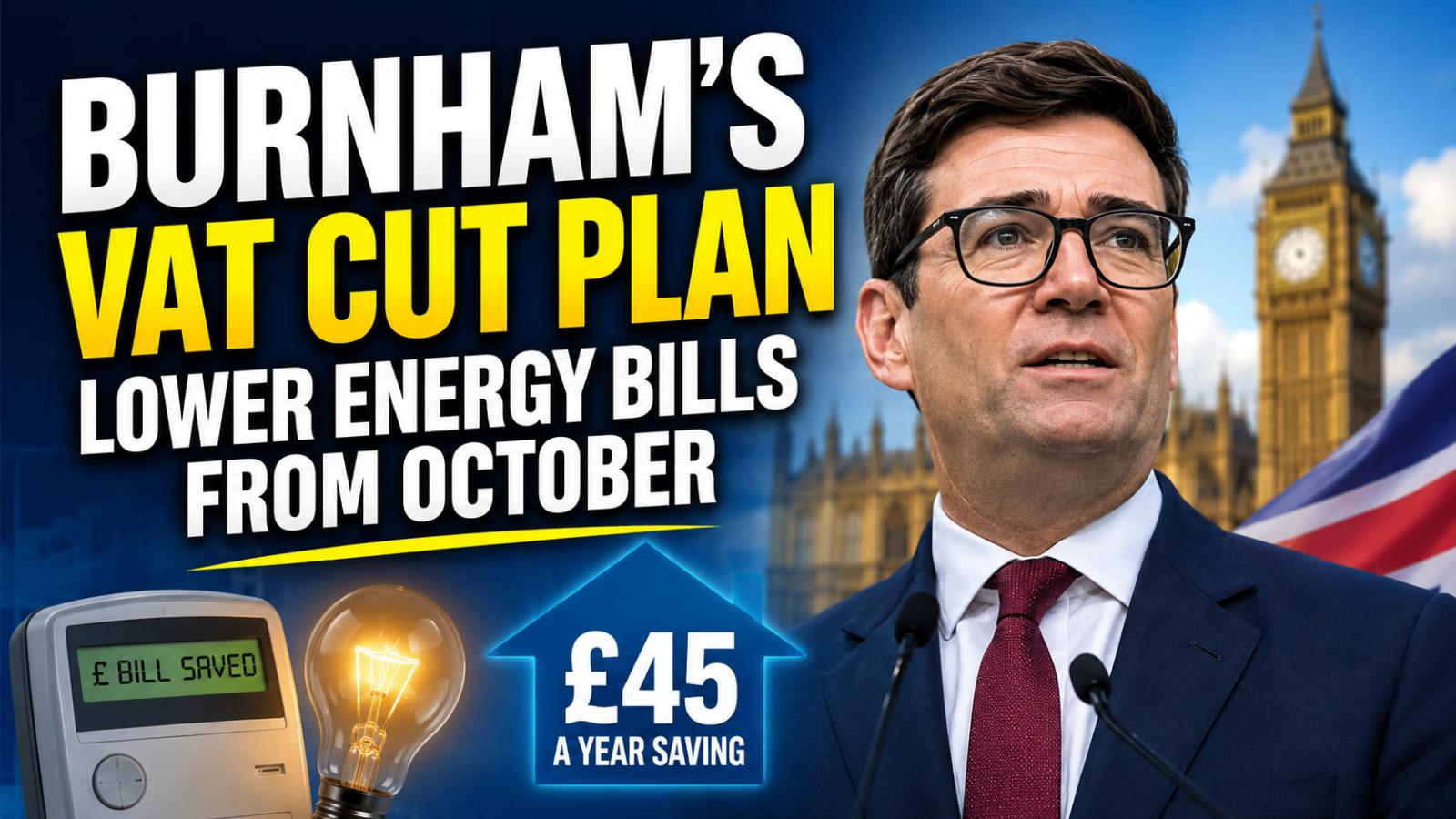
UK Prime Minister Andy Burnham has announced the removal of value added tax from household electricity bills from October 1, presenting the measure as immediate relief for families facing renewed cost-of-living pressures. The Burnham energy VAT plan is expected to reduce the annual Ofgem price cap by about £45 for an average household.
UK energy bills to receive VAT relief
Burnham announced the electricity VAT cut on July 21, one day after becoming prime minister. The government said the policy would apply during the current financial year and help millions of households manage higher winter energy costs.
“We’re taking immediate action to cut taxes on energy bills, put more money in people’s pockets and bring back hope,” Burnham said in an official government statement.
The government expects energy suppliers to pass the full VAT reduction to customers, including households using fixed-price tariffs. Small businesses that qualify for domestic energy VAT relief, along with eligible charities and residential care homes, are also expected to benefit.
Officials said the measure would particularly support lower-income families because energy costs account for a larger proportion of their available income. The tax reduction follows an earlier £150 reduction in annual energy costs announced in the previous Budget.
Digital ID programme cancelled to fund VAT cut
The government will fund the immediate £850 million cost of the electricity VAT cut by cancelling the proposed national Digital ID programme. The abandoned scheme had an estimated budget of £1.8 billion.
Burnham’s government said any extension of the VAT reduction beyond the current financial year would be considered during the Budget and assessed alongside an Office for Budget Responsibility forecast.
Chancellor John Healey said the policy would provide households with financial breathing room while remaining consistent with the government’s fiscal rules. The decision marks a clear break from the priorities of former prime minister Keir Starmer, whose administration had planned to expand the Digital ID system.
The government has not yet explained which parts of the Digital ID infrastructure have already received funding or how much cancellation may cost. That information will be important when assessing the policy’s full savings.
UK borrowing falls sharply in June
The announcement came as the Office for National Statistics reported that public sector borrowing reached £16 billion in June 2026. This was £7.9 billion, or 33.1%, lower than in June 2025 and £300 million below the official forecast.
However, the wider fiscal position remains challenging. Borrowing during the financial year to June stood at £57.6 billion, which was £2.7 billion above the Office for Budget Responsibility forecast. Public sector net debt was estimated at 94.9% of gross domestic product.
The improved monthly borrowing figure gives Healey some room to introduce short-term assistance, but it does not remove pressure on the government to control long-term spending. Extending the VAT cut permanently would require another funding source or reductions elsewhere.
Job vacancies highlight economic pressure
Separate ONS labour market figures showed that UK job vacancies fell by 7,000 to an estimated 712,000 during April to June 2026. The continued decline suggests that employers remain cautious about expanding their workforces.
The unemployment rate was estimated at 4.9% during March to May, while real regular earnings growth remained weak. These figures underline the economic challenge facing Burnham as he attempts to improve household finances without increasing government borrowing.
Removing VAT from electricity bills will offer modest relief rather than transform household finances. A saving of approximately £45 a year amounts to less than £4 a month. The policy may still help limit the effect of a higher Ofgem price cap, but stronger wage growth, stable employment and longer-term energy reforms will determine whether families experience a meaningful improvement.