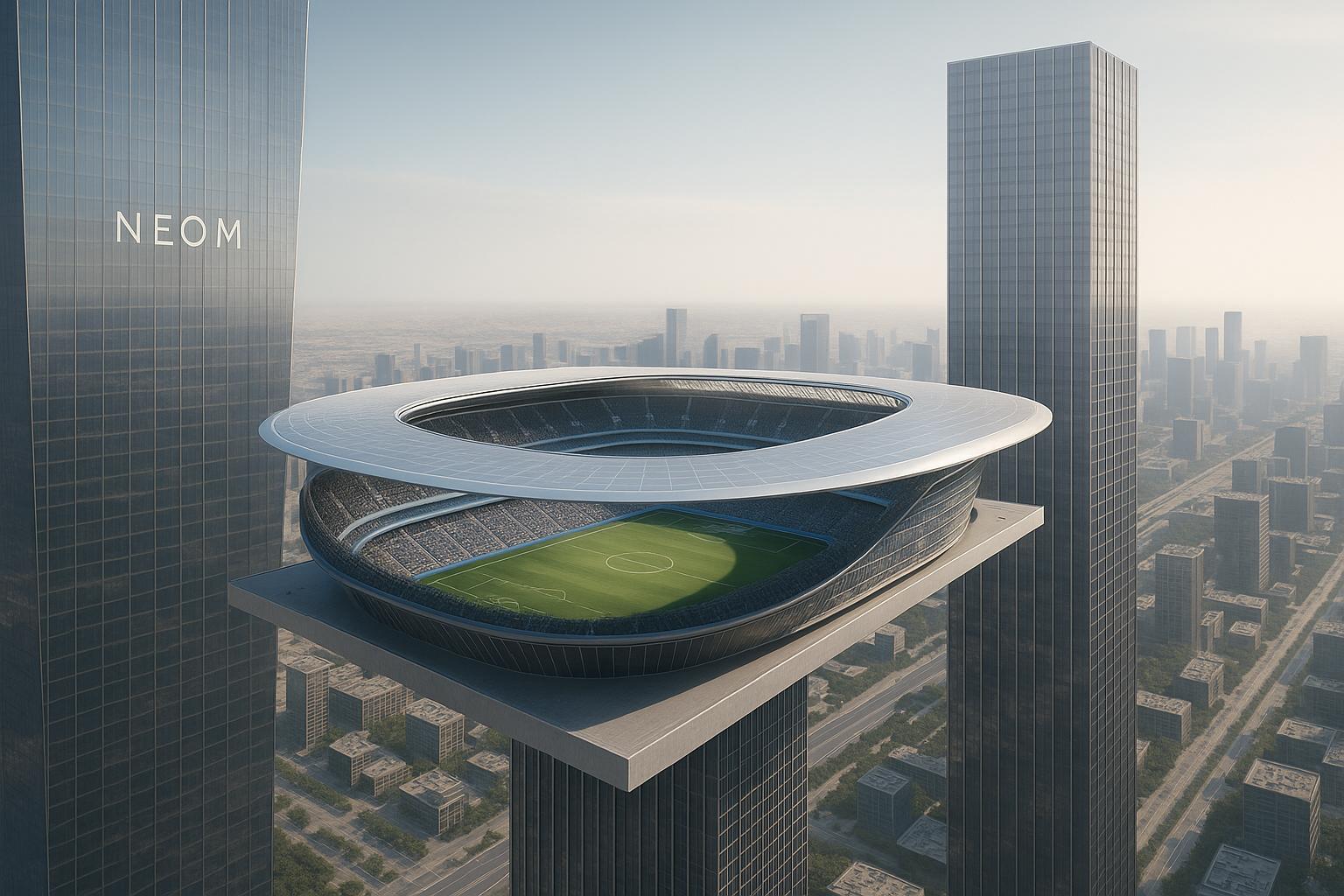
There are real plans for a large sports stadium within NEOM, the futuristic smart city being developed in northwestern Saudi Arabia. The project aims to showcase architectural innovation and sustainable design under the country’s Vision 2030 strategy. Official project outlines confirm that NEOM will include an elevated stadium, integrated into a high-rise urban structure known as “The Line.” The stadium is expected to sit several hundred meters above ground level and feature advanced energy-efficient systems, aligning with the country’s focus on sustainability and innovation.
The concept of a high-altitude stadium is indeed part of NEOM’s long-term vision, and the design includes a capacity of roughly 46,000 seats. Construction is projected to begin in the coming years, with completion targeted before the 2034 World Cup. The development will also rely on renewable energy infrastructure, primarily solar and wind, reflecting Saudi Arabia’s ambition to lead in sustainable mega-projects. In that sense, the idea of a stadium “in the sky” is based on real plans.
However, the viral videos that have been circulating give an exaggerated picture of what the project actually entails. Many of the videos and digital renderings depict a floating stadium sitting precariously on top of a single skyscraper, surrounded by clouds, as if hovering in the air. These images are largely conceptual or fan-made, not official architectural designs. The real plans do not show a stadium balanced on top of a narrow tower but rather a structure integrated into the upper levels of NEOM’s broader megastructure. Essentially, the stadium would be part of the city’s vertical architecture rather than a standalone building suspended in the air.
The claim that fans will use high-speed elevators to enter a glass-walled arena perched hundreds of meters above the desert is also an exaggeration. The design is innovative, but it remains within the bounds of practical engineering. Experts note that while an elevated venue is possible, the dramatic images circulating online tend to simplify complex construction realities. Building a full-scale stadium at extreme height presents engineering and safety challenges that require years of planning and advanced structural solutions.
This misunderstanding is not surprising given NEOM’s reputation for futuristic and sometimes ambitious design concepts. Many of its proposed projects—such as floating industrial zones, mirrored megastructures, and desert ski resorts—are still in conceptual or early construction phases. The stadium fits into that narrative as a visually stunning centerpiece, but like many large-scale developments, the final outcome may differ significantly from the early artistic renderings.
Saudi Arabia’s decision to host the 2034 World Cup has accelerated several major infrastructure projects. The government aims to create venues that not only meet international standards but also reflect technological progress and sustainability. The NEOM stadium, often described as “the world’s first sky arena,” embodies that goal, though its exact form remains under design development. The intention is to make it a global symbol of innovation, combining sports, architecture, and renewable energy in one impressive venue.
Despite the futuristic excitement, it’s important to separate confirmed plans from online speculation. The idea of a stadium perched on top of a traditional skyscraper, as shown in viral posts, is not supported by official sources. Instead, the stadium will likely occupy an elevated section of NEOM’s integrated city layout, making it appear high above the ground while still structurally part of the overall development. The visual concept has evolved from early artistic impressions meant to highlight the grandeur of the project rather than final construction blueprints.
As of now, the NEOM sky stadium remains in the planning stage, with no verified completion date or detailed architectural model released to the public. The project’s success will depend on technological feasibility, environmental considerations, and global economic conditions. If completed as envisioned, it could become one of the most distinctive sports venues in the world and a major symbol of Saudi Arabia’s modernization efforts.
In summary, Saudi Arabia does plan to build a high-elevation football stadium within NEOM, designed with renewable energy systems and futuristic architecture. That much is real. What’s not true are the viral depictions of a floating or suspended arena on top of a single skyscraper. The stadium will be elevated but structurally part of NEOM’s broader city framework, not an isolated tower-top design. While the ambition is undeniable, it’s still a concept in progress, and its final realization will depend on time, engineering, and sustained investment.
The fascination with this “sky stadium” highlights how digital renderings can blur the line between visionary architecture and viral fantasy. Saudi Arabia’s plans are bold, but the reality, when it finally rises above the desert, will likely blend imagination with practicality rather than science fiction.