NRI vs OCI Difference: What Indian-Origin Americans Should Know
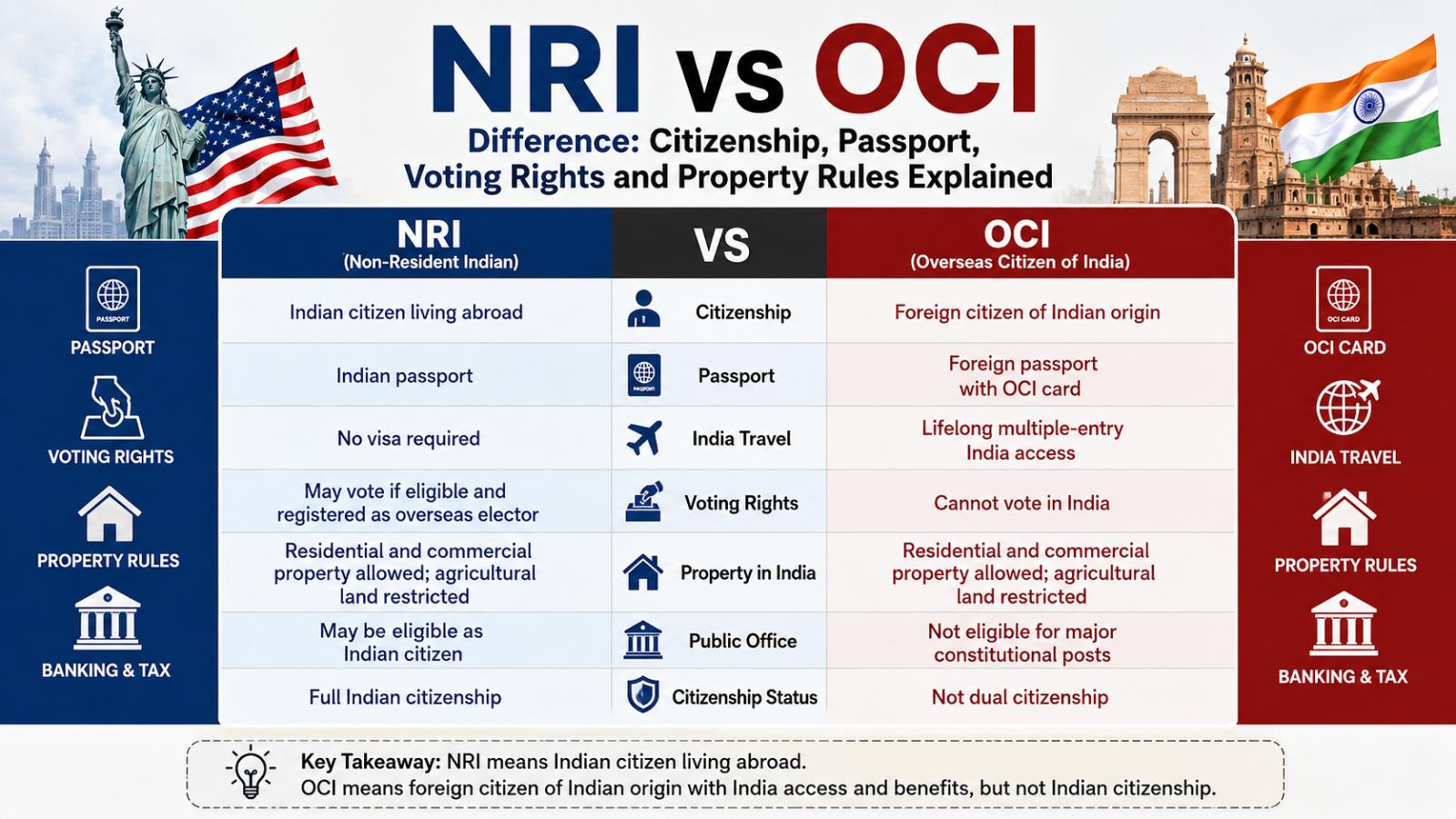
The main difference between NRI and OCI is citizenship. An NRI is an Indian citizen living outside India, while an OCI cardholder is a foreign citizen of Indian origin who gets special India-related benefits but not Indian citizenship.
For Indian-origin Americans, this difference matters because it affects passport use, India travel, voting rights, property ownership, banking access and long-term legal status.
NRI vs OCI: Quick Comparison
| Category | NRI | OCI |
|---|---|---|
| Full Form | Non-Resident Indian | Overseas Citizen of India |
| Citizenship | Indian citizen living abroad | Foreign citizen of Indian origin |
| Passport | Indian passport | Foreign passport with OCI card |
| India Travel | No visa needed | Lifelong multiple-entry India access |
| Voting Rights | May vote if eligible and registered | Cannot vote in India |
| Indian Passport | Allowed | Not allowed |
| Property in India | Residential and commercial property generally allowed | Residential and commercial property generally allowed |
| Agricultural Land | Restricted | Restricted |
| Public Office | May be eligible as Indian citizen | Not eligible for major constitutional posts |
| Citizenship Status | Full Indian citizenship | Not dual citizenship |
What Is an NRI?
An NRI, or Non-Resident Indian, is an Indian citizen who lives outside India for work, education, business or long-term residence.
For Indians living in the United States, NRI status usually applies when the person still holds an Indian passport and has not taken U.S. citizenship. NRIs can enter India without a visa because they remain Indian citizens.
NRIs may also use India-linked banking options such as NRE, NRO and FCNR accounts, depending on income source, residency status and banking rules.
For a detailed explanation of NRI status, read: What Is an NRI? Meaning, Benefits, Banking and Property Rules Explained.
What Is an OCI Cardholder?
An OCI, or Overseas Citizen of India cardholder, is generally a foreign citizen of Indian origin who receives long-term access to India.
For many Indian-origin Americans, OCI becomes important after they become U.S. citizens and surrender their Indian passport. The OCI card allows eligible people to visit India frequently, stay for long periods and maintain family, cultural, business or property ties with India.
However, OCI is not Indian citizenship. OCI cardholders cannot vote in Indian elections, hold an Indian passport, contest elections or claim full political rights in India.
For a complete guide on OCI benefits and restrictions, read: What Is an OCI Card? Benefits, Eligibility and India Travel Rules Explained.

Main Difference Between NRI and OCI
The biggest difference between NRI and OCI is legal citizenship.
An NRI remains an Indian citizen even while living abroad. An OCI cardholder is a foreign citizen of Indian origin who receives India-related benefits but does not become an Indian citizen.
This one difference affects passport rights, voting rights, visa rules, property rules, public office eligibility and long-term legal status in India.
NRI vs OCI for Indian-Origin Americans
For Indian-origin Americans, the NRI vs OCI difference becomes especially important after U.S. citizenship.
A person living in the United States with an Indian passport may be treated as an NRI. But once that person becomes a U.S. citizen, Indian citizenship is no longer retained. At that stage, the person may apply for an OCI card if eligible.
OCI helps preserve long-term access to India, but it does not restore Indian citizenship rights.
Passport and India Travel Difference
NRIs hold Indian passports because they remain Indian citizens. They do not need a visa to enter India.
OCI cardholders hold foreign passports. For Indian-origin Americans, this usually means a U.S. passport along with an OCI card. The OCI card provides lifelong multiple-entry access to India, but it is not an Indian passport.
Can NRI or OCI Vote in India?
Voting rights are one of the clearest differences between NRI and OCI.
An NRI may vote in India if eligible and registered as an overseas elector because an NRI remains an Indian citizen. An OCI cardholder cannot vote in Indian elections, contest elections or hold major constitutional posts in India.
Property Rules for NRI and OCI Cardholders
Both NRIs and OCI cardholders can generally buy residential and commercial property in India, subject to applicable rules.
However, agricultural land, farmhouse and plantation property are restricted. Inheritance rules may also differ from purchase rules, so families handling property in India should check the latest official rules before making major property decisions.
Banking and Tax Difference
NRIs commonly use India-linked bank accounts such as NRE, NRO and FCNR accounts, depending on income type and banking rules.
OCI cardholders may also have banking options, but eligibility can depend on residency status, income source, documentation and current banking regulations. Tax treatment is not decided only by the NRI or OCI label. It usually depends on residential status, income source and applicable tax laws.
Is OCI Dual Citizenship?
No, OCI is not dual citizenship.
OCI gives eligible foreign citizens of Indian origin certain India-related benefits, but it does not make them Indian citizens. OCI cardholders cannot hold an Indian passport, vote in India or claim full political rights.
The easiest way to understand NRI vs OCI is this: NRI means Indian citizen abroad. OCI means foreign citizen of Indian origin with India access, benefits and legal limits.
For Indian-origin Americans, the difference becomes important after U.S. citizenship, Indian passport surrender, India travel, property planning, banking decisions and long-term family ties with India.