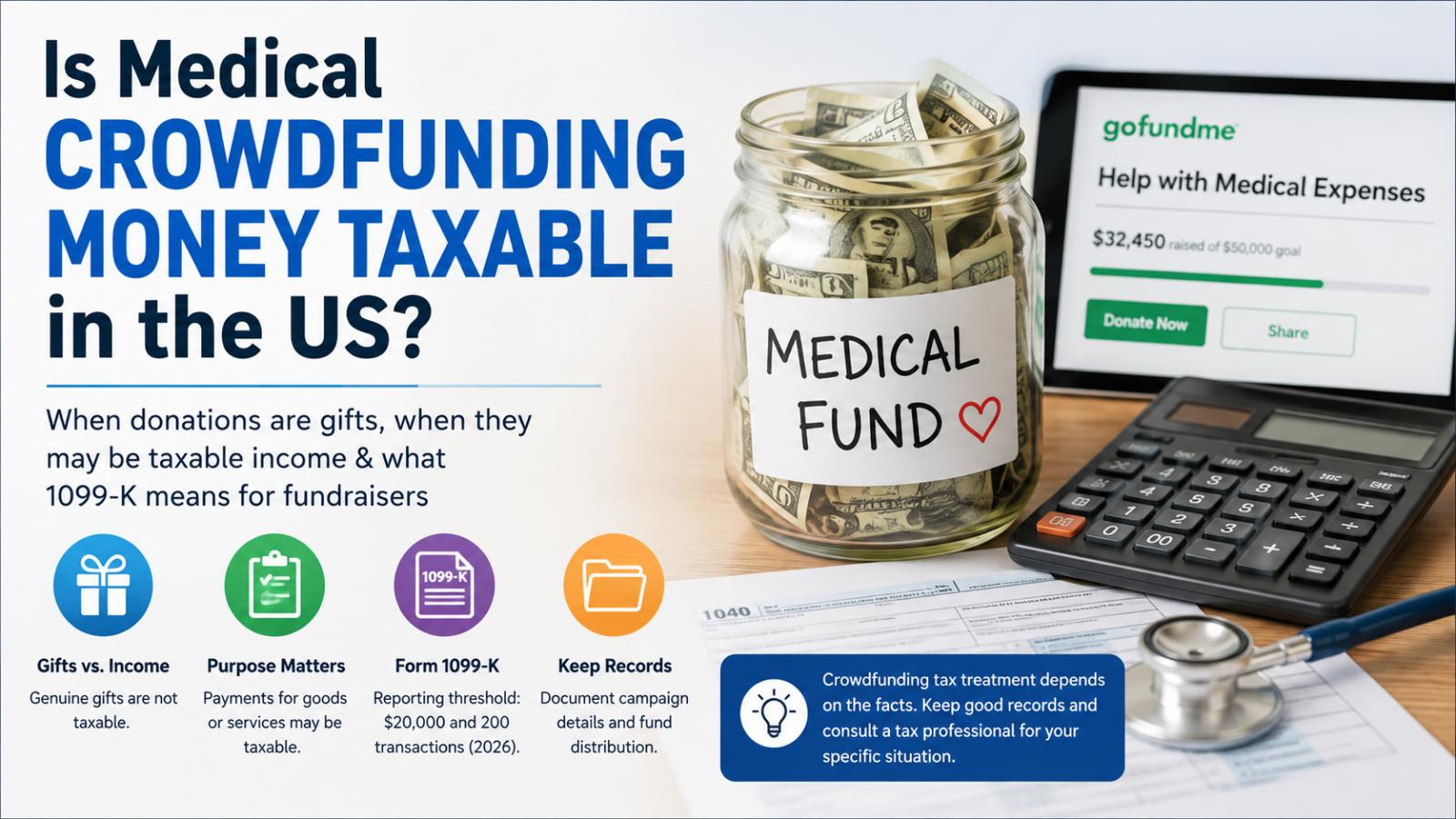
Medical crowdfunding money is not automatically taxable in the US. Genuine donations made from generosity, with nothing expected in return, may be treated as gifts. But tax treatment can change based on who contributes, why funds are raised and whether goods or services are provided.
Is medical fundraiser money considered taxable income?
Money raised through a medical crowdfunding campaign is not automatically taxable income in the United States.
The IRS says crowdfunding contributions may qualify as gifts when people contribute out of generosity and receive or expect nothing in return. In most cases, genuine gifts are not included in the recipient's gross income.
This can apply to campaigns created to help someone pay medical bills, recover from an emergency or support a family facing a serious health crisis.
When can crowdfunding money become taxable?
Not every crowdfunding contribution qualifies as a gift.
Tax treatment depends on the facts and circumstances surrounding the payment. If contributors receive goods, services or another benefit in exchange for their money, the payment may be treated differently for tax purposes.
The IRS also notes that contributions made by an employer for the benefit of an employee are generally included in the employee's gross income.
For that reason, fundraiser organizers should avoid assuming that every payment labeled a “donation” is automatically tax-free.
What if someone raises money for another person?
Friends, relatives or community members often create medical fundraisers on behalf of a patient.
The IRS says money received by an organizer may not be included in the organizer's income when the organizer is collecting it for another person and then transfers the funds to that intended beneficiary.
Keeping a clear record of the fundraiser's purpose, beneficiary and transfers is therefore important.
Does receiving Form 1099-K mean the money is taxable?
No. Receiving Form 1099-K does not automatically mean crowdfunding money is taxable.
Under current IRS rules, third-party settlement organizations generally must issue Form 1099-K for payments for goods or services when payments exceed $20,000 and more than 200 transactions during the calendar year. Personal payments and gifts are generally not supposed to be reported as payments for goods or services.
A platform may still issue a Form 1099-K in some circumstances. If that happens, recipients should not simply ignore it; the form should be reconciled with their tax records.
Medical crowdfunding records should be preserved
The IRS recommends that crowdfunding organizers and recipients maintain complete records showing the circumstances of the campaign and how the funds were distributed.
For a straightforward personal medical fundraiser funded by people giving voluntarily and receiving nothing in return, contributions may generally be treated as gifts rather than taxable income. More complicated situations involving employers, businesses, rewards, large transfers or multiple organizers may require professional tax guidance.
This article provides general information and should not be treated as individual tax or legal advice.