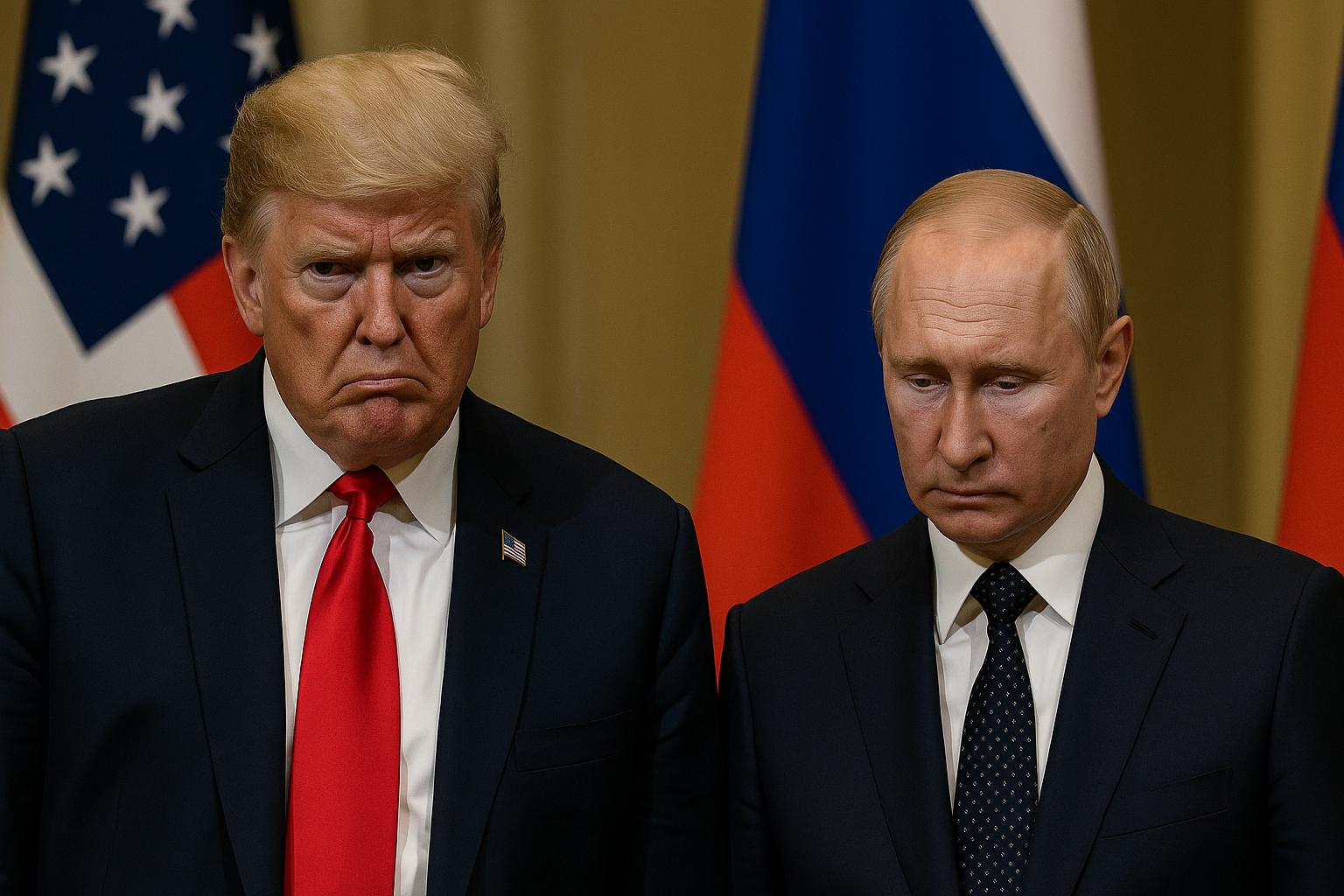
In a move reflecting deepening frustration within Washington, United States President Donald Trump has reportedly cancelled a planned summit with Russian President Vladimir Putin. The decision follows Moscow’s insistence on sweeping conditions for peace in Ukraine, which American officials have described as amounting to a demand for Ukraine’s surrender of sovereignty.
According to reports, the decision came after Russia sent a detailed memorandum outlining Putin’s terms for ending the war in Ukraine. The document, delivered to the Trump administration earlier this month, reiterated what the Kremlin calls the “root causes” of the conflict — a phrase that, in effect, refers to Russia’s longstanding territorial and political demands over Ukraine. Upon reviewing the memo, senior US officials concluded that Moscow was not interested in meaningful negotiations. Secretary of State Marco Rubio is said to have held a tense conversation with Russian Foreign Minister Sergei Lavrov, after which the administration assessed that Putin had no real intention of reaching a diplomatic resolution.
The planned summit, which had been announced following a recent phone call between Trump and Putin, was subsequently cancelled. The move marks a new low in the already strained relationship between Washington and Moscow, and underscores growing concerns in the United States about Russia’s continued aggression and uncompromising stance in Eastern Europe.
Putin’s list of demands, often referred to as “maximalist conditions,” largely mirrors the positions he has maintained since the start of the invasion. These terms, presented again during negotiations mediated by Turkey earlier this year, seek not only recognition of the territories currently under Russian occupation but also of regions claimed by Moscow but not yet controlled by its forces. Among these are the Ukrainian provinces of Crimea, Donetsk, Luhansk, Kherson, and Zaporizhzhia, which Russia has sought to annex formally.
Additionally, Putin has demanded the establishment of a “buffer zone” within Ukrainian territory, the length and breadth of which remain unspecified. Analysts note that such a provision would effectively strip Ukraine of more land and push its defensive lines further westward. Former Russian President Dmitry Medvedev, now serving as a senior security adviser, has even shared maps showing buffer zones that encompass most of Ukraine, suggesting the Kremlin’s ambition to dismantle the country’s sovereignty almost entirely.
Beyond territorial concessions, Moscow’s proposed terms impose sweeping military restrictions reminiscent of the Treaty of Versailles after World War I. These include limiting the size and capability of Ukraine’s armed forces, restricting its ability to acquire or deploy advanced weaponry, and permanently barring it from joining NATO or hosting foreign military personnel. Such conditions, if accepted, would severely undermine Ukraine’s independence and leave it vulnerable to future coercion by Russia.
Putin’s demands also extend to the cultural and social fabric of Ukraine. His conditions reportedly call for the restoration of the pro-Russia Ukrainian Orthodox Church, the reinstatement of Russian as a formal language of business and administration, and the prohibition of what Moscow terms “nationalist formations.” Observers interpret these as measures designed to erode Ukraine’s national identity and integrate it more closely into Russia’s political and cultural sphere.
Diplomatic experts believe Putin’s latest actions reveal his strategy to prolong hostilities while seeking to pressure Ukraine into capitulation. By maintaining a state of constant conflict and offering peace terms that are impossible for Kyiv to accept, the Kremlin appears intent on exhausting Ukraine’s military and social resilience. This approach, analysts say, also serves to test the patience of Western allies and gauge the extent of international unity behind Ukraine’s defence.
According to policy experts in Washington, the Trump administration’s decision to cancel the summit underscores its unwillingness to engage with Russia under such one-sided terms. Officials have expressed concern that any negotiations based on Putin’s current demands would legitimise territorial aggression and undermine the international principle of state sovereignty.
As the war continues with no sign of de-escalation, the diplomatic standoff between Washington and Moscow reflects the larger geopolitical struggle shaping the region. The United States and its allies maintain that lasting peace in Ukraine can only be achieved through the restoration of its territorial integrity and independence, while Russia’s position appears fixed on reshaping Eastern Europe to suit its strategic ambitions.
With Putin showing little willingness to compromise, the cancellation of the Trump-Putin summit marks yet another reminder of the widening gulf between the world’s two major powers over the future of Ukraine — and the broader security architecture of Europe.