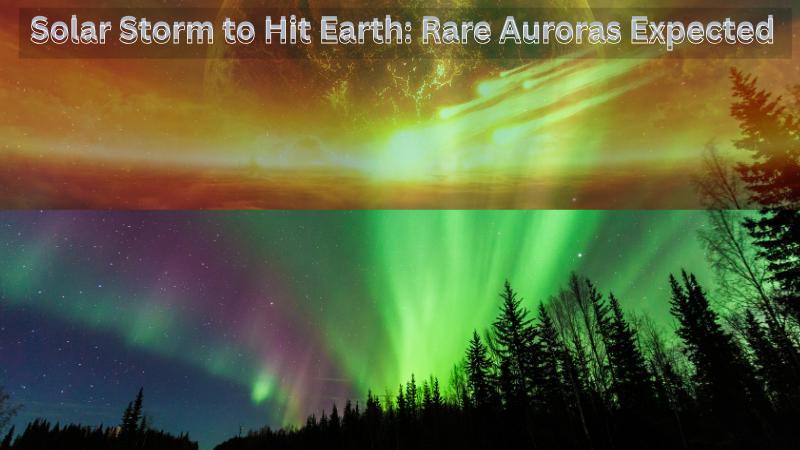
A rare and powerful space weather event is on its way, as a cannibal coronal mass ejection from the sun is forecast to strike Earth late on Monday, September 1, 2025. Scientists warn that this unusual solar explosion could create a strong geomagnetic storm, bringing both dazzling auroras and potential disruptions to satellites, power grids, and communications.
The phenomenon began on August 30 when sunspot region AR 4199 released a long-duration M2.7-class solar flare. That eruption was followed by multiple coronal mass ejections in quick succession. What makes this situation especially noteworthy is that one fast-moving CME overtook another slower one, merging into a much stronger burst. Scientists refer to this scenario as a cannibal CME because of the way the two solar blasts combine into a single, more forceful impact.
To understand the significance, it helps to know what a CME actually is. A coronal mass ejection is essentially a massive cloud of solar plasma and magnetic fields ejected from the outer atmosphere of the sun, called the corona. These eruptions contain billions of tons of charged particles, which are launched into space at millions of kilometers per hour. If directed toward Earth, these particles can arrive within one to three days, colliding with the planet’s magnetic field.
When such a collision happens, Earth responds with what is known as a geomagnetic storm. The planet’s protective magnetosphere is temporarily disturbed, resulting in both spectacular visual displays in the atmosphere and possible challenges for modern technology. The most visible outcome is the northern lights, or auroras, which glow in the sky when energetic particles interact with oxygen and nitrogen molecules in the atmosphere. At the same time, more serious consequences can occur, such as interference with GPS systems, navigation tools, satellite orientation, radio communications, and even electrical power grids.
According to space weather forecasts from scientific agencies, the cannibal CME is expected to arrive late on September 1 and continue into the early hours of September 2. Models suggest that the storm will likely strengthen from a moderate G2 level to a strong G3 level as the merged CME sweeps past Earth. A G3-class geomagnetic storm is significant because it is strong enough to impact technology but still safe for people on the ground.
One of the most exciting aspects of this event is the potential for unusually widespread aurora sightings. Experts say the northern lights may be visible much farther south than normal. In the United States, skywatchers as far south as Virginia, Missouri, and Colorado could have a chance to see the shimmering green and purple lights if skies are dark and clear. Similar latitudes in Europe and Asia are also expected to get a rare view of auroras, normally confined to higher latitudes closer to the poles.
While the aurora displays may inspire awe, the storm also carries technical risks. High-latitude power grids may face voltage fluctuations, and satellites in low Earth orbit may experience increased drag or electrical charging. Operators are monitoring the situation closely and making preparations to minimize disruptions. GPS users, aviators, and shipping operators may notice brief periods of reduced accuracy. Radio signals, particularly shortwave frequencies, could also be affected during the peak of the storm.
For most people, the impact will likely be limited to the chance of witnessing a rare celestial display. Scientists emphasize that while the storm may temporarily interfere with technology, it is not expected to cause catastrophic damage. However, they note that with the sun approaching the peak of its 11-year cycle, known as Solar Cycle 25, more frequent and intense solar storms are likely in the coming months.
Events like this highlight both the beauty and the power of the sun. The same solar forces that drive life on Earth can also disturb the systems we rely on daily, reminding us of the close connection between space weather and life on our planet. For skywatchers, September 1 may bring an unforgettable spectacle of lights stretching across unexpected parts of the night sky, while scientists continue to study and prepare for the dynamic activity of our star.